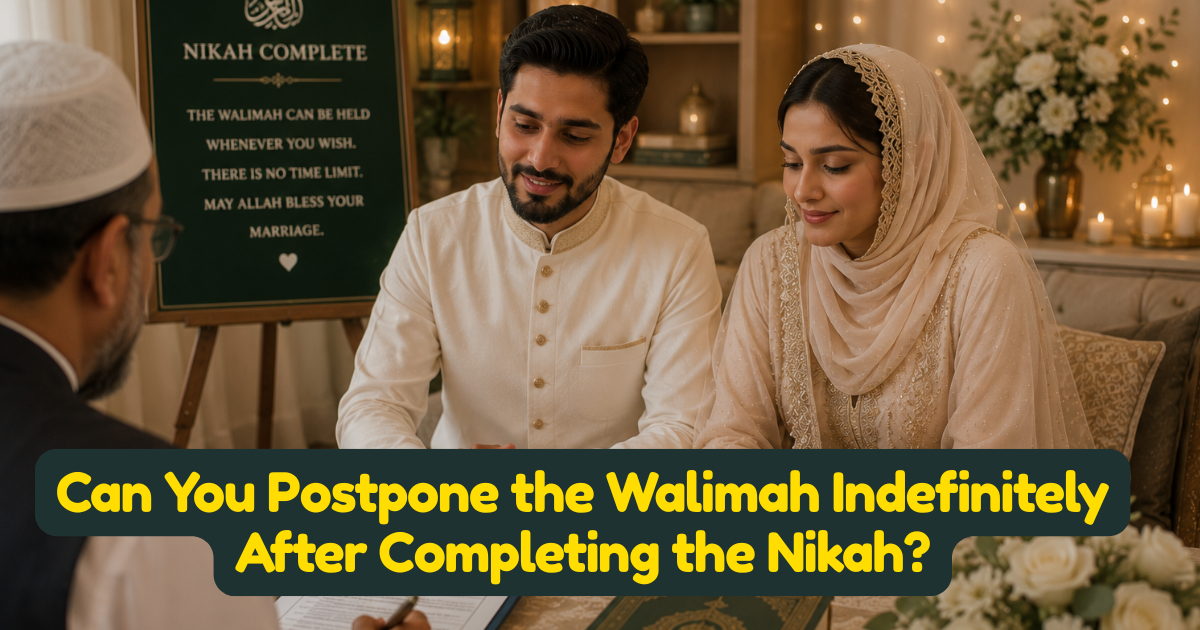
Can You Postpone the Walimah Indefinitely After Completing the Nikah?
Couples completing their nikah online, particularly diaspora families managing visa timelines, financial planning, or family scheduling across multiple countries, often find themselves legitimately married well before they're able to host the larger celebratory gathering — the walimah — that traditionally follows. This raises a genuine and practical question: is there any religious clock ticking on how long a couple can wait before holding this celebration?
What the Walimah Actually Is
The walimah is the wedding feast or celebratory gathering traditionally held to publicly mark and celebrate a marriage, generally understood as recommended (mustahabb) rather than an obligatory pillar of the marriage itself. It serves an important social and community function — publicly announcing the marriage, allowing family and friends to celebrate with the couple, and fulfilling the broader Islamic preference for marriages to be known and acknowledged rather than kept hidden. But its timing, unlike the nikah's core conditions, is not fixed by any strict religious requirement.
Is There Any Specific Time Limit Prescribed
There is no universally agreed, fixed maximum timeframe within which a walimah must be held after the nikah contract is completed. Historical practice, including accounts from the early Islamic period, shows some variation in timing — some walimahs were held very close to the marriage's consummation, while others followed at different intervals based on the couple's and family's circumstances. This variation itself suggests flexibility was always understood to be part of how the walimah's timing works, rather than a strictly fixed window.
Why the Marriage Itself Is Already Complete Without the Walimah
It's worth being unambiguous about this: the marriage is fully valid, complete, and religiously binding from the moment the nikah conditions are satisfied — the walimah's absence, or its indefinite postponement, does not affect the marriage's validity in any way. Couples sometimes worry, particularly under family pressure, that an unheld walimah somehow leaves the marriage "incomplete" in some sense; this isn't accurate. The nikah and the walimah are related but entirely distinct events, and only the nikah carries the conditions necessary for the marriage's validity.
Common Reasons Couples Delay the Walimah
- Financial preparation — saving for a celebration the couple wants to host properly, rather than rushing into debt or an underwhelming gathering.
- Visa and immigration timelines — waiting until a spouse can physically join the other before hosting a joint celebration both can attend together.
- Family scheduling across countries — coordinating a date when key family members from multiple locations can realistically travel and attend.
- Practical life circumstances — waiting for a more settled period, whether around work, health, or other significant life events, before taking on the planning and hosting involved.
Why Some Scholars Encourage Not Delaying Excessively
While there's no fixed maximum, many scholars do encourage holding the walimah reasonably soon after the marriage where practically feasible, given its role in publicly acknowledging the union and fulfilling the broader preference against secrecy in marriage. This is a general encouragement toward reasonable promptness, not a strict deadline — couples facing genuine practical constraints shouldn't feel they're acting improperly by delaying for legitimate reasons, but those with no specific obstacle might consider whether indefinite delay, purely out of inertia, serves them well.
Publicly Acknowledging the Marriage in the Meantime
Couples delaying their walimah for practical reasons can still fulfill the broader spirit of publicly acknowledging their marriage in simpler ways in the interim — informing family and close community that the nikah has taken place, even without a formal celebratory event yet, so the marriage isn't perceived as secret or hidden during the gap before the larger walimah eventually happens.
Does Delaying the Walimah Affect Intimacy Between Spouses
This is a related question worth addressing directly: consummation and normal marital life between spouses are permissible from the moment the nikah is validly completed, regardless of whether or when the walimah takes place. Couples do not need to wait for the walimah to begin their married life together; the two events, again, are entirely separate in terms of what each one permits or requires.
Combining a Delayed Walimah With Another Occasion
Some couples who delay their walimah for an extended period choose to combine it with another meaningful milestone — a first anniversary, the arrival of a child, or a family gathering already being planned — turning what might otherwise feel like an overdue obligation into a naturally timed, additionally meaningful celebration.
What If Family Pressure Pushes for an Earlier Walimah Than the Couple Wants
Where family members express impatience or pressure around walimah timing, it can help to gently but clearly explain the couple's specific reasons for the timeline they've chosen, reassuring family that the marriage is fully valid and complete regardless of when the celebration happens, while being open about the practical constraints — financial, logistical, or otherwise — driving the decision.
Planning a Walimah Long After the Nikah
Couples finally ready to host their walimah well after their nikah, sometimes a year or more later, shouldn't feel that any diminished significance attaches to the celebration simply because of the gap — it remains a fully meaningful and appropriate way to publicly celebrate the marriage whenever the couple is ready and able to do so properly.
How InstantNikah.com Supports Couples Navigating This Timeline
While our core service focuses on the nikah ceremony itself, we regularly reassure couples navigating exactly this kind of delayed-walimah situation that their marriage stands fully complete and valid regardless of when their celebration eventually takes place, and we're happy to discuss how to communicate this reassurance to family members who may not fully understand the distinction between the two events.
Admin User
Author