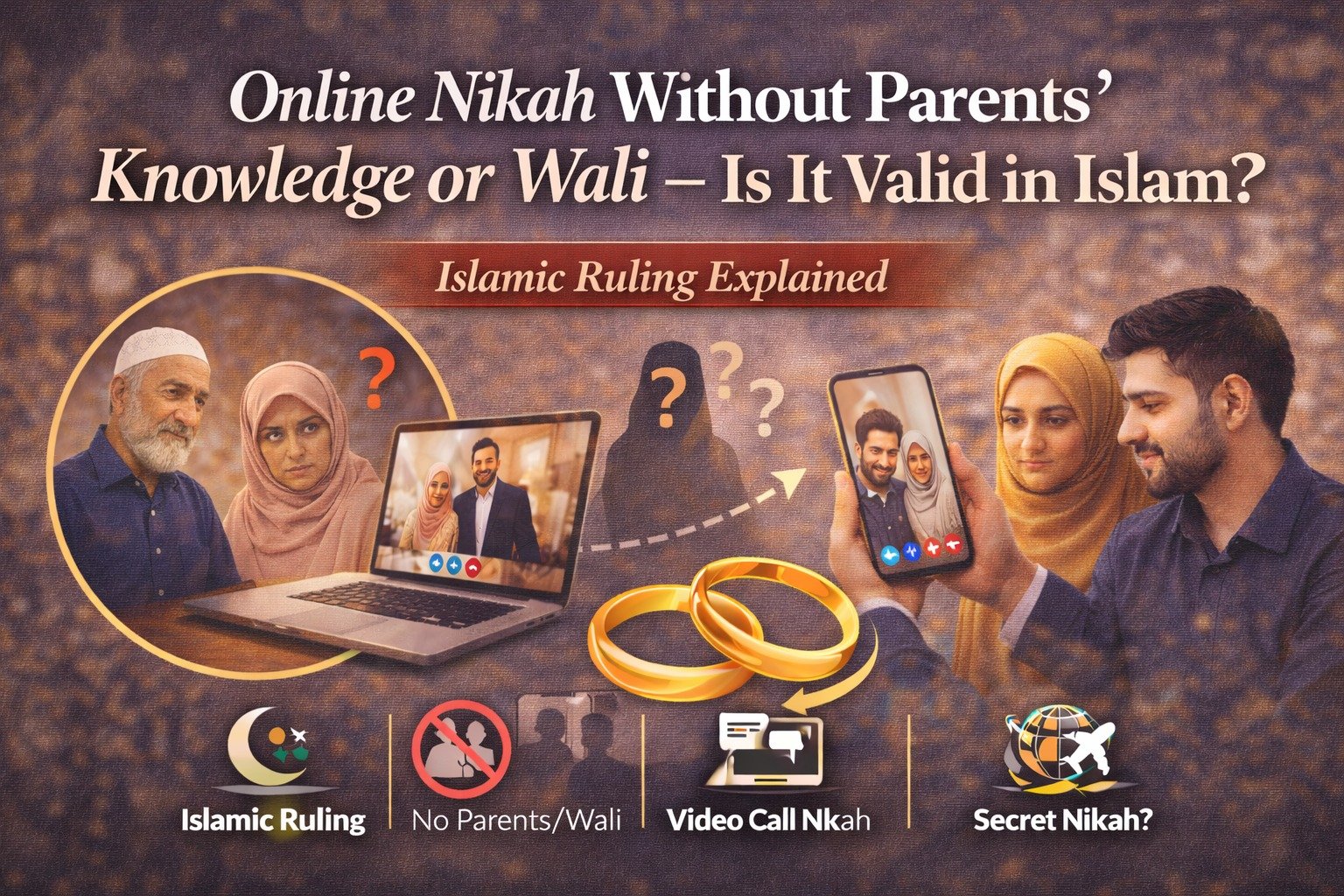
Many couples ask whether Online Nikah can be performed without parents’ knowledge or without a wali. Islam answers this with clarity: parental presence is encouraged, but Nikah validity depends on Islamic pillars — especially wali, witnesses, and consent.
Parents vs Wali – Understanding the Difference
Parents are not automatically wali unless the father or legal guardian is involved. Islam encourages family participation, but legal guardianship (wali) is a separate Islamic requirement.
Nikah is judged by wali, witnesses, and consent — not by how many relatives attend.
Prophetic Guidance on Wali
“There is no Nikah without a wali and two witnesses.” — Abu Dawood, Tirmidhi
This hadith establishes that a wali is required for Nikah according to the majority of scholars.
When Can Online Nikah Proceed Without a Family Wali?
Islam provides compassionate solutions when a wali is unavailable or unjustly blocks marriage:
- If the woman has no wali (convert or orphan)
- If the wali refuses marriage without Islamic reason (adhal)
- If the wali is unreachable
In such cases, a qualified Qazi or Nikah officiant may act as wali-e-hakim after verifying the bride’s consent.
Judicial guardianship replaces family guardianship when needed to prevent injustice.
Hanafi Position
According to Hanafi fiqh, a mature woman may contract Nikah herself in limited circumstances. Even so, scholars still advise involving family whenever possible.
Online Nikah Without Parents Present
Online Nikah may be conducted privately when necessary. If wali (or wali-e-hakim), two Muslim witnesses, bride, groom, and Nikah reciter are present on the same live video call, the Nikah remains Islamically valid — even if parents are not aware.
Essential Conditions for Valid Online Nikah
- Live ijab and qabul
- Two Muslim witnesses on video
- Wali or wali-e-hakim
- Clear bride consent
- Agreed mahr
- Verified identities
Conclusion: Online Nikah without parents’ knowledge may be valid if Islamic requirements are fulfilled. Without a wali, Nikah is not valid except where wali-e-hakim applies or under Hanafi allowances. Islam encourages honesty and family harmony, but provides lawful alternatives when guardianship becomes unjust.
For authenticated prophetic narrations:
Sunnah.com — Hadith Collections