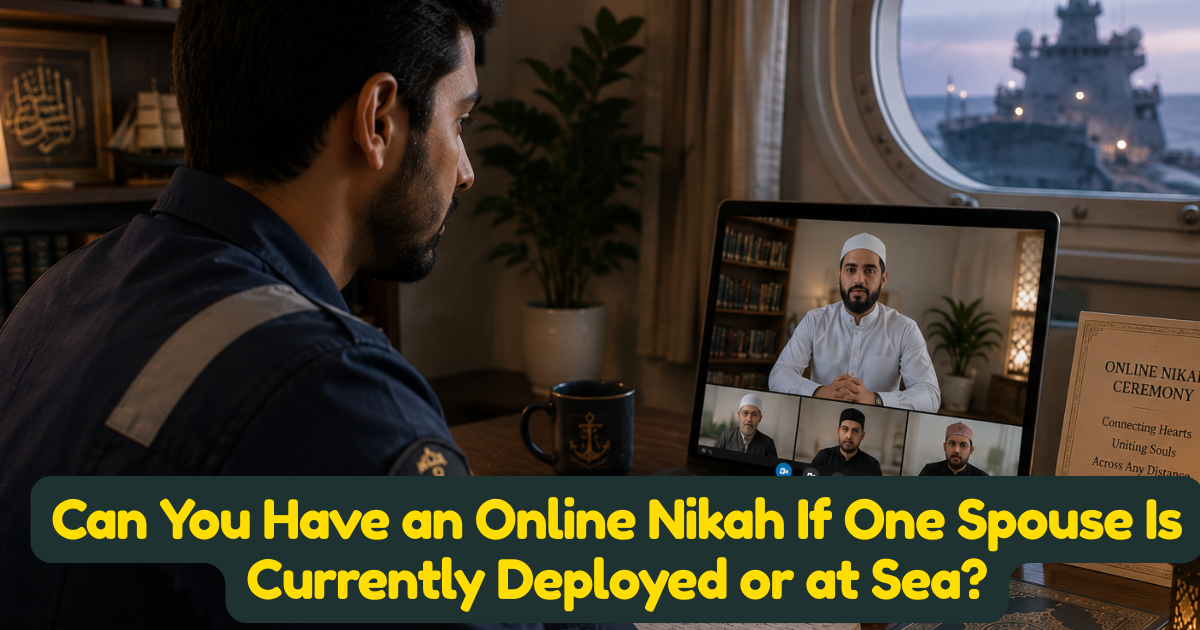
Can You Have an Online Nikah If One Spouse Is Currently Deployed or at Sea?
Military service members on deployment and maritime workers spending months at sea face a genuinely distinct challenge when planning a nikah: limited, intermittent, or scheduled-only internet access, rather than the reliable, on-demand connectivity most online ceremonies assume. Understanding how to plan around this makes the difference between a smooth ceremony and a frustrating series of dropped calls.
Is a Valid Nikah Possible With Limited Connectivity?
Yes — what matters religiously is that the ijab and qabul exchange happens in real time, with witnesses genuinely hearing it as it occurs. This doesn't require perfect, uninterrupted video for the entire ceremony; it requires a stable enough connection during the specific, typically brief moment when vows are exchanged. Couples working around deployment or maritime schedules should plan the ceremony's timing around whatever window of connectivity is actually reliable, even if that window is narrow.
Planning Around Scheduled Communication Windows
Many deployed service members and maritime workers have specific, sometimes brief, windows for personal communication — a satellite call slot, a scheduled shore-based internet session, or a designated time when connectivity is available. Coordinating the ceremony to fall precisely within one of these windows, with everyone else (officiant, witnesses, the other spouse) prepared and ready in advance, is the most reliable approach.
Backup Plans for Connectivity Interruptions
Given the genuine unpredictability of military and maritime connectivity, having a backup plan matters: a secondary call platform ready if the primary one fails, a clear understanding with the officiant about what to do if the connection drops mid-ceremony (typically, pausing and resuming once reconnected, since the ijab and qabul needs to be heard as a coherent, real-time exchange), and flexibility on the exact ceremony time within an agreed window.
Audio-Only as a Fallback
In situations where video connectivity is unreliable but audio (including basic phone or satellite phone connections) is more consistent, an audio-only ceremony can be conducted validly, provided witnesses clearly hear the voice of the deployed or at-sea spouse and can confirm identity through other means (such as prior video identity verification completed when connectivity allowed). This should be discussed with your officiant in advance so everyone is prepared for this possibility.
Coordinating Time Zones and Duty Schedules
Beyond connectivity, deployed service members and maritime workers often operate on schedules dictated by duty rotations rather than standard time zones. Building extra flexibility into the planned ceremony date — rather than fixing on a single specific time — gives everyone room to adjust if duty requirements shift unexpectedly, which is common in these settings.
Documentation Considerations
Military and maritime personnel should ensure their identification documents are current and accessible for the identity verification step, which sometimes requires advance coordination if the deployed spouse's documents are held by a command unit or otherwise not immediately on hand — worth checking well before the planned ceremony date rather than discovering this gap at the last minute.
Family Support Back Home
For the spouse not deployed, having family or a wali physically present on their end of the call, even while the other spouse joins from a ship or deployment location, helps create a more complete and supported ceremony experience despite the physical distance and connectivity constraints involved.
How InstantNikah.com Supports Deployed and Maritime Couples
Our officiants have experience working around military and maritime connectivity constraints, building flexible scheduling around communication windows, preparing backup audio options, and completing identity verification whenever a reliable connection allows, so the ceremony itself can proceed smoothly during whatever window actually becomes available.
Admin User
Author