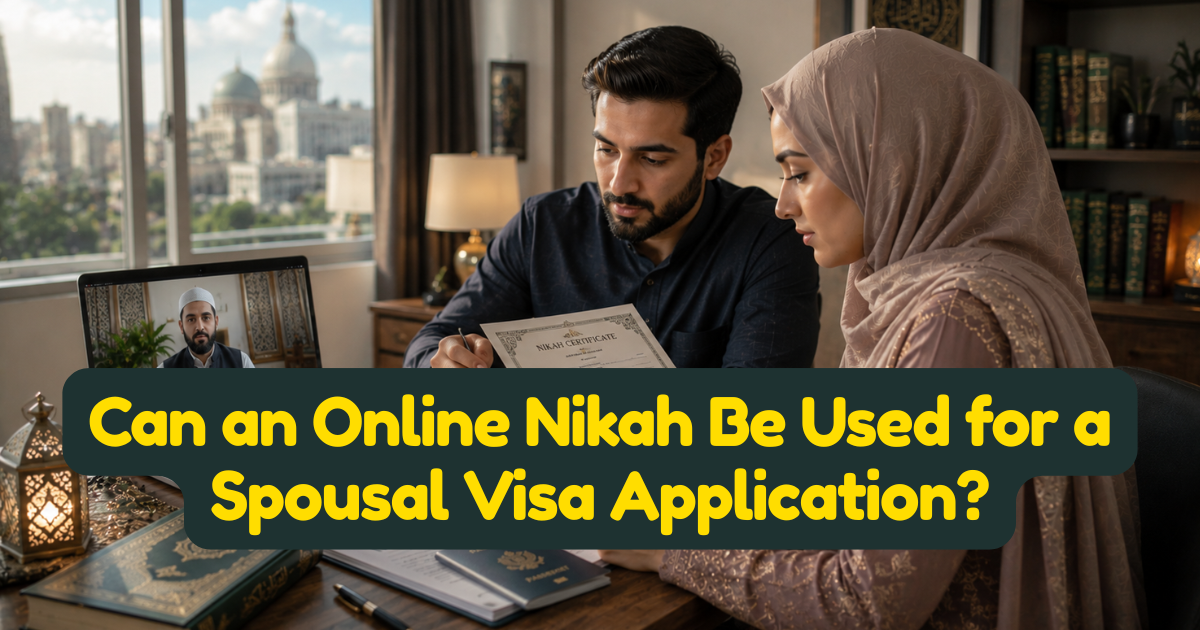
An online nikah can be fully valid Islamically and still leave a couple short of what an immigration authority actually requires as proof of marriage. This isn't a flaw in the online nikah itself — it reflects a broader pattern that applies to nikah generally, in person or online: religious validity and civil/immigration recognition are simply different systems, evaluated separately.
A Concrete Example of How This Plays Out
Real visa documentation requirements make this gap explicit. Guidance on Pakistan civil documents for US immigration purposes states plainly that applicants must present both an original, signed Nikah Nama and a separately issued NADRA marriage registration certificate — and explicitly notes that each document on its own does not constitute sufficient proof of marriage. The religious contract and the civil registration are treated as two distinct pieces of evidence that have to be presented together, not as interchangeable proof of the same thing.
Which Visa Path Matters Here
This intersection plays out differently depending on which visa route a couple is using. A detailed comparison of the K-1 fiancé visa and spousal visa options explains the structural difference: a K-1 visa is for couples who aren't yet married and plan to marry within 90 days of the fiancé's arrival in the US, while a spousal visa (CR-1/IR-1) is for couples who are already married before the visa process begins. If you've already had an online nikah and intend to use that marriage as the basis for a spousal visa petition, the marriage needs to be recognised as legally valid in the country where it took place — which is exactly where the civil registration step becomes essential, not optional.
Why "Mostly Online" Relationships Face Extra Scrutiny Anyway
There's a separate, related issue worth knowing about. Detailed K-1 visa guidance notes that immigration officers are specifically trained to identify relationships that may be entered into primarily for immigration purposes, and that relationships conducted mostly online, alongside large age differences or unusually short timelines, can draw extra questions during review. This isn't a judgment on the validity of an online nikah itself — it's a reminder that couples relying heavily on remote courtship and an online ceremony should be prepared to document the broader relationship just as thoroughly as the marriage itself.
What This Means Practically
- Don't treat the online nikah certificate alone as sufficient proof of marriage for any visa application — confirm exactly what civil registration step is also required in the country where the ceremony took place.
- Complete civil registration promptly after the religious ceremony, rather than treating it as something to handle later once the visa process is already underway.
- Build a broader evidence record of the relationship itself — communication history, visits, shared plans — particularly if much of the relationship happened remotely before the marriage.
- Clarify which visa path you're pursuing before the ceremony, since a K-1 fiancé visa and a spousal visa have different timing requirements relative to when the marriage actually needs to have taken place.
- Work with an immigration attorney alongside your nikah officiant — the two processes need to be coordinated, not handled as if one automatically satisfies the other.
Key Takeaway
An online nikah and a spousal visa application sit in genuinely separate systems that happen to intersect — the religious ceremony establishes the marriage in the eyes of Islamic law, but immigration authorities need the civil registration evidence that confirms the marriage is also legally recognised where it occurred. Couples planning to use their online nikah as the basis for a visa application should treat civil registration as a required next step, not an optional formality, and should be ready to document their relationship broadly, not just the marriage itself.
```Admin User
Author