Online Nikah Requirements: The Complete Checklist
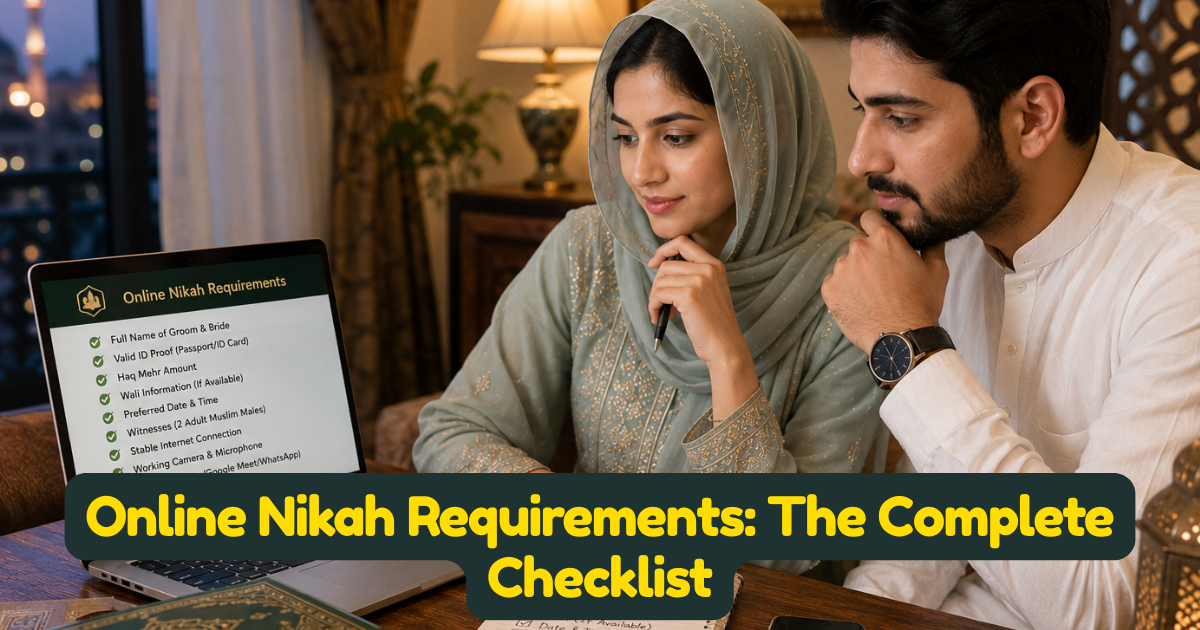
"Online nikah requirements" is one of the most searched phrases among couples just beginning to plan a remote marriage, usually reflecting a genuine desire to understand everything needed before diving into the details of any one service. Rather than scattering this across many separate articles, this checklist consolidates every essential requirement — religious, documentary, and practical — into a single reference point.
Religious Requirement One: Mutual, Free Consent
Both spouses must freely and clearly consent to the marriage, without coercion from either family or circumstance. This is the foundational condition every other requirement exists to protect, and any properly conducted ceremony should confirm this genuinely, not merely assume it.
Religious Requirement Two: Two Qualified Witnesses
Depending on the couple's madhab, this typically means two adult Muslim men, or one man and two women, genuinely present and attentive during the offer and acceptance. As covered in our detailed guide on how this works over video call, witnesses can join from separate locations entirely, provided they observe the live exchange in real time.
Religious Requirement Three: Agreed Mahr
The groom must offer, and the bride must agree to, a mahr — whether paid promptly, deferred, or split between the two. This should be discussed directly with the bride, not simply announced, as covered in our article on mahr negotiation dynamics.
Religious Requirement Four: Wali Involvement, Where Applicable
For madhabs requiring it, the bride's wali — typically her father, or the next appropriate relative in the wali hierarchy where he's unavailable — must be properly involved in the marriage arrangement. Some Hanafi scholars permit an adult woman of sound mind to contract her own marriage without this requirement, as covered in our dedicated guide on this distinction.
Religious Requirement Five: Legal Capacity to Marry
Both parties must genuinely be free to marry — not already validly married to someone else, having reached the age and maturity for informed consent, and where either party was previously married, past any applicable iddah period following divorce or a spouse's death.
Documentation Requirement: Government Identification
Both spouses provide valid government-issued identification for verification purposes, protecting against fraud and ensuring the resulting certificate matches your legal names precisely, as covered in our guide on identity verification.
Documentation Requirement: Prior Marriage Records, Where Applicable
If either spouse was previously married, documentation confirming that marriage's end — a divorce decree or a deceased spouse's death certificate — is generally needed, as covered in our dedicated guides on documentation for divorced and widowed individuals.
Documentation Requirement: Proof of Address, Where Relevant
Not universally required, but relevant for civil registration or immigration purposes in some jurisdictions, as covered in our article on when address documentation actually matters.
Technology Requirement: Stable Internet and a Working Camera
A reliable internet connection, a device with functioning camera and microphone, and a quiet, private space for the ceremony are the core practical requirements, with backup options worth having ready as discussed in our guide on connection interruptions.
Technology Requirement: A Secure Video Platform
The service should use a secure, reliable video call platform capable of hosting all core participants — couple, officiant, witnesses, and wali where applicable — simultaneously and clearly, as compared across common options in our platform guide.
Practical Requirement: A Genuine Pre-Ceremony Consultation
Before the ceremony, a proper consultation should confirm eligibility, madhab-specific requirements, mahr terms, and documentation needs, as detailed in our guide on what this first call should cover.
Practical Requirement: Confirmed Witnesses and Wali Availability
Witnesses and, where required, a wali should be confirmed and briefed on how to join the ceremony call ahead of the scheduled date, avoiding last-minute scrambling that can compromise the ceremony's proper conduct.
What's Not Actually Required, Despite Common Assumptions
Several things couples sometimes assume are required actually aren't: a formal khutbah speech isn't strictly mandatory (though widely recommended), photography or video recording isn't necessary for validity, and there's no requirement that both spouses have previously met in person, as covered in our respective articles on each of these points.
Country-Specific Additional Requirements
Beyond the universal religious and practical requirements above, civil registration requirements vary considerably by country — some requiring separate civil marriage entirely apart from the religious ceremony, others allowing a registered officiant to satisfy both simultaneously. Our detailed country guides cover the specific civil requirements relevant to your location.
A Quick Summary Checklist
- Free, mutual consent from both spouses.
- Two qualified, attentive witnesses.
- An agreed mahr, discussed directly with the bride.
- Wali involvement, where the bride's madhab requires it.
- Legal capacity to marry, confirmed for both parties.
- Valid government identification for both spouses.
- Documentation of any prior marriage's conclusion, where applicable.
- A stable internet connection and secure video platform.
- A genuine pre-ceremony consultation completed in advance.
How InstantNikah.com Confirms Every Requirement Is Met
Our pre-ceremony consultation systematically works through each of these requirements with every couple — religious, documentary, and practical — before any ceremony date is confirmed, ensuring nothing essential is left unaddressed by the time you join your ceremony call.
Admin User
Author