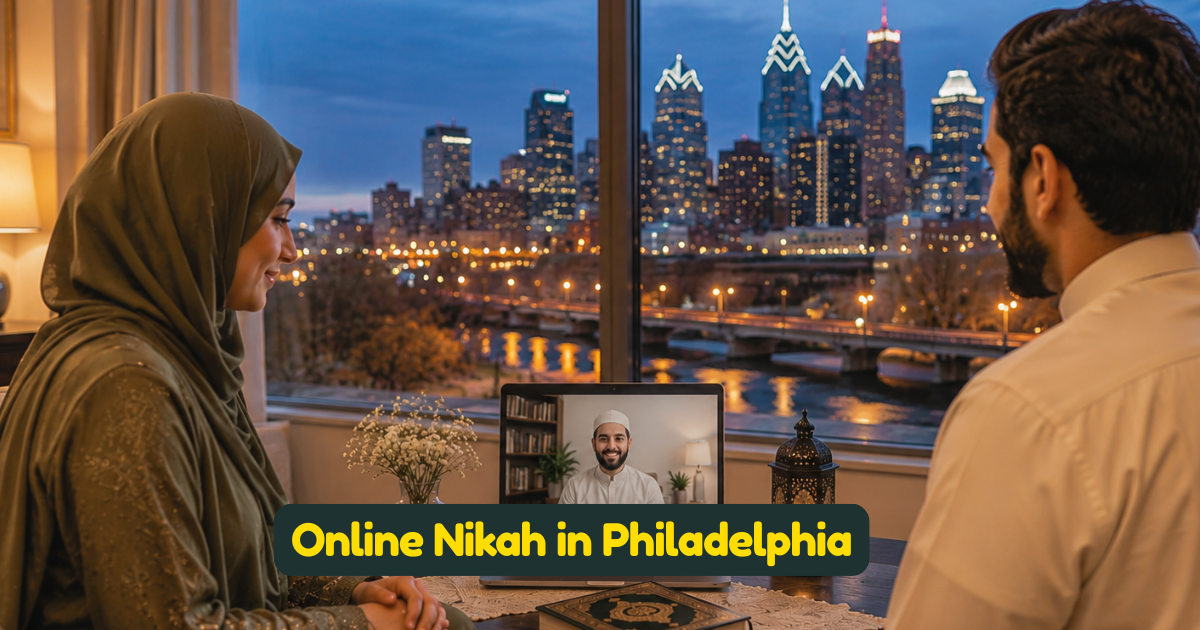
Online Nikah in Philadelphia
Philadelphia holds a distinct place in American Muslim history. The city has one of the oldest and most established African American Muslim communities in the country, with roots tracing through generations of families and mosques that predate much of the immigrant Muslim growth seen in other major U.S. cities. Alongside that history, Philadelphia and the surrounding Delaware Valley have also built newer immigrant communities — South Asian, Arab, and West African — supported by organizations like the Islamic Society of Central Pennsylvania's Philadelphia-area counterparts and the Muslim Society of Delaware Valley (MSDV), which coordinates nikah services across the region.
A Real Local Limitation Worth Knowing
One detail worth being upfront about for Philadelphia-area couples specifically: some of the region's established nikah coordinators, including MSDV, explicitly limit how far their representatives will travel to perform a ceremony — commonly capped at around a 40-mile radius from their base locations. For couples in the city proper, this rarely matters. For couples in outlying parts of the Delaware Valley, or families wanting to include relatives further out, it can become a real constraint that an online option sidesteps entirely.
What Stays the Same, What Changes
An online nikah doesn't alter any of the underlying religious requirements a Philadelphia mosque would apply: a clear offer and acceptance, the wali's role, two qualifying witnesses, and an agreed, documented mahr. What it changes is the format and the geography — useful for a couple whose family spans the Delaware Valley, other parts of Pennsylvania, or beyond, and who don't want a 40-mile radius limit or a specific mosque's schedule to determine when and how they can marry.
Civil Marriage in Philadelphia
As with anywhere else, an Islamic nikah on its own doesn't create a legally recognized civil marriage in Pennsylvania. Couples wanting civil recognition need a marriage license from the Philadelphia Register of Wills, which requires both applicants to appear in person, becomes valid on the third day after application, and remains valid for 60 days. A useful detail for Delaware Valley couples: a Philadelphia-issued license can be used to marry anywhere in Pennsylvania, not just within the city — though it can't be used in another state, so couples living just across the New Jersey line should apply in the correct state.
Who This Tends to Fit in Philadelphia
- Couples outside the immediate 40-mile radius many local nikah coordinators serve.
- Families spanning Pennsylvania and neighboring New Jersey or Delaware, a common situation in the broader Delaware Valley.
- Couples on a tighter timeline than the counseling-session-plus-scheduling process many local mosques require.
- Couples who want a fully documented, recorded ceremony as part of their long-term marriage records.
Frequently Asked Questions
Is an online nikah accepted the same way as one performed by a local Philadelphia coordinator?
Religiously, yes — the same conditions apply. Neither format alone constitutes Pennsylvania civil marriage, which remains a separate process.
Can we use a Philadelphia marriage license if we live just outside the 40-mile radius some coordinators use?
Yes — the city's marriage license works throughout Pennsylvania; that radius limitation applies to some officiants' travel policies, not to the license itself.
Do we still need to obtain a Pennsylvania marriage license for an online nikah?
Yes, if civil recognition is wanted — this applies regardless of whether the religious ceremony was in-person or online.
Authority References Used (Live & Clickable)
- City of Philadelphia, Register of Wills (phila.gov) — official Pennsylvania government resource for marriage licenses
Suggested Internal Links
- Online Nikah in Washington DC & Northern Virginia
- Online Nikah in the USA
- Documents Needed Before Booking an Online Nikah
- Online Nikah for Converts
- Book Your Online Nikah
Why This Article Is Different
This page names a real, verifiable local constraint — the 40-mile travel radius some Philadelphia-area coordinators apply — rather than making a generic case for going online, and includes accurate, specific Pennsylvania civil license detail (the 60-day window, statewide but not interstate validity) that gives it genuine local grounding.
Zainab Butt
Author