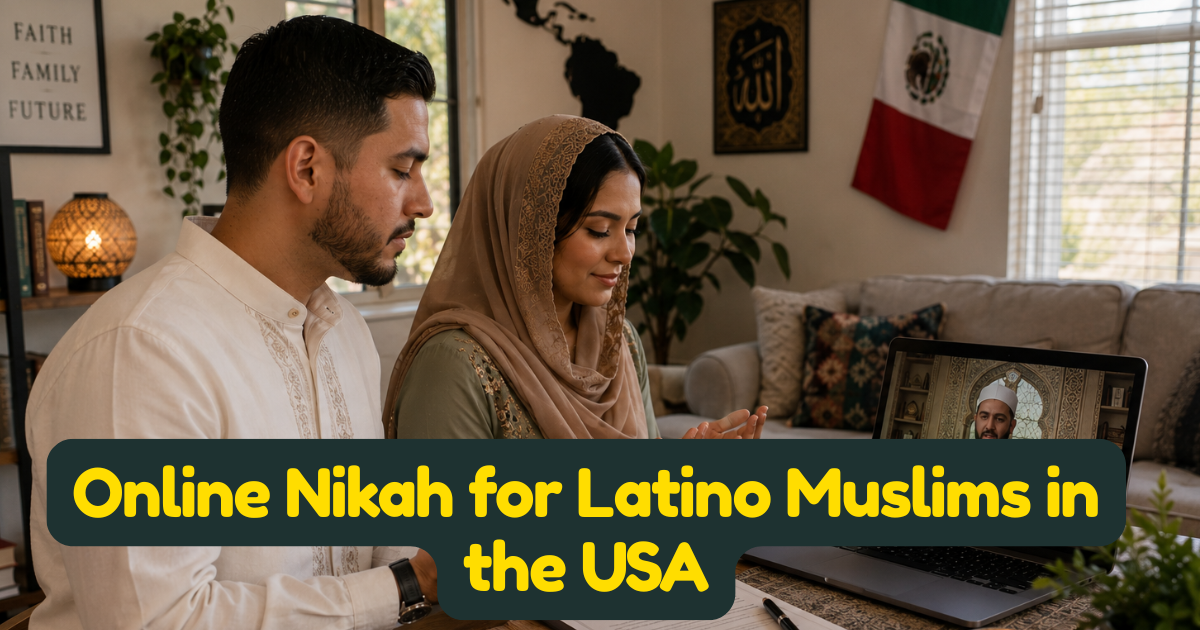
Online Nikah for Latino Muslims in the USA: Al-Andalus, Spanish Harlem, the Houston Centro Islámico, and the Wali Challenge Every Latina Convert Faces
Jaime "Mujahid" Fletcher grew up in Colombia, moved to the United States, and converted to Islam after a year of personal reflection. In 2001 he founded IslamInSpanish, the first Islamic organisation specifically designed to serve Spanish-speaking American Muslims. In 2016, IslamInSpanish opened the Centro Islámico in Houston — the first mosque in the United States specifically designed for and led by Latino Muslims. In November 2024, they opened a new, expanded 10,000 square-foot facility in Alief, southwest Houston, featuring an Andalusian-inspired interior, a museum dedicated to 800 years of Muslim Spain, Spanish-language Friday prayers, and a community education hub. As reported by Houston's KPRC Click2Houston, the centre's design incorporates Andalusian art and architecture "paying homage to the historical Muslim presence in Spain" — a deliberate statement that Islam is not a foreign religion to Spanish-speaking peoples but one woven into their civilisational roots through eight centuries of Al-Andalus.
That framing — Islam as a return to Andalusian roots rather than an adoption of an alien culture — is central to the Latino Muslim experience in the United States, and it gives the community's marriage practices a specific cultural and theological character. Latino Muslims, particularly Latina converts, face the most acute version of the wali challenge found anywhere in the American Muslim landscape. A Colombian woman who converted to Islam in Miami, a Mexican-American woman who took shahada in Houston, a Puerto Rican woman who discovered Islam through a Spanish Harlem mosque — all of them, with near certainty, have a Catholic or evangelical non-Muslim family. Their fathers cannot be their Islamic guardian. Their brothers are not Muslim. And without a properly appointed wali, the nikah conditions that the majority of scholars require cannot be met without external arrangement.
The Latino Muslim Journey: From Spanish Harlem to Houston
The Latino Muslim presence in the United States has a longer history than most people realise. As documented by Al Jazeera's feature on Latino Muslims, Latino converts to Islam have been part of the U.S. religious landscape since the 1930s, when Puerto Ricans in the northeast began joining Elijah Muhammad's Nation of Islam movement. The first organised Latino Muslim group — the Alianza Islamica — was founded in East Harlem in the late 1980s by Puerto Rican converts, creating a community in the same neighbourhood that has housed Puerto Rican and Dominican families for generations. The Alianza pioneered the concept of Islamic identity rooted in Latino culture rather than Arab or South Asian culture — an approach that IslamInSpanish and the Centro Islámico have built on three decades later.
According to Pew Research Center's 2017 survey of U.S. Muslims, Latino Muslims grew from 6 percent to 8 percent of American Muslim adults between 2011 and 2017 — representing the fastest proportional growth of any demographic segment within the American Muslim community. The U.S. Council of Muslim Organizations describes Latino Muslims as the fastest-growing new Muslim community in the country. Geographically, they are concentrated in Texas (Houston, Dallas), Florida (Miami, Orlando), New York (the Bronx, Spanish Harlem), California (Los Angeles, the Central Valley), and Illinois (Chicago), tracking the broader Latino population distribution.
US Civil Marriage and the Nikah: Two Separate Steps
In the United States, as in most countries in this series, the Islamic nikah and the civil marriage are entirely separate acts. A couple becomes legally married in the United States when they obtain a marriage licence from their county clerk's office and have the ceremony officiated by an authorised officiant — who can be a civil official, a justice of the peace, a judge, or a licensed religious officiant. In most states, a licensed imam or Islamic centre officiant can conduct a marriage ceremony that is simultaneously a nikah and a legally registered civil marriage, provided they hold the relevant state authorisation and the couple has obtained a marriage licence beforehand.
However, as documented by the nikah services guidance of Al Muhajreen Islamic Community Center, the nikah itself — the Islamic contract — has specific conditions beyond what the state requires: "The presence of a 'Wali' (Guardian) for the bride, if available, is essential. A minimum of two Muslim, male witnesses, excluding the 'Wali,' must be provided by the bride and groom." These conditions are Islamic, not legal — the county clerk does not ask about them. And for Latina converts, they create the central challenge of Islamic marriage in the United States.
The Wali Challenge: The Defining Marriage Problem for Latina Converts
The wali requirement sits at the intersection of Islamic jurisprudence and the social reality of Latino converts. In the majority scholarly view, a bride marries through her wali — her male Muslim guardian. For a Latina woman who converted to Islam, her father is almost certainly Catholic or evangelical Christian. Her brothers, if she has them, are not Muslim. Her extended male family is not Muslim. She has no natural wali.
The solution is established in classical Islamic jurisprudence: where a woman has no natural wali, an imam or the head of an Islamic organisation can serve in that role. This is not a fringe position — it is the mainstream scholarly provision for precisely the situation that every Latina Muslim convert faces. The practical implementation requires finding a qualified, trustworthy Islamic scholar who will accept this responsibility, communicate with the bride, and conduct the nikah with the proper conditions met.
An online nikah conducted through InstantNikah.com resolves this for Latina Muslims nationwide. Whether the couple is in Houston, Miami, New York, Los Angeles, or Chicago, InstantNikah.com provides a qualified qazi who officiates the ceremony, arranges a suitable wali for the bride where none exists, confirms two Muslim witnesses on the call, ensures the mahr is agreed and documented, and issues a nikah certificate. The civil marriage licence and state-level registration is handled separately at the county level — the online nikah ensures the Islamic contract is properly completed, which is what the state cannot supply. For our dedicated guide on this specific challenge, see our resource on how a convert finds a wali for nikah and our complete Muslim convert nikah checklist.
The Al-Andalus Narrative and the Nikah's Roots in Spanish Culture
Fletcher's decision to build the Houston Centro Islámico with Andalusian architecture — and to include a museum of eight centuries of Muslim Spain — is not merely aesthetic. It reflects a central argument in the Latino Muslim movement: that Spanish-speaking peoples have a deeper connection to Islamic civilisation than is commonly acknowledged. As Brian Catlos of the University of Colorado noted in Tablet Magazine, "there are thousands and thousands of Arabic loanwords in Spanish" — the linguistic inheritance of eight centuries during which Arabic-speaking Muslim scholars, merchants, farmers, and rulers shaped the Iberian Peninsula from which Spain's conquests of the Americas were launched. The nikah — the Islamic marriage contract — is part of that inheritance, older in Spanish cultural history than the Catholic marriage that replaced it.
For Latino Muslims, embracing the nikah is thus not adopting a foreign practice but in some sense recovering an ancestral one — a narrative that gives the ceremony additional cultural resonance and makes its proper conduct particularly important. The conditions of a valid nikah — the wali, the witnesses, the mahr, the offer and acceptance — are not culturally distant requirements but the conditions of a ceremony whose roots predate Columbus's voyage and the Christianity that accompanied it. InstantNikah.com serves this community with the same care and qualification it brings to every ceremony, wherever in the United States the couple is located.
Who This Particularly Serves Among Latino Muslims in the USA
- Latina converts with non-Muslim families — the most common and most acute scenario — who need a qualified wali appointed before the nikah can proceed validly under Islamic conditions.
- Latino Muslim couples in smaller cities where no Spanish-speaking Islamic centre or qualified nikah officiant is locally available. With the IslamInSpanish Centro Islámico in Houston and Islamic centres in Dallas, New York, and Miami, major cities are increasingly served — but Latino Muslims in smaller communities throughout Texas, Florida, California, and the southeast remain underserved.
- Long-distance Latino Muslim couples where one party is in the United States and the other is still in Mexico, Colombia, Venezuela, Honduras, El Salvador, or another Latin American country.
- Latino Muslim couples planning a destination nikah who want the Islamic contract completed before their civil marriage ceremony at the county courthouse, ensuring they are Islamically married from the earliest moment.
Quick Answers for Latino Muslims in the USA
Can a mosque imam conduct a nikah that is also a legally registered marriage in the USA? Yes, in most states — provided the imam holds the relevant state officiant authorisation and the couple has a valid county marriage licence. The nikah and the civil marriage can be the same ceremony. Contact the specific state and county for officiant authorisation requirements.
What if my family is Catholic and I have no Muslim wali? A qualified imam or Islamic scholar can be appointed as your wali — the mainstream scholarly provision for converts without Muslim male guardians. This is one of the most common situations InstantNikah.com handles for Latino Muslims.
Is an online nikah valid for a Latina Muslim in the USA? Yes — when the wali participates (or is arranged), two witnesses genuinely hear the contract, mahr is agreed, and consent is free. The online medium does not invalidate the nikah provided its conditions are properly met.
Where are the main Latino Muslim communities in the USA? Texas (Houston, Dallas), Florida (Miami, Orlando), New York (the Bronx, Spanish Harlem, North Philadelphia area), California (Los Angeles, Central Valley), and Illinois (Chicago). The IslamInSpanish Centro Islámico in Houston (November 2024 new facility) is the largest and most established Latino-led Islamic centre.
From Spanish Harlem to Al-Andalus to Houston — One Community's Return to Its Roots
The Latino Muslim community is building something that has never existed before in the United States: a Spanish-speaking Islamic identity rooted simultaneously in American Latino culture and in the civilisational inheritance of Al-Andalus. The nikah — the marriage contract that formalises the union of two Muslims before Allah — is part of that tradition, older and deeper than the Catholic ceremonies that defined Latino religious life for five centuries. InstantNikah.com serves this community's nikah needs wherever in the United States the couple is located: with a qualified qazi, a properly appointed wali for every convert bride who needs one, two witnesses, a documented mahr, and a ceremony conducted with the care that a 1,400-year-old tradition deserves. When you are ready, book your online nikah and speak with our team.
Admin User
Author