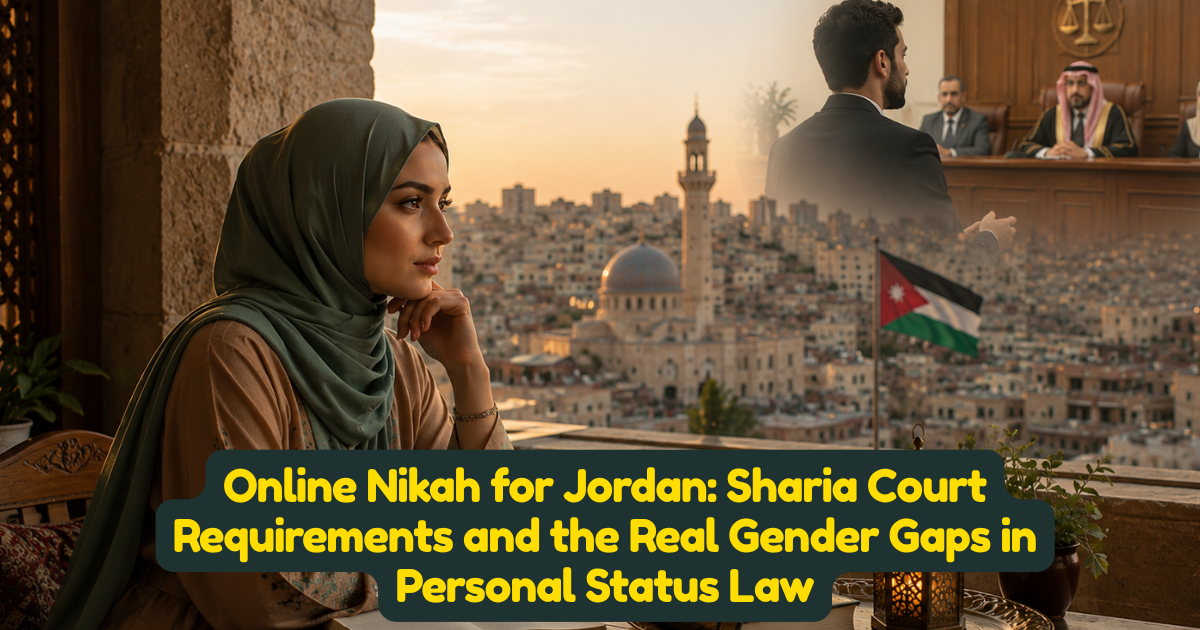
Online Nikah for Jordan: Sharia Court Requirements and the Real Gender Gaps in Personal Status Law
Jordan's marriage system runs through a formal, constitutionally recognised Sharia Court structure — and while a Nikah conducted through this system is genuinely well-integrated with the country's civil framework, real, documented gaps in how the law treats men and women differently are worth understanding honestly before planning a Nikah with a Jordanian connection.
The Legal Foundation: Article 106 and the Sharia Courts
Jordan's court system is formally divided by jurisdiction, with religious courts holding constitutional standing. Detailed research from Musawah, the global Muslim family law network, confirms Jordan's courts are divided into civil courts, religious courts, and special courts — with Sharia Courts holding executive jurisdiction over matters of personal status for Muslims, cases concerning blood money (Diya), and matters pertaining to Islamic endowments (waqfs), applying provisions of Sharia law under Article 106 of the Jordanian Constitution.
Both Civil and Religious Procedures Are Genuinely Required
Real, comparative guidance on Nikah recognition across different countries confirms Jordan's specific structural requirement: in Jordan, Nikah is legally recognised and Muslim marriages are governed by Sharia law, but both civil and religious procedures are required for a fully recognised marriage. This is a genuinely important distinction from Egypt, where no civil alternative exists at all, and from Lebanon, where the religious court's own solemnisation is the complete legal marriage — Jordan sits between these two models, requiring couples to properly complete both layers.
Minimum Age: A Real, Recent Reform Worth Knowing
Jordan's Personal Status Law has moved toward international standards on minimum marriage age, though with a real, documented exception worth understanding. Musawah's research confirms the Personal Status Law specifies 18 as the legal age of marriage, in line with international standards — though the law still permits Sharia court permission to grant marriage for persons who have completed fifteen years of age but not yet completed eighteen, a specific exception process governed by dedicated Civil Status Law instructions.
A Real, Documented Gender Gap: The Witness Requirement in Abuse Cases
This is a genuinely important gap worth understanding honestly, not glossed over. Musawah's research confirms that while assault and abuse are formally accepted as grounds for divorce, it is often very difficult for a woman to prove her case, because Sharia Courts require the testimony of two male witnesses in these specific circumstances — discouraging many women from initiating legal proceedings at all. This is a real, documented barrier distinct from the general witness requirement for the marriage contract itself, and worth understanding as context for anyone researching how Jordan's system treats women specifically in difficult circumstances.
The Wife's Work Consent Requirement
A further, real and specific provision worth knowing directly: Jordanian Personal Status Law ties a wife's financial support to her husband's consent regarding employment outside the home. The same research confirms the law states a wife loses her alimony if she works outside the home without her husband's consent, though he can only revoke that consent for legitimate reason and without causing her harm — a woman can only object to this if she specifically included a condition in her marriage contract protecting her right to work. This is a genuinely important, concrete detail: it means the marriage contract itself, not general legal protection, is the actual mechanism through which a Jordanian wife can secure her right to work regardless of her husband's later preference — worth discussing and documenting explicitly at the time of the Nikah rather than assumed as a default protection.
Polygamy: Permitted, Asymmetrically
Jordan's Personal Status Law maintains the classical asymmetric position on polygamy, and Musawah's research states this plainly: men and women are not treated equally in marriage — for instance, men can enter a polygamous marriage while women cannot.
Jordan's International Commitments and Their Limits
A useful piece of context worth understanding: Jordan has engaged with international human rights frameworks on this topic, but with specific, real limits. The same research confirms Jordan ratified CEDAW (the Convention on the Elimination of All Forms of Discrimination Against Women) in 1992, but made reservations, including declining to be bound by Article 9, paragraph 2, relating to equal rights regarding the nationality of children — meaning Jordan's formal international commitments on gender equality carry specific, documented carve-outs relevant to family law.
Why Marriage Contract Conditions Matter More in Jordan Than in Many Other Countries
Given these real, documented gaps — the work-consent issue, the polygamy asymmetry — Jordan is a genuinely strong example of why the marriage contract's specific written conditions matter enormously, not just the ceremony itself. A Jordanian Nikah contract that explicitly includes protective conditions, such as the wife's right to work regardless of later spousal preference, or conditions addressing polygamy, gives a bride real, documented legal standing that the default statutory framework alone does not automatically provide.
A Practical Sequence for Couples With a Jordanian Connection
Given Jordan's dual civil-and-religious requirement, couples completing an online Nikah with a Jordanian connection should ensure the ceremony is properly structured to satisfy the Sharia Court's requirements while also completing whatever separate civil registration step Jordan's system requires; and, given the real documented gaps discussed above, should give real, deliberate thought to which protective conditions — particularly around work rights — are worth writing explicitly into the marriage contract itself, rather than relying on default statutory protection.
Frequently Asked Questions
Is a Nikah alone sufficient for legal recognition in Jordan? No — Jordan specifically requires both civil and religious procedures to be completed for a marriage to be fully recognised.
Can a Jordanian wife work outside the home without her husband's consent? Under the default Personal Status Law, she risks losing alimony if she does — unless she has specifically included a protective condition in her marriage contract securing that right.
Does Jordan allow marriage below age 18? The standard legal age is 18, though Sharia court permission can be granted for marriage between ages 15 and 18 under specific circumstances.
Suggested Internal Links
Zainab Butt
Author