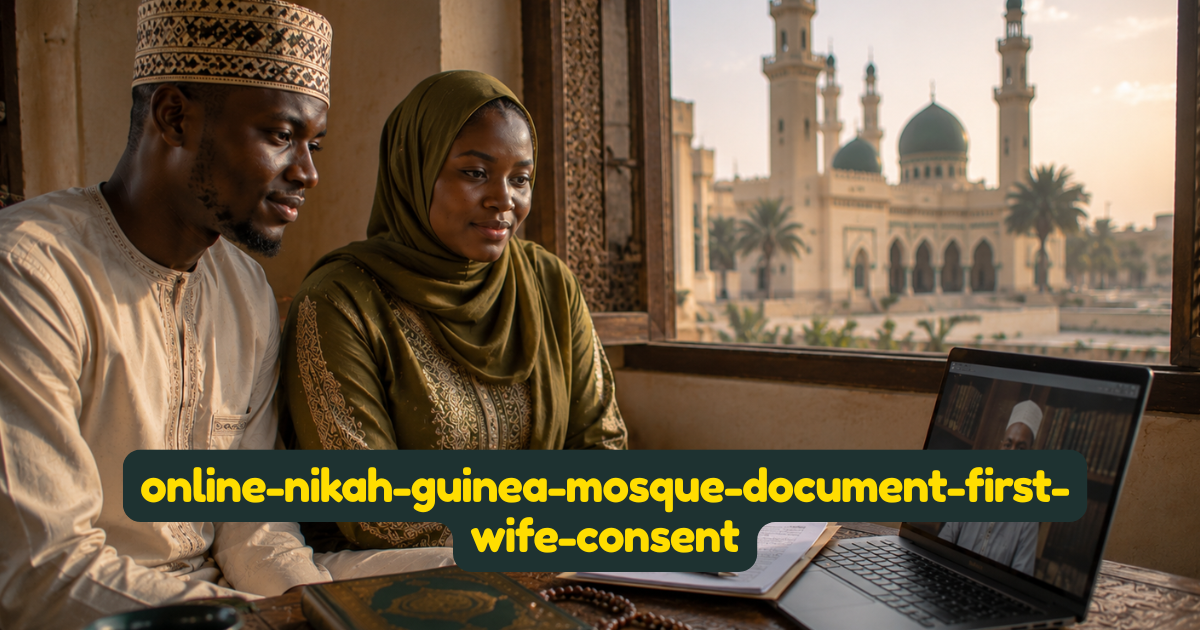
Online Nikah for Guinea: The New Mosque Document Reform and the Real First-Wife Consent Law
Guinea's marriage framework centres firmly on civil registration — but two genuinely current, real developments are worth understanding in detail: an active reform clarifying exactly how mosque-conducted ceremonies feed into that civil system, and a distinctive, real 2019 legal protection requiring a first wife's own consent before her husband can validly take a second.
The Core Legal Principle: Civil Marriage Only
This is the foundational fact about Guinea's system, stated directly by French diplomatic authorities operating in the country. Official guidance confirms that in Guinea, only civil marriage is legally recognised, per Article 283 of the Guinean Civil Code. This is confirmed independently by detailed official U.S. Library of Congress legal research, which states that traditional marriage celebration, per se, is not recognised by the Civil Code of Guinea — for a marriage contract to be valid under Guinean law, it must be performed in the presence of a civil officer, which may then be followed by a religious ceremony.
A Genuinely Current, Real Reform Worth Understanding in Detail
This is a genuinely fresh, current, and directly relevant development. Recent detailed reporting from Conakry confirms that mosques across the country have begun issuing a specific official document alongside religious ceremonies, priced at 100,000 Guinean francs. A representative responsible for issuing the document at one Conakry mosque explained that the form originates from the Ministry of Territorial Administration and Decentralisation, working in collaboration with the Ministry of Religious Affairs — and confirmed this new booklet will constitute the indispensable declarative act needed to create the legal bond, a mandatory prerequisite before the official civil marriage certificate can be issued. This reform is specifically described as promising to clarify the legal value of religious marriage in Guinea and end the previous confusion surrounding delivery fees for this documentation.
The Real, Distinctive First-Wife Consent Requirement
This is a genuinely rare, real legal protection worth understanding in full. Reference research citing official Library of Congress reporting confirms that Guinea's Parliament approved a Civil Code in 2019 that legalised polygamy under specific conditions — and independent reporting on the reform confirms it specifically gives first wives the legal right to approve a polygamous marriage before her husband can validly take a second wife. This is a genuinely distinctive real protective mechanism, standing in useful contrast to the mid-marriage regime-change provision this series has just documented as controversial in neighbouring Burkina Faso's 2025 reform — Guinea's approach specifically requires the first wife's own affirmative consent rather than leaving the decision to the husband alone.
What "Proxy" Marriage Actually Means Under Guinean Law
This is a genuinely useful, real clarification worth understanding directly, given the confusion this series has documented elsewhere around "proxy marriage" and immigration concerns. Official U.S. Library of Congress legal research confirms that Islamic law allows marriage to be performed by proxy, in which case the husband may be represented by another person — his presence at the time of the marriage's celebration is not required. This confirms Guinea's own legal recognition specifically accommodates the classical wakalah structure this series has documented throughout, though couples pursuing international recognition afterward should still follow the careful documentation practices this series has recommended given how differently immigration authorities in other countries may scrutinise such arrangements.
Dower Under Guinean Islamic Practice
The same Library of Congress research confirms Guinea's Islamic marriage practice follows the standard mahr structure documented throughout this series — a payment, in cash or kind, made by the husband to the wife upon marriage, forming a genuine, required element of a properly conducted Islamic ceremony even as the civil marriage itself remains the legally operative act under Guinean law.
What This Means for Structuring an Online Nikah With a Guinean Connection
Given Guinea's specific structure and its genuinely current reform, couples completing an online Nikah with a Guinean connection should ensure the civil marriage before a civil officer is properly completed as the legally operative act, obtain the new mosque-issued declarative document where the religious ceremony is conducted domestically, and — for any husband considering a subsequent marriage — secure the first wife's own affirmative legal consent, consistent with Guinea's 2019 reform.
Frequently Asked Questions
Is a religious Nikah alone legally recognised in Guinea? No — only civil marriage before a civil officer is legally recognised under Article 283 of the Guinean Civil Code; a religious ceremony may follow but doesn't independently create legal marital status.
What is the new mosque document reform in Guinea? A genuinely current initiative where mosques issue an official declarative document, developed jointly by Guinea's territorial administration and religious affairs ministries, designed to become the mandatory prerequisite step before the official civil marriage certificate.
Does a Guinean first wife have to approve her husband's second marriage? Yes — under Guinea's 2019 Civil Code reform, a first wife holds the specific legal right to approve a subsequent polygamous marriage.
Suggested Internal Links
Zainab Butt
Author