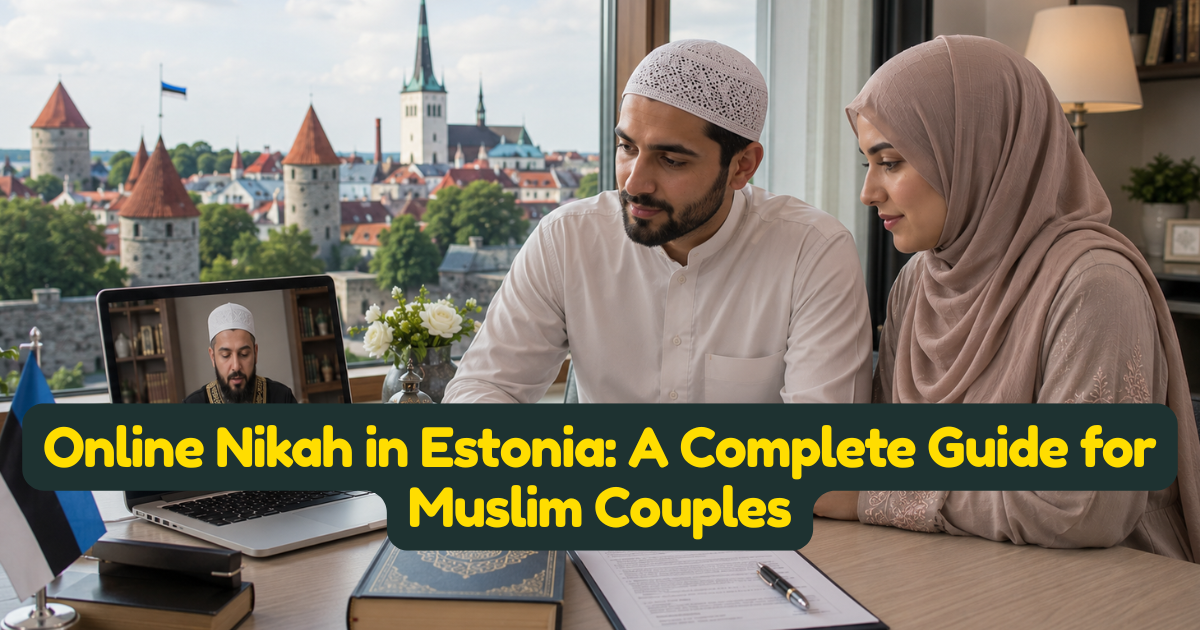
Online Nikah in Estonia: A Complete Guide for Muslim Couples
Estonia's Muslim population is small relative to much of Western Europe, concentrated primarily in Tallinn, but it is a genuinely diverse community — Tatar families whose presence in the region predates the modern Estonian state, alongside more recent arrivals from Central Asia, the Middle East, and North Africa building lives in a country with a distinctly different religious and legal landscape than they may be used to. For these couples, understanding exactly how Estonian law treats a nikah is essential before assuming any ceremony, in-person or online, automatically satisfies both religious and legal requirements.
Estonia's Civil Marriage Framework
Under Estonian law, marriage is contracted through a formal application process, and the ceremony itself may be performed by a vital statistics office official, a notary, or a minister of religion specifically authorized to perform this function, according to procedures set out by Estonia's Ministry of the Interior. Crucially, a religious ceremony performed by an officiant who has not been granted this specific authorization does not, by itself, register the marriage in Estonia's population register — the country's central civil records system.
Why This Distinction Matters for Muslim Couples
A nikah performed by an imam who is not an authorized vital statistics official is religiously valid — assuming the standard Islamic conditions of witnesses, mahr, and wali involvement where required are met — but it does not create a civilly recognized marriage in Estonia. This means the couple would not automatically appear as married in the population register, which affects tax status, residency sponsorship, inheritance under Estonian civil law, and a range of other practical matters tied to legal marital status.
The Two-Step Process Most Muslim Couples in Estonia Need
For couples wanting both religious and legal recognition, the practical approach is generally to pursue a civil marriage registration through the local government of the relevant county center (or the Tallinn Vital Statistics Office for those in the capital), alongside a separately conducted Islamic nikah ceremony that satisfies the religious conditions important to the couple. An online nikah service allows the Islamic ceremony to be conducted with a certified officiant, qualified witnesses, and a wali where required, while the couple pursues Estonian civil registration through the standard government process in parallel.
Documentation Required for Civil Registration
Estonian authorities require specific documentation depending on each party's residency status and prior marital history, including a certificate of legal capacity to marry for those who have lived in Estonia less than six months or whose residence is abroad, and proof that any previous marriage has ended, where applicable. Foreign nationals must also demonstrate legal stay in Estonia if they are not EU citizens. Couples should confirm current requirements directly with their local vital statistics office well ahead of any planned ceremony.
Apostille and Cross-Border Recognition
For couples who marry religiously online and plan to register civilly either in Estonia or in another country later, documentation prepared outside Estonia generally needs to be properly authenticated. Estonia has streamlined recognition arrangements with many EU member states, meaning an apostille is often unnecessary for documents used within the EU, though it remains relevant for documents intended for use outside the bloc.
Why Diaspora Couples in Estonia Choose Online Nikah
Estonia's Muslim community, while established, is small enough that finding an imam experienced with the specific documentation needs of international couples — particularly where one spouse is not yet resident in Estonia, or where the couple needs a certificate structured to support a future spousal residence application — can be genuinely difficult locally. An online Shariah-compliant nikah service gives these couples access to a certified officiant and properly qualified witnesses regardless of exactly where in Estonia, or where relative to Estonia, each spouse currently is.
Long-Distance and Cross-Border Couples
It is increasingly common for one spouse to be an Estonian resident while the other remains abroad, often navigating a residence permit or family reunification process. In these cases, a properly documented online nikah certificate — clearly stating witness presence, mahr terms, and officiant credentials — becomes an important supporting document for whatever residency process follows, alongside the separate Estonian civil registration requirement.
Mahr and Its Treatment Under Estonian Law
Estonian civil law does not have a direct legal equivalent to mahr, and a mahr agreement made as part of a nikah is not automatically enforceable as a civil debt under Estonian family law unless separately incorporated into a recognized legal agreement between the spouses. Couples who want their mahr terms to carry legal weight in Estonia should discuss this with a family law professional familiar with both Estonian civil code and how religious marriage agreements are treated there.
How InstantNikah.com Supports Muslim Couples in Estonia
Our officiants conduct fully Shariah-compliant online nikah ceremonies for couples connected to Estonia, with certificates structured to support Estonian civil registration or a spousal residence application where needed. We walk couples through the distinction between religious and civil marriage in Estonia clearly, so no one assumes one step automatically completes the other.
Admin User
Author