Can an Online Nikah Be Performed When the Couple Doesn't Share a Common Language?
Cross-cultural and cross-border marriages are increasingly common among diaspora Muslims, and not every couple in this situation shares a fluent common language — one spouse may speak Arabic and English, the other Urdu and French, communicating day to day through a mix of translation apps, gestures, and a shared third language neither speaks perfectly. When it comes time for the nikah itself, this raises a genuine and important question: does the ceremony require both spouses to fully understand every word spoken?
Why Understanding Matters More Than Language Itself
The core requirement is not that the ceremony be conducted in any particular language, but that each spouse clearly understands what they are agreeing to and gives free, informed consent. A nikah can be validly performed in Arabic, English, Urdu, or any other language — what cannot be compromised is the couple's genuine comprehension of the offer and acceptance they are making, along with the mahr terms and any conditions attached to the contract.
How Translation Is Handled During the Ceremony
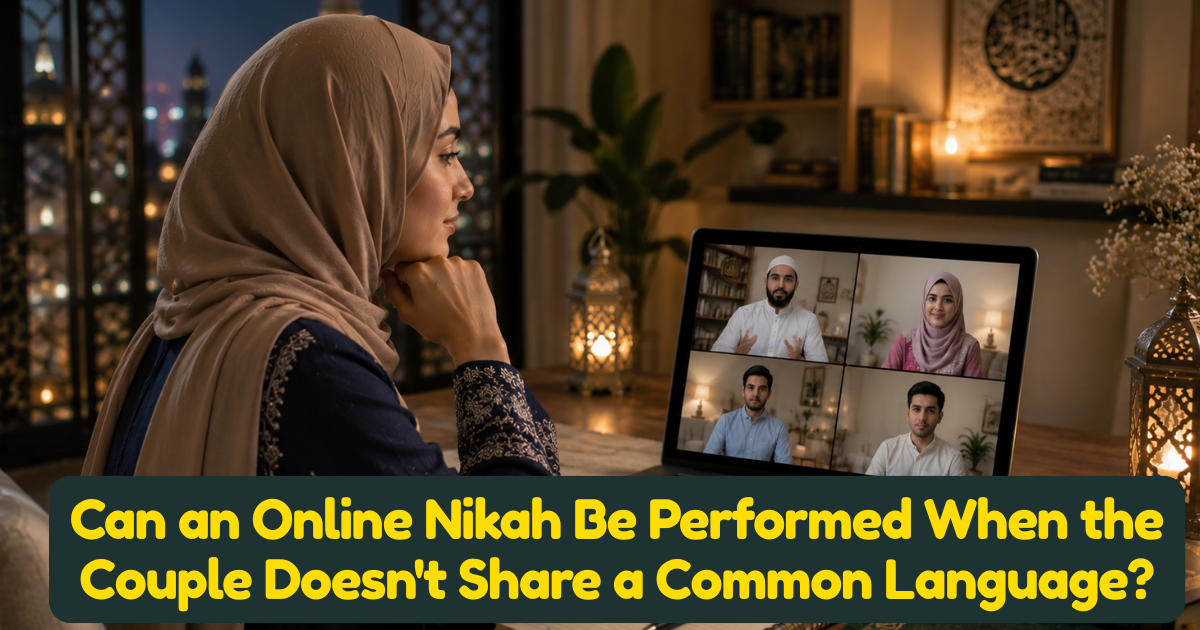
For couples without a fully shared language, the standard and religiously sound approach is professional or trusted translation throughout the ceremony — either a qualified interpreter present on the call, or the officiant themselves conducting the ceremony bilingually if capable, ensuring each spouse understands their vows, the khutbah's content, and the mahr terms in a language they genuinely comprehend, not merely a language spoken in their presence.
Choosing a Reliable Interpreter
The interpreter's role during a nikah carries real weight, since a mistranslation of the offer, acceptance, or mahr terms could create genuine confusion about what was actually agreed to. Couples should choose an interpreter who is not only fluent in both languages but ideally familiar with the specific religious terminology involved — a casual bilingual friend may not always convey concepts like mahr conditions or delegated divorce rights with full accuracy.
Does the Interpreter Need to Be a Witness Too?
An interpreter and a witness serve different functions and do not need to be the same person, though a single individual can serve both roles if qualified. What matters is that the interpreter accurately conveys the exchange to each spouse, while the witnesses — who may or may not need the same translation depending on their own language ability — separately confirm they heard the actual ijab and qabul as pronounced.
Written Translation of the Contract
Beyond the spoken ceremony, couples marrying across a language barrier should ensure their nikah certificate is available in a language both spouses can read and fully understand, not only in the language the officiant or one spouse's family primarily uses. This avoids a scenario where one spouse holds a certificate they cannot independently read or verify.
Wali Communication Across a Language Barrier
Where a wali is involved and does not share a language with the groom or officiant, the same translation principle applies — the wali's consent and understanding of the marriage terms should be confirmed through reliable interpretation, not assumed based on general goodwill or family trust alone, since the wali's informed agreement is itself part of what makes the marriage properly constituted for madhabs requiring this involvement.
Watching for Genuine Miscommunication Risk
Couples and officiants alike should treat any sign of genuine confusion — a spouse hesitating, asking the interpreter to repeat something multiple times, or appearing uncertain about the terms — as a signal to slow down and clarify fully before proceeding, rather than moving forward on the assumption that things will sort themselves out. A nikah is not the moment to rush past confusion for the sake of ceremony pacing.
How InstantNikah.com Supports Cross-Language Couples
Our officiants regularly conduct ceremonies for couples without a fully shared language, arranging qualified interpretation for the ceremony itself and ensuring certificates are provided in languages both spouses can genuinely read, with particular care taken to confirm real comprehension — not just formal participation — from every party involved, including a wali where applicable.
Admin User
Author