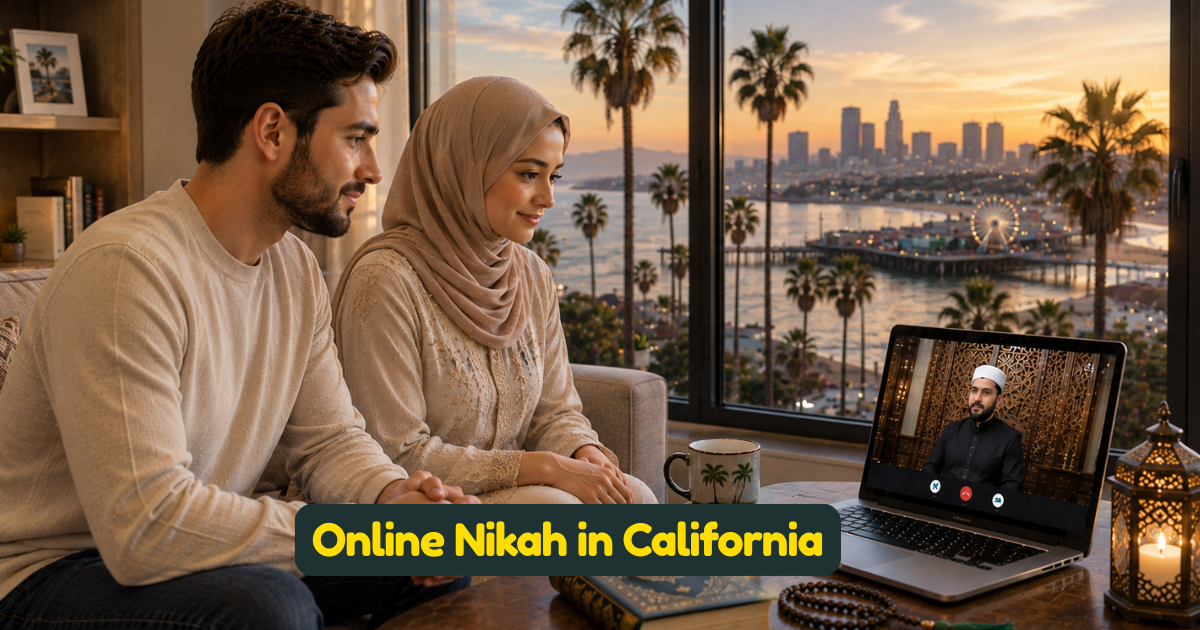
Online Nikah in California
California is home to a large, diverse Muslim population spread across the Bay Area, Los Angeles, Sacramento, and San Diego, served by well-established centers including the Muslim Community Association (MCA) in the Bay Area, SALAM Islamic Center in Sacramento, and MCC East Bay. It's also home to one of the more directly relevant pieces of state marriage legislation found anywhere in the country for couples considering an online ceremony.
AB 583: California's Remote Marriage Law
This is genuinely worth knowing in detail: California's Assembly Bill 583, enacted in 2021 as an urgency statute, created a formal legal framework titled "Remote Marriage License Issuance and Solemnization." Under this law, county clerks are authorized to issue marriage licenses remotely and to permit the marriage ceremony itself to be solemnized using remote technology — not merely the paperwork beforehand. The bill's official legislative summary confirms that a county clerk may require an affidavit affirming that the couple and everyone participating in a remote solemnization are physically present within the State of California at the time, and permits signature and transmission of documents by mail, fax, or electronic means. This is one of the most direct and comprehensive state-level legal endorsements of remote marriage ceremonies found among the jurisdictions covered on this site.
What This Means for California Couples
The practical implication is significant: California's own civil marriage system already anticipates and accommodates couples completing both the licensing and the ceremony itself without needing to be in the same physical room as their county clerk. This creates a genuinely supportive legal backdrop for couples who also want their religious nikah conducted online, and it's part of why at least one established Bay Area mosque, MCC East Bay, already offers its own members a Zoom-based Nikah option directly alongside its in-person service.
The Separate Question: Does a Nikah Alone Count as Marriage in California?
It's important to keep two things distinct. AB 583 addresses how California's own civil marriage process can be completed remotely — it doesn't change the underlying rule that a nikah performed on its own, without a California marriage license and proper solemnization, doesn't create a legally recognized California marriage. California Family Code Section 300 sets out three requirements for a valid marriage: legal capacity and consent, a marriage license, and solemnization by an authorized person. A nikah performed outside a licensed, solemnized framework — even a beautiful, fully valid Islamic ceremony — exists religiously without necessarily satisfying all three of these civil elements on its own.
Two Protections Worth Knowing About
California law does offer some protection for couples in ambiguous situations. Family Code Section 308 recognizes a marriage performed outside California as valid within the state if it was legally valid where it took place — relevant for couples who married via nikah while abroad. And Family Code Section 2251 protects a "putative spouse" — someone who genuinely and reasonably believed in good faith that their marriage was legally valid — with many of the same rights a legally married spouse would have, even if it later turns out the marriage wasn't fully valid under California law. Neither of these substitutes for properly completing a California marriage license and solemnization when that's genuinely what a couple wants and needs.
Where an Online Nikah Fits
For California couples, an online nikah's underlying religious requirements — a clear offer and acceptance, the wali's role, two qualifying witnesses, and an agreed, documented mahr — remain the same as any in-person California mosque ceremony, and can be paired naturally with a California marriage license obtained and solemnized in accordance with AB 583's remote provisions where a couple's county clerk offers this option.
Who This Tends to Fit Across California
- Couples whose county clerk offers remote license and solemnization services under AB 583.
- Families spread across California's major metro areas — the Bay Area, Los Angeles, Sacramento, San Diego.
- Couples who married via nikah while abroad and want clarity on how that ceremony is treated under California law.
- Couples who want a documented, recorded religious ceremony alongside a properly completed California civil marriage.
Frequently Asked Questions
Does every California county offer remote marriage license and solemnization services?
Not necessarily — AB 583 authorizes county clerks to offer this, but availability can vary, so couples should confirm directly with their specific county clerk's office.
Does a nikah performed abroad automatically count as valid in California?
Generally yes, if it was legally valid where it was performed, under California Family Code Section 308 — keeping documentation from that ceremony is important as proof.
What if we believed in good faith that our nikah alone made us legally married?
California's putative spouse doctrine under Family Code Section 2251 may offer some protection in that situation, though obtaining a proper marriage license remains the clearest, most protective path going forward.
Authority References Used (Live & Clickable)
- California Legislative Information (leginfo.legislature.ca.gov / CalMatters Digital Democracy) — official legislative record of AB 583, California's remote marriage license law
Suggested Internal Links
- Online Nikah in the Bay Area
- Online Nikah in Los Angeles
- Documents Needed Before Booking an Online Nikah
- When a Country Doesn't Recognise a Nikah-Only Marriage
- Book Your Online Nikah
Why This Article Is Different
This page is built around AB 583 — arguably the single strongest piece of U.S. state legislation supporting remote marriage found anywhere in this series, covering both licensing and solemnization — while carefully distinguishing that civil framework from the separate legal question of a standalone nikah's validity, citing the actual California Family Code sections rather than a generic "check with a lawyer" caveat.
Zainab Butt
Author