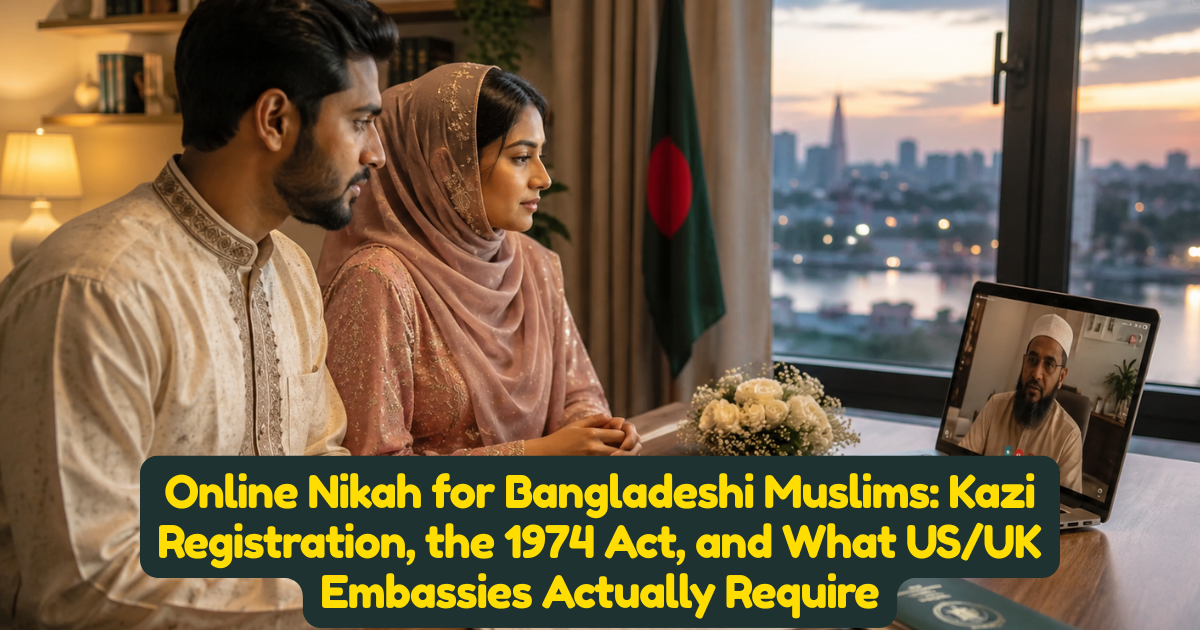
Online Nikah for Bangladeshi Muslims: Kazi Registration, the 1974 Act, and What US/UK Embassies Actually Require
Bangladesh operates one of the most immediate and strictly enforced Nikah registration requirements covered on this site — registration is expected to happen at the moment of the ceremony itself, not weeks later. For Bangladeshi couples and the wider diaspora, understanding exactly how the Kazi system works, and what embassies specifically require afterward, prevents real delays down the line.
The Legal Foundation: The Muslim Marriages and Divorces (Registration) Act, 1974
Bangladesh's system is governed by a single consolidating law. The official text, published on the Bangladesh Ministry of Law's own legislation portal, states plainly that notwithstanding anything contained in any other law, custom, or usage, every marriage solemnized under Muslim law shall be registered in accordance with this Act, with the government granting licences to a limited number of Nikah Registrars — no more than one licensed for any single area — to carry out this function.
Registration "At Once": A Genuinely Strict Standard
This is the detail that sets Bangladesh apart from many of the countries this site has covered. Official guidance published by the U.S. Embassy in Dhaka, drawing directly on the underlying law, confirms that under Section 5(1) of the Muslim Marriage and Divorce Registration Act, 1974, where a marriage is solemnized by the Nikah or marriage registrar himself, he shall register the marriage at once. This is a materially stricter standard than jurisdictions allowing a 30-day or longer window — Bangladesh's law contemplates registration happening essentially simultaneously with the ceremony when the Kazi personally conducts it.
The Kazi: Bangladesh's Licensed Nikah Registrar
Bangladesh's system centres on the Kazi, the licensed official equivalent to Pakistan's Nikah Khawan. Detailed legal guidance confirms that all Muslim marriages must be solemnized and registered by a licensed Nikah Registrar, with minimum two adult Muslim witnesses required and the mahr amount clearly recorded in the Kabinnama (the Bangladeshi term for the Nikah Nama). As with Pakistan's system, this means the officiant conducting an online Nikah for a Bangladeshi couple needs to either hold this specific Kazi licence directly, or ensure the ceremony is properly reported to a licensed Kazi for registration purposes.
What Happens If Registration Was Missed at the Time
Real legal guidance addressing this exact scenario offers genuine reassurance on one point while being clear about the fix required. Detailed commentary confirms that failure to execute the Nikahnama at the time of an earlier marriage does not make the marriage invalid, but the way forward is to complete registration properly now — with the Kazi confirming they hold a valid government-granted licence, filling in the register of marriage, and ensuring registration occurs within the jurisdiction where the marriage was actually solemnized.
The Bangla and English Requirement: A Real, Specific US Embassy Rule
This is a genuinely important, specific detail for diaspora couples pursuing a US spousal visa with a Bangladeshi Nikah. The U.S. Embassy's own official instructions state directly that applicants must obtain the Muslim Marriage Deed, also known as the Nikah Nama, in both Bangla and English versions from the Kazi office that registered the marriage — and both versions must be submitted during the visa interview. This is a real, specific requirement worth planning around well before any visa interview date: couples should confirm with their registering Kazi office that both language versions will be available, rather than discovering the gap at the interview itself.
Special Marriage Act as a Separate Civil Alternative
Bangladesh, like India, maintains a separate civil marriage option distinct from Muslim personal law registration. Detailed guidance confirms the Special Marriage Act, 1872 governs marriages between individuals of different religions or those preferring a civil, non-religious marriage, requiring both parties to be at least 21 years old. For Bangladeshi Muslim couples, this route is generally unnecessary unless the marriage is interfaith or the couple specifically wants a secular civil framework rather than Muslim personal law governance.
Polygamy: The Same Arbitration Council Structure as Pakistan
Bangladesh's 1974 Act operates alongside the same Muslim Family Laws Ordinance framework used in Pakistan, given the two countries' shared legal history — meaning polygamous marriage similarly requires proper procedure through an Arbitration Council before a subsequent marriage can be validly registered, rather than being freely available without oversight.
A Practical Sequence for Bangladeshi and Diaspora Couples
Given how immediate Bangladesh's registration standard actually is, the practical sequence for couples with a Bangladeshi connection should minimise any gap between ceremony and registration: confirm the officiant either holds a Kazi licence directly or has an established relationship with a licensed Kazi who will register the marriage immediately; ensure the Kabinnama properly records the mahr amount and full identifying details; request both Bangla and English versions of the Nikah Nama at the point of registration, particularly where any future visa application is anticipated; and treat any delay in registration as a gap to close as soon as possible rather than indefinitely, given the law's clear expectation of immediate registration.
Frequently Asked Questions
How quickly must a Bangladeshi Nikah be registered? The law specifies registration "at once" when the Kazi personally conducts the ceremony — a notably stricter and faster standard than many other countries' 30-day or longer windows.
Does a delayed Nikah Nama registration invalidate the marriage? No — Bangladeshi legal guidance confirms the marriage itself remains valid even if registration was not completed at the time; the fix is to complete registration properly now.
Do US spousal visa applications require anything beyond the standard Nikah Nama? Yes — the U.S. Embassy in Dhaka specifically requires both Bangla and English versions of the Nikah Nama, obtained from the registering Kazi office, submitted at the visa interview.
Suggested Internal Links
Zainab Butt
Author