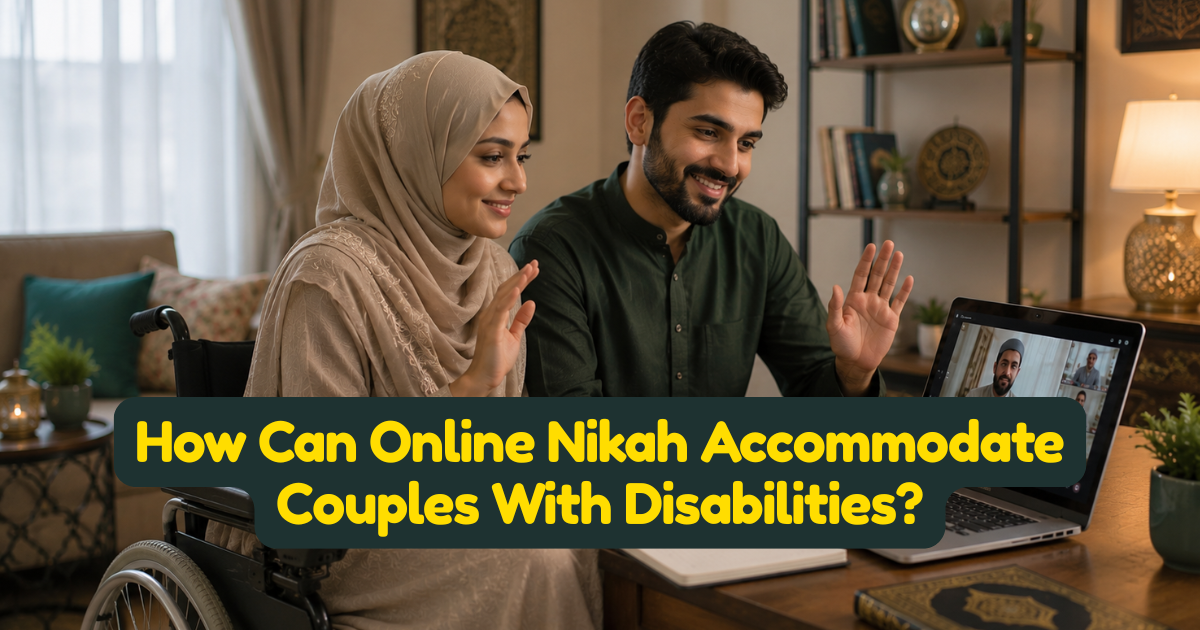
A disability affecting hearing, vision, or mobility has nothing to do with capacity to consent to marriage — what's needed is genuine communication access, and online nikah can accommodate this well with the right preparation.
How Can Online Nikah Accommodate Couples With Disabilities?
It's important to be clear from the outset: a disability affecting hearing, vision, or mobility has nothing to do with a person's capacity to consent to marriage. What matters is making sure communication genuinely reaches everyone involved — the bride, groom, wali, and witnesses — and online nikah can accommodate this well with some thoughtful preparation.
Interpretation for Deaf or Hard-of-Hearing Parties
A detailed guide to incorporating sign language interpretation at ceremonies confirms the core practice: a qualified interpreter should be positioned where they can be clearly seen throughout, with materials — in this case, the ijab and qabul wording, the khutbah, and any other spoken content — provided to them in advance so they're genuinely prepared rather than interpreting unfamiliar content live. For an online ceremony specifically, this means confirming the video platform can display the interpreter clearly alongside the main speakers, not relegated to a small, hard-to-see window.
Established Frameworks for Other Accommodations
Official accommodation standards for civic ceremonies offer a genuinely useful, authoritative framework here. Detailed guidance on accommodations for naturalization oath ceremonies confirms specific approaches that translate well: providing materials in large print or accessible formats for those with low vision, accepting alternative forms of nonverbal communication — such as nodding, blinking, or other clear gestures — for applicants whose physical condition limits other forms of response, and allowing an applicant's own chosen interpreter where one is preferred over an assigned one.
Practical Steps for an Online Nikah
- Ask directly what accommodations are genuinely needed, rather than assuming — the person with the disability is always the best source on what actually helps them.
- Confirm your video platform supports the accommodation you need — multiple simultaneous video feeds for an interpreter, screen reader compatibility for digital documents, or captioning where useful.
- Share the ceremony's content in advance with any interpreter involved, including the specific wording of the offer and acceptance, so they arrive genuinely prepared.
- Confirm understanding directly and respectfully during the ceremony itself — a simple, clear confirmation that the person understood and freely consents, conducted through whatever communication method works for them, satisfies the same consent requirement that applies to everyone.
- Build in extra time, since interpretation and accommodation naturally add some length to the ceremony, and rushing through it works against the goal of genuine, clear communication.
Key Takeaway
Online nikah can genuinely accommodate couples and witnesses with disabilities affecting hearing, vision, or mobility — the underlying consent requirement is identical for everyone, and what changes is simply the communication method used to confirm it clearly. Asking directly what's needed, preparing any interpreter with the ceremony's actual content in advance, and confirming your video platform supports the accommodation are the practical steps that make this work smoothly.