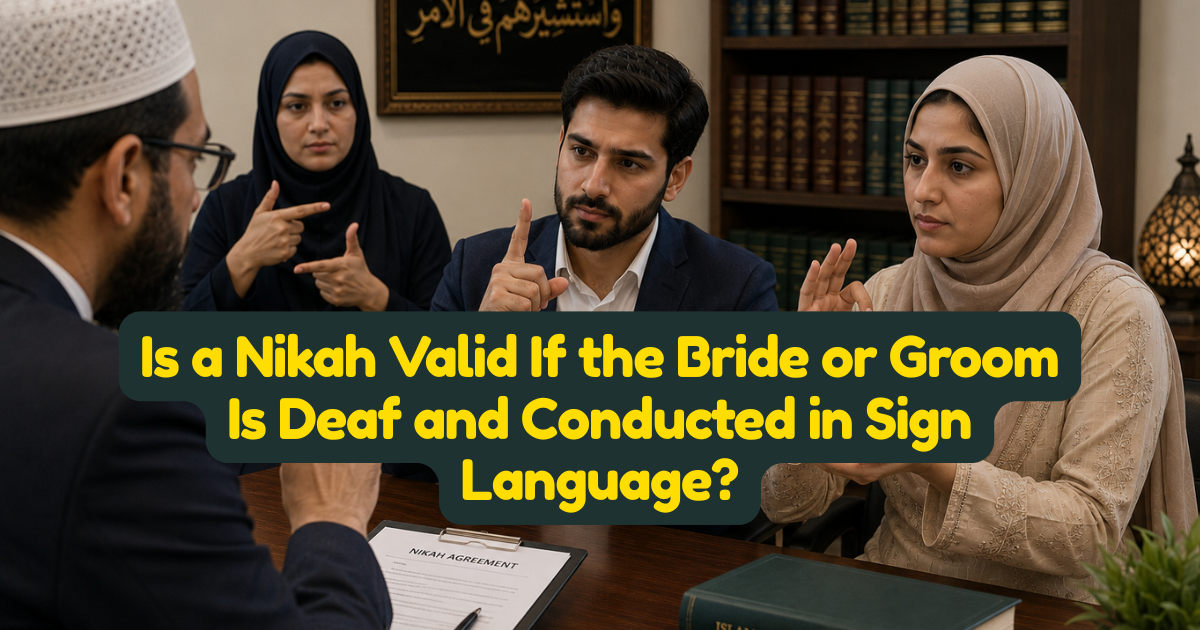
Nikah for Deaf Muslims: Is Sign Language Sufficient for a Valid Marriage?
Classical fiqh texts describe the offer (ijab) and acceptance (qabul) of a nikah in terms of spoken words heard by witnesses. Taken literally, this raises a real concern for deaf Muslims and their families: does a marriage conducted through sign language meet the requirement at all?
The Underlying Requirement Is Clear Communication, Not Specifically Speech
Classical manuals are explicit that the offer and acceptance must be clearly understood by the witnesses — this is the actual legal substance behind the requirement, not the mechanism of spoken sound itself. A widely cited Hanafi fatwa makes this distinction directly: as explained by Daruliftaa.com's ruling on whether signing a marriage certificate alone is sufficient, what invalidates a marriage is the absence of a clear, witnessed declaration of intent — not specifically the absence of audible speech. Where speech is physically impossible, the same principle of unambiguous, witnessed communication has historically been extended to other clear methods of declaration.
Dar al-Ifta Egypt's Direct Ruling on Disability and Marriage
This isn't a theoretical question scholars have avoided. According to investigative reporting by Arab Reporters for Investigative Journalism's coverage of deaf Muslims' marriage rights, Egypt's Dar Al-Ifta confirmed that people with disabilities retain a full right to marry as long as all pillars of the marriage contract are genuinely fulfilled — explicitly rejecting any blanket restriction based on disability alone.
Academic Fiqh Treatment of Marriage Through Writing or Gesture
Contemporary Islamic legal scholarship has examined this question in depth. A peer-reviewed study published through an Indonesian state Islamic university, available via Raden Fatah State Islamic University's journal on pre-marital guidance regulations, specifically addresses the Shafi'i school's treatment of marriage contracted through writing (kitabah) or gesture (isharah) where speech isn't possible, confirming that intent (niyyah) and clearly conveyed acceptance — by whatever genuinely unambiguous means available to the person — satisfy the underlying requirement of ijab and qabul.
What Makes a Sign Language Nikah Religiously Sound
Drawing these threads together, a nikah conducted in sign language is on solid ground when: the wali or his proxy and the groom (or their representatives) both clearly understand the proposal and acceptance through the signing, the witnesses present can attest to having understood the exchange — ideally with the help of a qualified interpreter present specifically to confirm content for the witnesses — and the mahr, consent, and all other pillars are otherwise unambiguously satisfied. A comparative Shia legal source, available through al-Islam.org's code of ethics on the rules relating to marriage and its ceremonies, reinforces the same underlying principle across the broader Islamic legal tradition: mutual, clear understanding of the marriage contract is the substantive requirement, regardless of the means by which that understanding is conveyed.
The Practical Recommendation
For deaf or hard-of-hearing Muslims, the safest approach is to involve a certified sign language interpreter as part of the ceremony specifically to confirm, out loud, to the hearing witnesses that the offer and acceptance occurred and were understood — creating an unambiguous record that satisfies even the most cautious reading of the classical requirement.
Admin User
Author