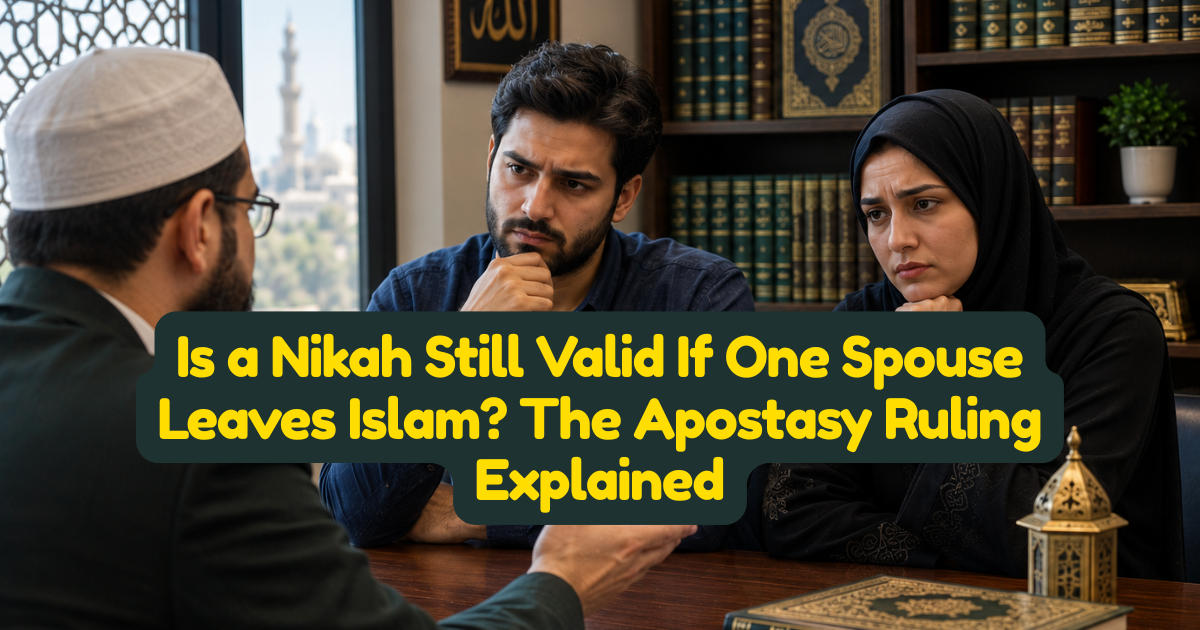
What Happens to a Nikah When a Spouse Leaves Islam?
This is one of the more painful questions a Muslim spouse can face — and one where the simplified online answers ("the marriage is automatically void") skip over genuinely important distinctions that determine whether reconciliation is even possible.
The Unanimous Core: Apostasy Dissolves the Marriage Bond
All four Sunni schools agree that apostasy by either spouse severs the marriage. According to a comparative academic study published in al-Afkar Journal for Islamic Studies' analysis of apostasy and marriage dissolution, the Hanafi and Maliki schools hold this dissolution to be immediate, while the Shafi'i and Hanbali schools tie it to the completion of the wife's iddah (waiting period) — a meaningful difference, because it determines whether reconciliation without a new contract remains possible.
Before Consummation vs. After: A Different Outcome
If apostasy occurs before the marriage is consummated, the dissolution is immediate across all schools, with no waiting period involved. If it occurs after consummation, the schools split on timing as described above — and on the financial consequence. According to a classical fiqh compilation reviewed in iPleaders' legal analysis of apostasy's effect on Muslim marriage law, if the husband is the apostate, the wife retains her full mahr entitlement; the Hanbali school in particular holds that a wife who apostatizes before consummation forfeits her right to any portion of it.
What Happens If the Spouse Returns to Islam
This is the part most simplified explanations skip entirely. If the apostate spouse returns to Islam before the iddah concludes, the majority view holds that the original marriage contract remains valid and intact — no new nikah, new mahr, or new witnesses are required. If the return happens after the iddah has ended, the majority of jurists require a fresh marriage contract with new mahr and witnesses before the couple can resume the marriage, since the original bond is considered to have lapsed. A detailed, pastoral explanation of this exact scenario — including the specific Hanafi citation from Radd al-Muhtar establishing that maintenance continues during the waiting period — is set out in this academic legal journal analysis from Black n' White Journal's comparative review of apostasy's legal consequences under Muslim law.
A Note on Disputed Modern Reinterpretation
It's worth noting that not every contemporary scholar accepts the classical apostasy framework as applicable in its original, state-enforced form today. Modern reformist scholarship — represented in detailed exchanges on platforms such as Ask Ghamidi's scholarly discussion forum — argues that the harshest classical apostasy rulings were addressed to a specific historical audience and context, and that the Qur'an itself is largely silent on the precise question of one spouse's unilateral faith change within an existing marriage. This is a genuine point of contemporary scholarly disagreement, not a settled matter, and families navigating it should consult a knowledgeable local scholar rather than relying on either extreme online position.
The Practical Reality for Families Facing This
Whatever timing applies, the immediate priority in any real situation is rarely the legal technicality — it's the wellbeing of any children involved and the emotional weight on both spouses. Couples and families navigating this should seek guidance from a local, qualified scholar who can weigh the specific facts, rather than applying a generic online ruling to a deeply personal situation.
Admin User
Author