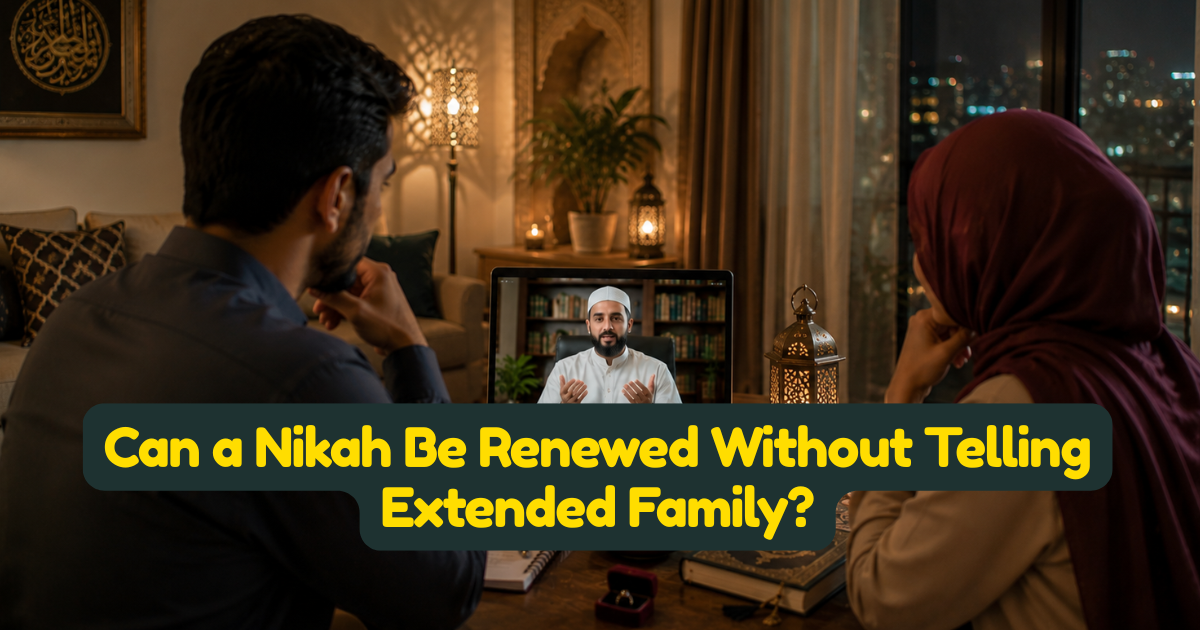
Can a Nikah Be Renewed Without Telling Extended Family?
Family involvement in a Muslim marriage is often assumed to be automatic — parents at the ceremony, relatives spreading the news, a community celebration. But real life is messier than that assumption. Some couples renewing their nikah are doing so precisely to get away from family interference: overbearing in-laws who insert themselves into every decision, relatives who never accepted the marriage in the first place, or simply a couple who values privacy. The question they bring to us is consistent: can we renew our nikah without extended family knowing?
The Key Distinction: Private Versus Secret
Islamic law does not require a wedding announcement to extended family, distant relatives, or the wider community as a precondition of validity. What it does require is the absence of deliberate concealment from everyone — what scholars term nikah al-sirr, a fully secret marriage hidden even from those who would normally be expected to know, such as close witnesses and, in many cases, a wali. A renewal attended by two qualified witnesses, conducted openly between the spouses even if no announcement is made beyond that circle, does not fall into the category of secrecy that classical jurists caution against. This distinction is explained clearly in research published by the Yaqeen Institute for Islamic Research, which addresses common misconceptions around marriage announcement requirements.
Why Couples Choose a Quiet Renewal
- Extended family conflict over the original marriage, particularly in cases of interfaith background, prior family disapproval, or cultural disagreement.
- A desire to avoid a second round of wedding-related financial or social pressure that often comes with announcing any marriage event.
- Protecting a vulnerable spouse — for example, a convert whose family relationship with their birth family is strained — from unwanted scrutiny.
- Simply valuing a quiet, personal moment over a public one, particularly for couples who already had a large original wedding and see the renewal as private and reflective.
What Cannot Be Skipped, Regardless of Privacy Preference
Privacy from extended family is not the same as bypassing the conditions of the contract itself. Two qualified witnesses must still be present and attentive during the live ijab and qabul. A wali must still be properly involved where the wife's madhab requires it — and notably, a wali is very rarely "extended family" in the sense of distant relatives; it is typically the father or another specific close relative defined by fiqh, so involving the wali does not mean involving the wider family circle. Mahr must still be clearly stated. None of these core requirements are softened simply because the couple wants a smaller, quieter ceremony.
Where This Gets Legally and Religiously Risky
The risk arises when "privacy" tips into actual concealment of the marriage's existence from the wali, from witnesses, or — in jurisdictions where civil registration matters — from any authority that later needs proof the marriage occurred. A renewal performed with no witnesses, no documentation, and an explicit intention to keep even the fact of marriage hidden from everyone crosses into the territory scholars have historically discouraged, partly because it leaves a wife in particular without protection if disputes arise later. Family law commentary referenced by the Guardian's coverage of Muslim marriage practices in the UK has highlighted how undocumented, fully secret religious marriages disproportionately disadvantage women when a relationship later breaks down, since there is no clear record to rely on.
Choosing Witnesses Outside the Family Circle
For couples who want privacy from relatives specifically, the practical solution is straightforward: select witnesses who are not part of the family network causing friction. Trusted friends, community members, or witnesses arranged through a certified online nikah service can fulfill the witness requirement fully without involving the relatives the couple is trying to keep distance from. This preserves both the validity of the contract and the couple's desired privacy.
Documentation Still Matters, Even for a Private Renewal
A private ceremony should not mean an undocumented one. Issuing a proper certificate — even if no announcement is made beyond the witnesses and officiant — protects the couple if the marriage's status is ever questioned later, whether for inheritance, a legal dispute, or future civil registration needs referenced in frameworks like the UK government's marriage guidance. Privacy from extended family and proper documentation are not in conflict with each other.
What to Say If Family Eventually Asks
Many couples worry less about the religious permissibility and more about the social awkwardness of family finding out later. There is no Islamic obligation to fabricate a story or actively deceive family members who directly ask whether a renewal took place — avoiding an unsolicited announcement is different from outright denial if asked. Couples uncomfortable navigating this distinction often find it helpful to agree, before the ceremony, on a simple, honest explanation they're both comfortable giving if the topic comes up.
How InstantNikah.com Supports Privacy-Conscious Couples
Our online ceremonies are conducted with full discretion — witnesses can be arranged independently of either spouse's family network, no public announcement is made on our end, and certificates are issued directly and privately to the couple. What we do not compromise on, privacy or not, is the presence of qualified witnesses and a properly documented contract, since those protections exist for the couple's own benefit.
Admin User
Author