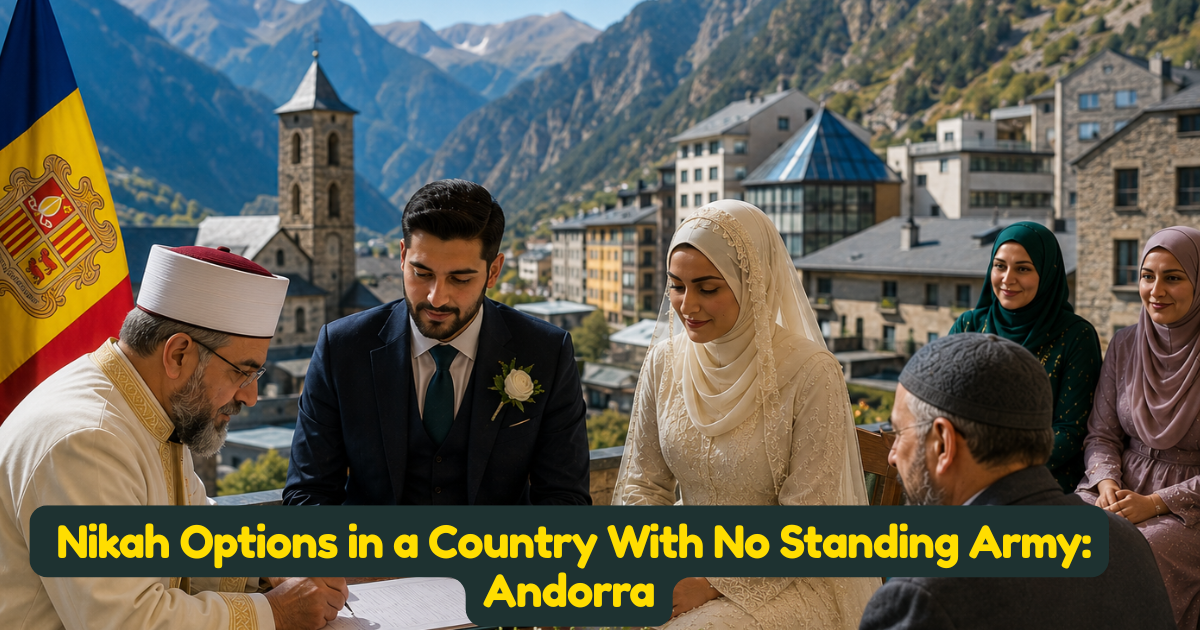
Nikah Options in a Country With No Standing Army: Andorra
Andorra is one of Europe's smallest and most unusual states — a co-principality nominally ruled jointly by the President of France and the Bishop of Urgell in Spain, with no standing army of its own, and a legal tradition that draws directly from both larger neighbors it sits between.
A Legal System Borrowed From Two Directions
Andorra's civil law has historically drawn heavily from both French and Spanish legal traditions, a reflection of its literal position between the two countries and its unusual joint-sovereignty structure. This dual influence shows up in how the country handles marriage: Andorra recognizes civil marriage as the legally binding form, administered through its own Ministry of Justice and Interior, with religious ceremonies — predominantly Catholic given the country's overwhelming Catholic majority — held separately or in coordination with, but not as a substitute for, civil registration.
A Small Population, Without Dedicated Islamic Infrastructure
Andorra's Muslim population is genuinely small, made up largely of expatriate workers and residents drawn by the country's tourism, finance, and retail-driven economy, alongside its well-known tax advantages. The country has no dedicated, purpose-built mosque of its own — Muslims living in or connected to Andorra generally rely on informal prayer arrangements or travel to nearby French or Spanish cities, such as Toulouse or Barcelona, for larger community gatherings and religious occasions.
What This Means for Marriage Planning
Given the absence of formal Islamic religious infrastructure, a couple planning a nikah with any connection to Andorra faces a genuinely practical reality: there's no local mosque or established Islamic authority to coordinate through the way there is in most of the countries covered on this site. The clearest path is to complete Andorra's own civil marriage process for legal recognition, and arrange the religious nikah independently, drawing on a properly qualified officiant regardless of physical location.
Where an Online Nikah Fits
This is precisely the kind of situation an online nikah serves well: a couple connected to Andorra can access a properly qualified officiant and a fully documented, recorded religious ceremony without needing to travel to Toulouse, Barcelona, or elsewhere simply to find one. The underlying religious requirements remain the same as anywhere else: a clear offer and acceptance, the wali's role, two qualifying witnesses, and an agreed, documented mahr.
Who This Tends to Fit in Andorra
- Expatriate workers and residents without easy access to organized Islamic religious infrastructure.
- Couples who've completed Andorra's civil marriage process and want a properly documented religious ceremony to follow.
- Families with ties to nearby French or Spanish Muslim communities.
- Couples who want a documented, recorded ceremony without needing to travel across the border to arrange one.
Frequently Asked Questions
Is there a mosque in Andorra?
No — Andorra has no dedicated, purpose-built mosque; Muslims connected to the country generally rely on informal arrangements or travel to nearby France or Spain.
Does a nikah carry legal effect in Andorra?
No — only civil marriage, administered through Andorra's Ministry of Justice and Interior, is legally recognized.
Can family across France, Spain, or further afield join an online nikah for an Andorra-connected couple?
Yes — this is a genuinely practical advantage given the country's limited local religious infrastructure.
Authority References Used (Live & Clickable)
- Govern d'Andorra (Ministry of Justice and Interior) — official Andorran government resource on civil marriage procedure
Suggested Internal Links
- Nikah Without a Mosque: Europe's Microstates
- Online Nikah in Paris
- Nikah With Legal Force in Madrid
- Documents Needed Before Booking an Online Nikah
- Book Your Online Nikah
Why This Article Is Different
This page treats Andorra's genuinely unusual dual-sovereignty legal structure as central to understanding its marriage law, rather than skipping the country entirely the way most nikah content would, given how small and easy to overlook its Muslim population is.
Zainab Butt
Author