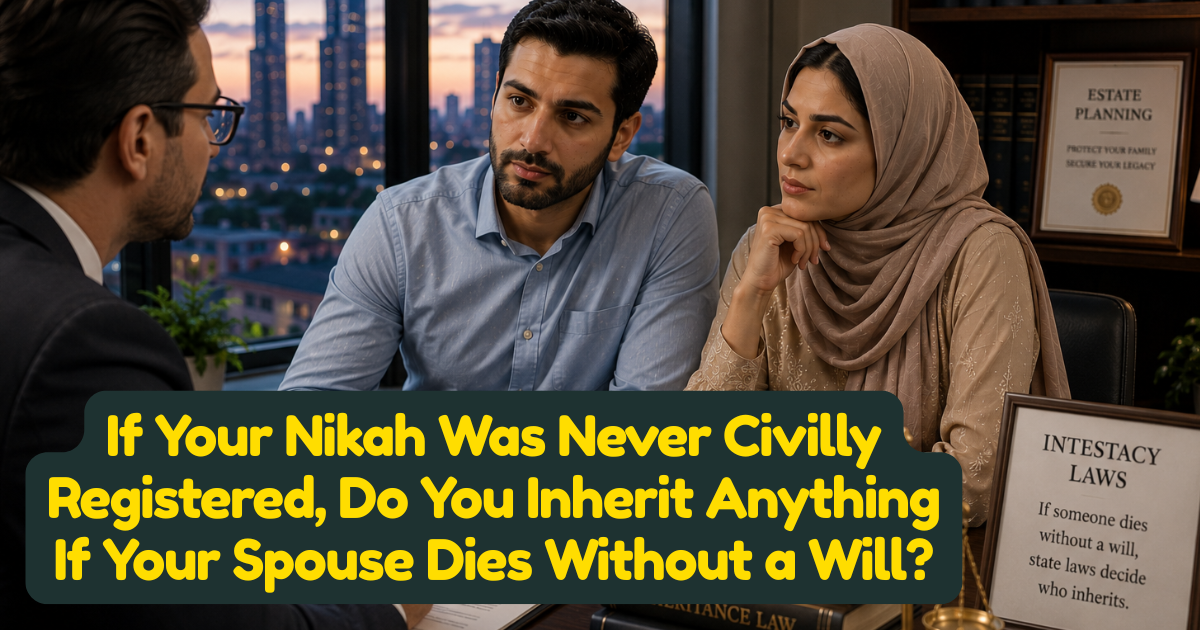
Intestate succession laws hand a deceased person's estate to their "surviving spouse" first — but courts define that term by civil law, not by an Islamic ceremony. Here's what an unregistered nikah actually leaves you with.
Dying Without a Will: Why "Surviving Spouse" Doesn't Automatically Include a Nikah-Only Partner
When someone dies without a will, state intestate succession law decides who inherits — and in almost every case, the surviving spouse inherits first and most. The entire outcome turns on one definitional question: does the law consider you a "spouse" at all?
The Default Rule Favors Spouses Heavily — If You Qualify
According to Nolo's detailed guide to intestate succession, to qualify as a surviving spouse for inheritance purposes, "the survivor must have been legally married to the deceased person at the time of death" — a requirement that, outside the small number of common-law marriage states, simply isn't satisfied by a religious ceremony alone.
What This Means If the Nikah Was Never Registered
Without civil registration, a nikah-only spouse generally has no automatic intestate inheritance rights at all in the eyes of the civil court — regardless of the length, sincerity, or religious validity of the marriage. According to Trust & Will's overview of unmarried couples' rights when a partner dies, intestate succession follows bloodline, not partnership — meaning the deceased's estate typically passes to their parents, children, or siblings instead, with the surviving partner receiving nothing unless specifically named in a will or trust.
How Estates Actually Get Distributed Without a Will
A practical breakdown from Justia's estate planning legal center on intestate succession shows the typical hierarchy: spouse and children inherit first, followed by parents, then siblings, with each state setting its own exact formula for how the estate is divided when multiple categories of heirs survive — but in every version of this formula, "spouse" is defined by civil marital status, not religious ceremony.
The Islamic Inheritance Conflict This Creates
This produces a genuinely painful gap for Muslim couples: Islamic inheritance law (mirath) clearly entitles a wife to a defined share of her husband's estate as a matter of religious obligation, but if the marriage was never civilly registered, the civil court distributing the actual estate may never recognize her as an heir at all — leaving the religious entitlement legally unenforceable against the assets that matter most: bank accounts, property, and retirement funds governed by state law.
The Two Protections That Close This Gap
There are two independent fixes, and ideally both should be used: civilly register the marriage so the surviving spouse automatically qualifies under intestate succession law, and separately draft a will that names the spouse explicitly and reflects the Islamic inheritance shares the couple wants honored. A will protects you even if civil registration is delayed; civil registration protects you even if a will is somehow lost, contested, or never finalized — together, they remove this entire category of risk.