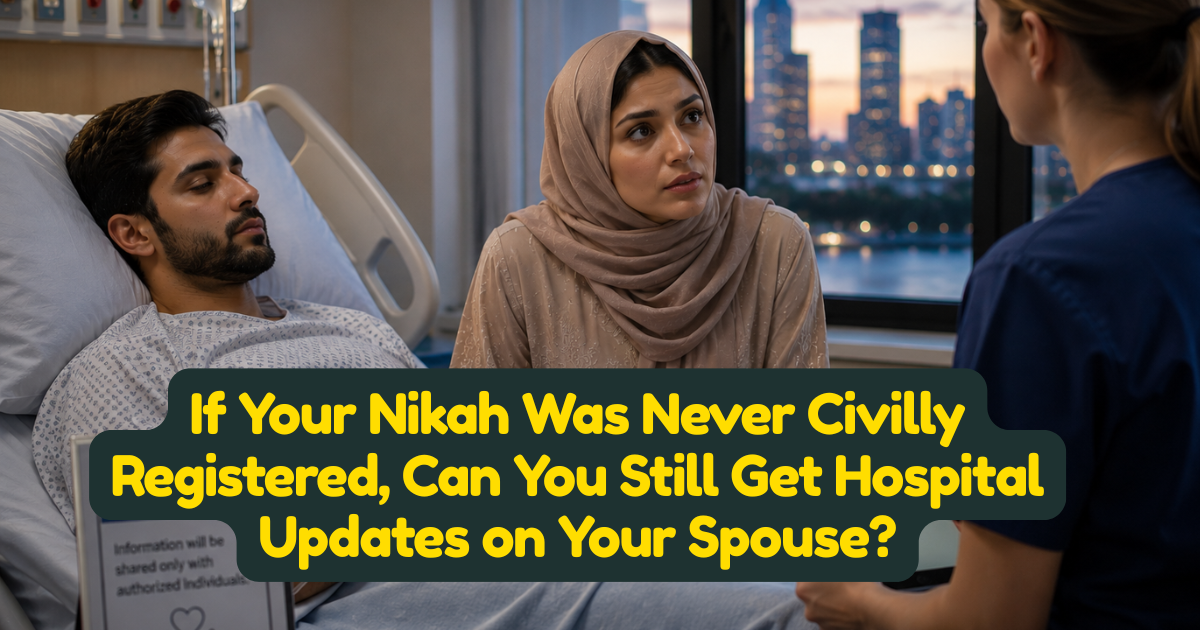
HIPAA doesn't actually require you to be "legally married" to get hospital updates on a loved one — but it does require something. Here's exactly what hospitals are allowed to share with a nikah-only spouse, and what they're not.
Hospital Visits and Medical Updates: What a Nikah-Only Spouse Can Actually Access
A frightening but common scenario: a spouse is hospitalized, and the nikah-only partner waiting outside isn't sure whether hospital staff will even speak to them. The actual rule under US federal privacy law is more flexible than most people assume — but it has real limits.
HIPAA Doesn't Require Legal Marriage for Basic Communication
According to the U.S. Department of Health and Human Services' official guidance on HIPAA and unmarried partners, the Privacy Rule explicitly permits providers to share information with a patient's "family member, other relative, close personal friend, or any other person identified by the individual" — using their professional judgment, without verifying legal relationship status, as long as the patient hasn't objected and the information is relevant to that person's involvement in the patient's care.
The Real Line: Personal Representative Status
Where it gets more restrictive is full access — reviewing complete medical records, making treatment decisions, or being treated legally as if you were the patient. According to HHS's detailed guidance document on HIPAA and marriage, this elevated status — called a "personal representative" — is governed by state law on who has health care decision-making authority, and a legally married spouse is automatically granted it where state law provides for it. A nikah-only spouse, without civil registration, generally does not qualify for this automatic status.
Hospital Visitation Rights Are Actually a Separate, Broader Protection
Visitation itself is covered by different rules entirely, and they're more generous than people expect. According to a practical overview from HealthSherpa's blog on hospital visitation rights for family members and partners, federal regulations since 2011 require any hospital accepting Medicare and Medicaid to let patients designate their own visitors — meaning a conscious patient can name their nikah-only spouse as a visitor regardless of legal marital status, and hospitals are required to honor it.
The Genuine Gap: When the Patient Cannot Communicate
The real vulnerability appears when the patient becomes incapacitated and can no longer personally state who they want involved. At that point, without a documented healthcare power of attorney or advance directive naming the nikah-only spouse, decision-making authority defaults to whoever state law recognizes — typically next of kin by blood or a legally married spouse, not a religious-only partner, however long and genuine the relationship.
The Document That Closes This Gap Completely
A signed healthcare power of attorney and HIPAA authorization form, naming your spouse specifically, removes this uncertainty entirely — granting both information access and decision-making authority regardless of your marriage's civil registration status. This costs little, takes an afternoon to prepare, and should be treated as a standard part of marriage paperwork for any couple whose nikah has not yet been civilly registered.