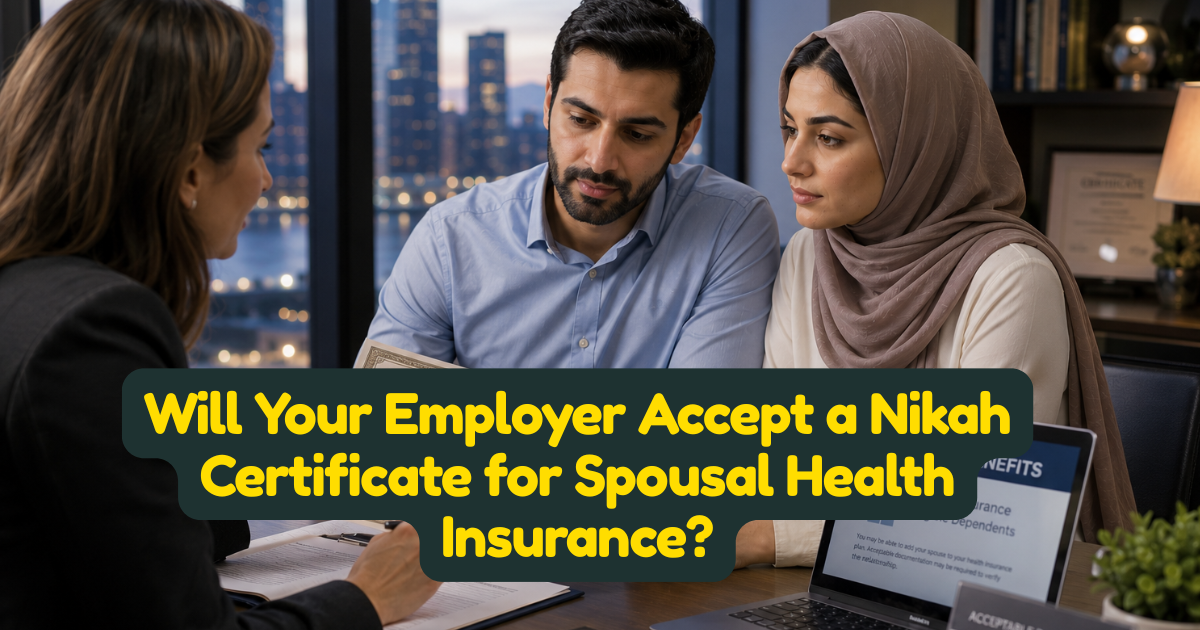
Adding a spouse to employer health insurance has a short enrollment window and specific documentation rules — and an unregistered nikah can quietly cost you that window entirely.
Getting Your Spouse on Your Health Plan: What a Nikah Certificate Does and Doesn't Prove
Marriage is one of the few events that lets you change employer health insurance outside the annual open enrollment window — but only if you can document it quickly, and only if what you're documenting is recognized as a legal marriage.
The "Qualifying Life Event" Window Is Short
Most employer plans only allow mid-year changes following a "qualifying life event," and marriage is one of them. According to LawInfo's overview of marriage and spousal health insurance coverage, federal law requires employer plans to provide at least 30 days from the marriage date to enroll a spouse — and most insurers require a copy of the marriage certificate to process it.
How a Federal Agency Defines What "Counts" as Proof
A useful, highly detailed model comes from the federal government's own employee health benefits program. According to the U.S. Office of Personnel Management's family member eligibility fact sheet, a legally married spouse is verified with an official marriage certificate, and if the marriage has lasted 12 months or more, additional proof — such as a joint tax return or evidence of combined finances — may also be required to confirm the marriage is ongoing, not just that it occurred.
Why Employers Are Increasingly Strict About This
A detailed legal analysis prepared for employers by Proskauer's guidance on verifying healthcare eligibility explains that employers now routinely audit dependent eligibility specifically to avoid the cost of covering ineligible dependents, and require documented proof of marriage and family relationships before extending coverage — a trend that has only intensified industry-wide, not relaxed.
Where a Nikah-Only Marriage Creates Real Risk
A nikah certificate, on its own, documents a religious ceremony — it does not, by itself, establish a legally recognized marriage in most jurisdictions unless it was also civilly registered. If your employer or insurer specifically requires proof of legal marriage (the typical standard for spousal coverage), an unregistered nikah may be rejected as insufficient, leaving a spouse without coverage and the qualifying-event enrollment window closed before the gap is even noticed.
The Fix Is Simple, and Time-Sensitive
Register your marriage civilly as close to the nikah date as your jurisdiction allows, and submit the resulting marriage certificate to HR within the qualifying-event window — typically 30 days. If your nikah and civil registration happen on different dates, use the civil registration date as your enrollment trigger, and don't assume the religious ceremony date alone starts the clock with your specific employer's plan.