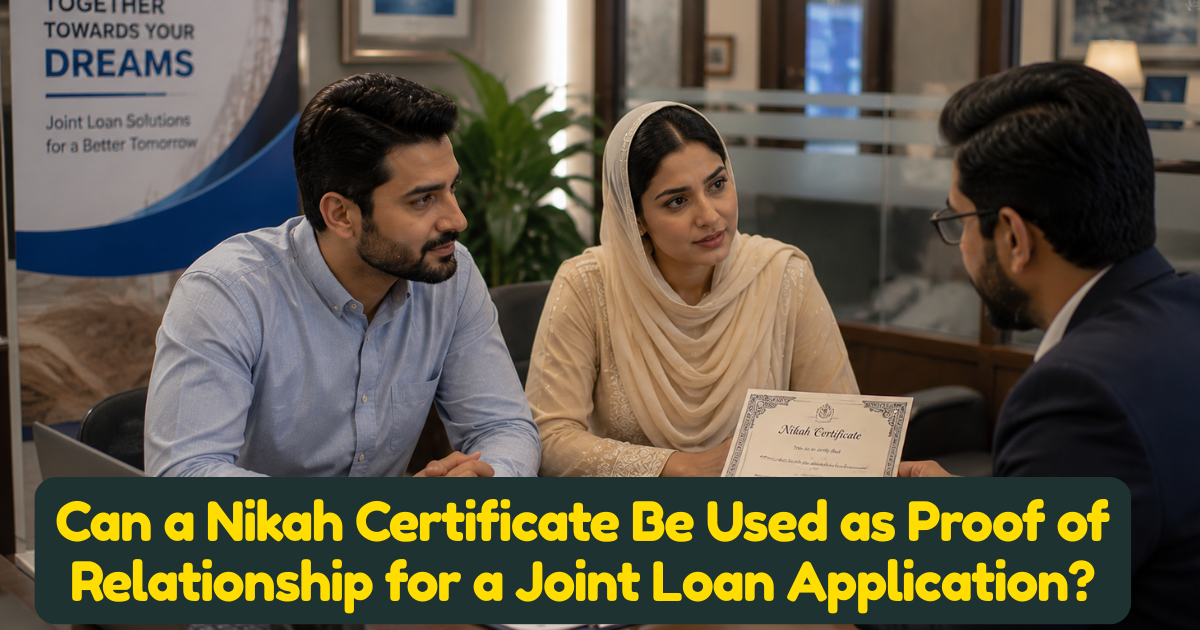
Can a Nikah Certificate Be Used as Proof of Relationship for a Joint Loan Application?
Couples ready to apply for a joint mortgage, personal loan, or other significant financial product together often assume that presenting their nikah certificate settles the relationship-proof portion of the application. Whether this holds up depends heavily on the specific lender and, critically, on whether that nikah certificate also carries civil legal recognition in the couple's jurisdiction — a distinction that matters a great deal here.
What Lenders Actually Want to Verify
When a lender asks for proof of relationship as part of a joint loan or mortgage application, they're generally trying to confirm the legal basis for the joint application — that both applicants have a recognized legal relationship (commonly marriage) that supports jointly assuming the financial obligation, and sometimes to understand liability and inheritance implications relevant to the loan structure. This is fundamentally a civil, legal question, not a religious one.
Why a Religious-Only Nikah Certificate Often Isn't Sufficient Alone
In jurisdictions where nikah and civil marriage are separate processes, as covered extensively throughout our country guides, a lender is typically looking for civil marriage documentation specifically — the government-recognized marriage certificate — rather than, or in addition to, a religious nikah certificate. This is because the lender's legal and risk assessment framework is built around civilly recognized relationships, which carry specific legal implications for jointly held debt that a religious-only marriage, however meaningful, doesn't automatically establish in the eyes of civil and financial law.
When Your Nikah Certificate Does Satisfy This Requirement
Where your nikah was performed by an officiant registered as an authorized civil marriage officer, or in a jurisdiction where religious and civil marriage are unified into a single process, your nikah certificate functions as your complete legal marriage record and should satisfy a lender's relationship-proof requirement exactly as any other legally recognized marriage certificate would.
What to Do If You Only Have a Religious Certificate
Couples who have completed their nikah but haven't yet pursued separate civil registration in a jurisdiction that requires it should generally complete that civil registration process before or alongside applying for a joint loan requiring proof of marriage, since most mainstream lenders will specifically request the civil marriage certificate rather than accepting a religious-only document as sufficient legal proof of the relationship.
Alternative Documentation Some Lenders May Accept
Depending on the lender and jurisdiction, some may accept alternative proof of relationship for joint applications where a couple isn't civilly married — such as evidence of a shared address over a sustained period, joint utility bills, or other documentation establishing cohabitation and financial interdependence — though this varies enormously and is generally a less straightforward path than simply providing standard civil marriage documentation where that's available.
Why This Matters More for Larger Financial Commitments
The stakes around this documentation distinction increase significantly with the size and legal weight of the financial commitment — a joint mortgage, in particular, typically involves careful legal scrutiny of the applicants' relationship and legal standing, given the long-term, significant nature of the debt and property ownership implications involved, making proper civil documentation especially important for this kind of application specifically.
Discussing This With Your Specific Lender Directly
Rather than assuming what documentation a specific lender will accept, the most reliable approach is contacting the lender directly, early in the application process, to confirm exactly what proof of relationship they require and whether your specific documentation situation — nikah certificate alone, nikah plus civil registration, or another combination — meets their standards before investing significant time in a full application.
How This Connects to the Broader Certificate-Type Confusion
This scenario is a direct, practical application of the broader distinction covered in our article comparing nikah certificates and marriage licenses — lenders, like most secular institutions requiring formal legal proof of marital status, are generally operating within the civil documentation framework rather than the religious one, reinforcing why understanding this distinction matters well beyond just employer or government contexts.
Preparing Documentation Before You Need It
Couples anticipating a joint loan or mortgage application in their future are well served by ensuring their civil marriage registration, where applicable in their jurisdiction, is completed well ahead of the actual application process — this avoids delays and complications that arise from scrambling to complete civil registration under the time pressure of an active loan application timeline.
How InstantNikah.com Helps Couples Prepare for This Scenario
During consultation, we clearly explain whether the certificate we issue satisfies civil registration in the couple's specific country or whether separate civil documentation will be needed for purposes like joint financial applications, helping couples plan ahead rather than discovering a documentation gap only once they're already in the middle of applying for a loan or mortgage together.
Admin User
Author