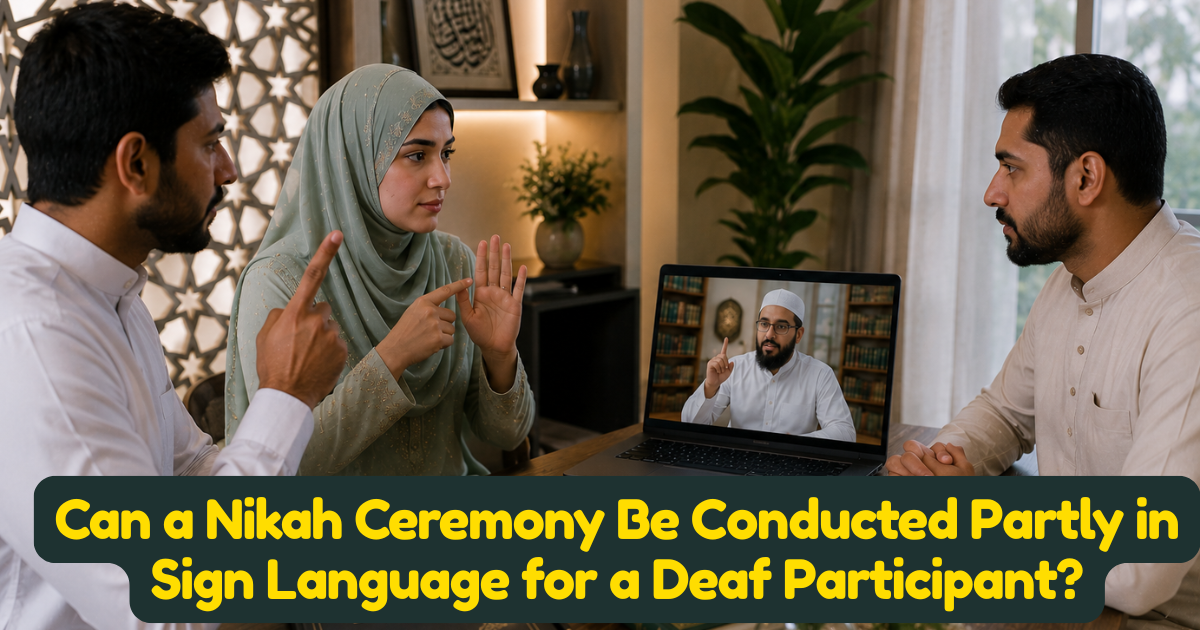
Can a Nikah Ceremony Be Conducted Partly in Sign Language for a Deaf Participant?
A deaf or hard-of-hearing spouse, witness, or wali should never have to settle for partial understanding or diminished participation in what is, for anyone, a significant and personal moment. Islamic law's emphasis on clear, genuine consent and understanding makes proper accommodation not just a courtesy but a religious necessity — and sign language interpretation is a fully legitimate way to achieve this in an online nikah setting.
Why Genuine Understanding Matters More Than the Communication Method
As with the language-barrier scenarios discussed elsewhere on our site, what matters religiously is not the specific medium through which understanding is achieved, but that each participant genuinely comprehends what is being said and communicated — the offer, the acceptance, the mahr terms, and any conditions attached to the contract. Sign language is simply another legitimate language through which this understanding can be reliably conveyed.
Incorporating a Qualified Sign Language Interpreter
For a deaf spouse, witness, or wali, arranging a qualified sign language interpreter to be present on the video call — visible clearly alongside the officiant — allows real-time interpretation of the ceremony as it unfolds, mirroring how spoken-language interpretation works for couples navigating a language barrier. The interpreter's role is to ensure full comprehension, not to alter the substance of what's being communicated.
Confirming the Deaf Participant's Own Consent Clearly
For a deaf spouse specifically, their acceptance (qabul) needs to be clearly conveyed and understood by the officiant and witnesses — whether through sign language interpreted aloud by the interpreter, written confirmation, or another clear method the spouse is comfortable with. What matters is that their consent is unambiguous, not that it takes any single specific form.
Witness Considerations When a Deaf Person Serves as a Witness
A deaf individual can serve as a valid witness, since the core requirement is the capacity to observe and later testify to what occurred — sign language interpretation allows a deaf witness to fully understand and later confirm the exchange, satisfying the witnessing function just as effectively as for a hearing witness following the ceremony through spoken language.
Video Call Setup for Effective Sign Language Interpretation
Practically, this requires some setup consideration: ensuring the interpreter is clearly visible on screen throughout (not just during specific segments), good lighting and camera positioning so hand movements and facial expressions are clear, and, where possible, a screen layout that lets the deaf participant see both the interpreter and the officiant or other key participants simultaneously.
Finding a Qualified Interpreter Familiar With Religious Terminology
As with spoken-language interpretation, an interpreter familiar with Islamic marriage terminology — mahr, wali, ijab and qabul — will convey the ceremony's content more accurately than a general interpreter encountering these concepts for the first time. Couples should ask their officiant or service for help identifying a qualified interpreter with this specific familiarity where possible.
Written Documentation for Full Accessibility
Following the ceremony, providing the nikah certificate and any related documentation in written form the deaf participant can independently review — rather than assuming interpreted spoken content was fully retained — ensures ongoing accessibility to the marriage's terms and documentation, not just accessibility during the ceremony itself.
How InstantNikah.com Supports Deaf and Hard-of-Hearing Participants
We arrange qualified sign language interpretation for any ceremony involving a deaf spouse, witness, or wali, structuring the video call to ensure full, genuine participation and clear confirmation of consent — treating accessibility as an essential part of conducting a properly valid and meaningful ceremony, not an afterthought.
Admin User
Author