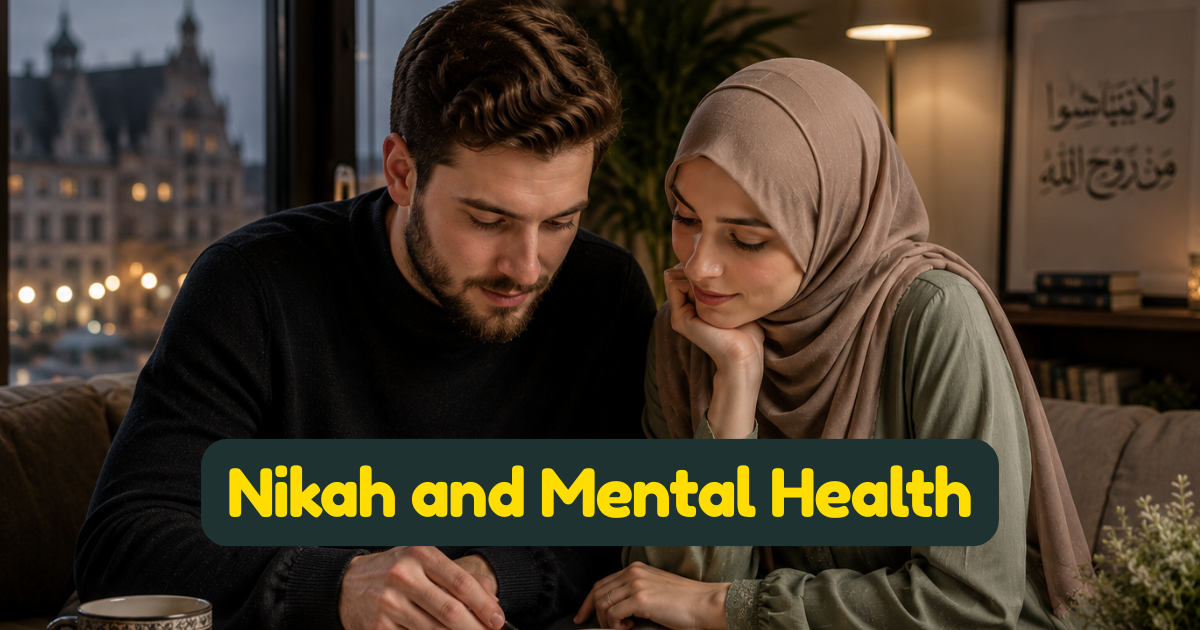
Nikah and Mental Health — What Islam Says About Marrying Someone With Anxiety, Depression, or Trauma
It is one of the conversations that almost never happens before nikah — and one of the ones that most needs to. Two people meet, they find compatibility, they make istikhara, their families approve or are persuaded, and the ceremony is arranged. Somewhere in that process, one or both of them is quietly carrying something: a history of depression that they manage on their own, an anxiety disorder that affects how they function in close relationships, a past trauma that surfaces in ways they have never fully explained to anyone.
And then marriage happens — and the person their spouse thought they were marrying turns out to be more complicated than the pre-nikah meetings revealed. Not dishonest, necessarily. Not bad. Simply carrying something that was never brought into the conversation.
Mental health in the context of Islamic marriage is a topic that sits at the intersection of several things Muslims find difficult to discuss openly: illness, vulnerability, stigma, the fear of being rejected, and uncertainty about what Islamic obligation actually requires. This article addresses all of those dimensions — what Islam says about mental health conditions themselves, what disclosure obligations exist in nikah, what the prophetic model of care within marriage looks like, and how couples can approach this dimension of pre-nikah preparation with the honesty it deserves.
---First: What Islam Actually Says About Mental Health
Before addressing mental health in the context of nikah specifically, it is worth establishing the Islamic framework for mental health conditions generally — because much of the stigma that prevents honest pre-nikah conversations flows from a misunderstanding of where Islam actually stands on this.
Mental Illness in Islamic Thought Is Not a Spiritual Failure
The Quran recognizes that human beings experience states of distress, grief, fear, and despair. The Prophet Ibrahim (peace be upon him) expressed profound anguish. The Prophet Yunus (peace be upon him) cried out from darkness. The Prophet Ayyub (peace be upon him) endured sustained affliction — physical and psychological — over years, and his patience is held up not as the absence of suffering but as the endurance of it. These are not figures who had weak faith. They are among the greatest of the Prophets.
The Prophet Muhammad ﷺ himself experienced grief so profound after the death of Khadijah and Abu Talib that the year is recorded in Islamic history as the Year of Grief — Aam al-Huzn. He ﷺ wept. He ﷺ experienced fear during the initial revelation that was so intense Khadijah wrapped him in a cloak. He ﷺ faced periods of spiritual difficulty that the Quran acknowledges directly.
None of this is presented in the Islamic tradition as weakness or as evidence of distance from Allah. It is presented as the reality of human experience — and the prophetic response to it models seeking comfort, speaking about distress to those who can help, taking practical steps alongside spiritual ones, and continuing to place trust in Allah through difficulty rather than pretending the difficulty does not exist.
The Prophetic Recognition of Psychological States
The Prophet ﷺ acknowledged anxiety, sadness, grief, and emotional states in his duas — his supplications. The dua for anxiety and distress is among the most established in the Sunnah: "O Allah, I am Your servant, the son of Your servant, the son of Your maidservant. My forelock is in Your hand. Your command over me is forever executed and Your decree over me is just. I ask You by every name belonging to You which You have named Yourself with, or revealed in Your Book, or You taught to any of Your creation, or You have preserved in the knowledge of the Unseen with You, that You make the Quran the spring of my heart and the light of my chest, and a departure for my sorrow and a release for my anxiety." (Ahmad, authenticated).
The existence of this dua — comprehensive, emotionally specific, addressing sorrow and anxiety by name — is itself an Islamic acknowledgment that these states are real, that they affect believers, and that seeking relief from them is not weakness but appropriate response.
Seeking Treatment Is Islamic
The Prophet ﷺ said: "Make use of medical treatment, for Allah has not made a disease without appointing a remedy for it." (Abu Dawud, authenticated). The scholars apply this principle to all illness — physical and psychological. Seeking therapy, counselling, psychiatric treatment, or medication for a mental health condition is not un-Islamic. It is the application of a prophetic instruction to use the means Allah has made available for healing.
A Muslim who manages depression with therapy and medication while maintaining their salah and their relationship with Allah is not choosing medicine over deen. They are combining both — as the prophetic model of seeking treatment alongside supplication instructs.
This matters for the nikah conversation because much of the resistance to discussing mental health before marriage comes from the assumption — sometimes implicit, sometimes explicit — that having a mental health condition means being spiritually deficient, or that a person who truly relied on Allah would not need treatment. This assumption has no Islamic basis and has caused significant harm to Muslim individuals and Muslim marriages.
---The Disclosure Question: What Does Islamic Law Require?
This is the question that generates the most anxiety among Muslims with mental health conditions who are approaching marriage — and it is one the fiqh addresses more carefully than most people realize.
The General Principle: Deception in Nikah Is Prohibited
Islamic marriage law is built on genuine consent — and genuine consent requires genuine information. A nikah contracted on the basis of materially false information about one of the parties is a contract formed under deception, which has consequences for its Islamic integrity. The scholars who discussed concealment in nikah were addressing exactly this: when does withholding information about oneself constitute deception that affects the validity or moral standing of the marriage contract?
The general principle that emerges across the madhabs is that a person entering nikah should not actively misrepresent themselves in ways that, if known, would have materially affected the other party's decision. This is a principle of honesty and trust — not a requirement to disclose every private detail of one's personal history.
What This Means for Mental Health Specifically
The scholars have discussed concealment of illness in nikah primarily in the context of physical conditions — chronic illness, fertility-affecting conditions, disability, and conditions that affect the ability to fulfill marital obligations. The same principles apply to mental health conditions, and the analysis runs on similar lines.
The relevant questions are not simply "does this person have a mental health condition" but rather:
- Does the condition significantly affect the ability to fulfill marital obligations? A person with well-managed mild anxiety that has minimal impact on their functioning is in a very different position from someone with severe, treatment-resistant depression that affects their ability to maintain relationships, employment, or daily life.
- Would a reasonable person in the other party's position consider this information material to their marriage decision? If the honest answer is yes — if you believe your potential spouse would make a different decision knowing this — then withholding it begins to approach the kind of concealment the scholars considered problematic.
- Is the condition being actively managed and stable, or is it acute and significantly affecting daily life? A condition that is well-understood, treated, and stable is meaningfully different — both practically and Islamically — from one that is untreated, deteriorating, or creating significant ongoing difficulty.
The fiqh does not require complete medical disclosure before nikah. It requires honesty — and specifically, it prohibits the kind of deliberate concealment that amounts to misrepresentation of who one is entering the marriage as.
The Distinction Between Privacy and Deception
There is an important line between maintaining appropriate privacy about one's personal history and actively deceiving a prospective spouse. A person is not obligated to volunteer every difficult experience of their life in pre-nikah meetings. But a person who, when directly and sincerely asked about their health — physical or mental — provides a false or deliberately misleading answer has crossed from privacy into the territory the scholars identified as problematic.
Similarly, a person who has a condition they know will significantly affect their spouse's experience of the marriage — and who makes no mention of it and would deny it if asked — is not simply exercising privacy. They are constructing a false picture of themselves for the purpose of a decision that cannot be undone without significant cost.
The Islamic framework is not punitive about this. It is honest about the fact that marriages built on genuine knowledge of each other are more likely to produce the tranquility and mercy the Quran describes as the purpose of the relationship — and that marriages built on concealment carry the weight of that concealment into the household from the beginning.
---The Prophetic Model of Care Within Marriage
Whatever one concludes about pre-nikah disclosure, the question of how a Muslim spouse relates to a partner's mental health challenges within marriage has a clear prophetic model — and it is one of extraordinary gentleness.
Khadijah's Response to the Prophet's Distress
When the Prophet ﷺ received the first revelation and returned home trembling, overwhelmed, and saying "cover me, cover me" — Khadijah did not panic, did not respond with dismissal, and did not treat his distress as weakness. She wrapped him in a cloak. She held him. She spoke words of reassurance grounded in her knowledge of his character: "By Allah, Allah will never disgrace you. You keep good relations with your relatives, you help the poor, you serve your guests generously and assist those hit by calamity." (Bukhari). She then took him to Waraqah ibn Nawfal for guidance.
This response — physical comfort, words of reassurance, recognition of the person's character in a moment when they cannot see it themselves, and practical action — is a model of spousal support for psychological distress that is fourteen centuries old and could have been written by a contemporary therapist.
The Prophet's ﷺ Care for Aisha in Her Grief
When Aisha (may Allah be pleased with her) was distressed — including during the deeply painful incident of the slander (the ifk) — the Prophet ﷺ did not respond with impatience or dismissal of her emotional state. He was present. He asked what was wrong. He engaged. The prophetic model within marriage is one of emotional attentiveness — of treating a spouse's inner life as worthy of attention and care.
The Quranic Framework: Sukoon, Mawaddah, Rahmah
Surah Ar-Rum 30:21 describes the purpose of the marriage relationship in three words: sukoon — tranquility, mawaddah — love and warmth, and rahmah — mercy. Mercy, specifically, is what the relationship between spouses is meant to embody. Rahmah in Arabic is the same root as the word for womb — it carries connotations of tender, encompassing care for someone in a state of vulnerability.
A marriage in which one partner carries anxiety, depression, or trauma and the other responds with rahmah — genuine mercy, patience, and care — is not a deficient marriage. It is a marriage expressing one of the highest qualities the Quran associates with the spousal relationship. The difficulty does not negate the possibility of the Islamic ideal — it can become one of the ways the ideal is lived.
---Specific Conditions and What They Mean for Nikah
Mental health conditions are not monolithic, and the questions they raise in the context of nikah differ. It is worth addressing the most common ones specifically.
Anxiety Disorders
Anxiety is among the most prevalent mental health conditions globally — including among Muslims. Generalized anxiety disorder, social anxiety, panic disorder, OCD, and health anxiety all fall within this category, and they range considerably in severity and impact.
For someone with anxiety considering nikah: the question is not whether anxiety makes you unsuitable for marriage. It does not. The question is whether you understand how your anxiety manifests in close relationships — whether it creates patterns of reassurance-seeking, conflict avoidance, difficulty communicating needs, or other dynamics that your future spouse should understand so they can engage with you constructively rather than in confusion.
For someone considering marrying a person with anxiety: the question is not whether anxiety is a dealbreaker. For most people with managed anxiety, it is not a barrier to a full, loving, functional marriage. The question is whether you understand what supporting an anxious partner looks like, whether you have the emotional capacity and patience it requires, and whether you are entering the relationship with accurate expectations rather than the assumption that anxiety will simply stop being relevant once the marriage is established.
Anxiety in a partner does not mean a life of crisis. It often means learning to communicate in specific ways, recognizing triggers, building reassurance into how the relationship operates, and sometimes navigating periods of difficulty with patience. These are learnable, manageable things — for the right person.
Depression
Depression affects how people feel, how they function, and how they engage in relationships. During episodes of significant depression, a person may withdraw, have reduced capacity for intimacy and communication, struggle with motivation and daily functioning, and be difficult to reach emotionally in the ways a spouse needs to be reached.
For someone with depression considering nikah: the most important thing is honest self-assessment of where you are — not to exclude yourself from marriage, but to enter it with realistic understanding. Is the depression well-managed? Do you have a treatment approach that works? Do you understand your own patterns well enough to communicate them to a partner? Have you been honest, at an appropriate level, about this aspect of your life?
For someone considering marrying a person with depression: the questions are similarly practical. What does their depression look like during episodes? How do they manage it? What does support look like to them — and what does unhelpful behavior look like? Depression in a spouse is not a character flaw or a failure of faith — but it does require a specific kind of emotional capacity and resilience from the partner that not everyone is equipped for. Knowing what you are entering is both fair to you and protective of the person with depression, who deserves a partner who has genuinely chosen them with full knowledge.
Trauma and PTSD
Trauma — whether from childhood experiences, previous relationships, loss, abuse, or other sources — affects how people relate to intimacy, trust, conflict, and closeness. Post-traumatic stress, even when not diagnosed as full PTSD, can manifest in ways that significantly affect a marriage: triggers that seem inexplicable to a spouse who does not know their origin, patterns of hypervigilance or emotional shutdown, difficulty with physical or emotional intimacy, or cycles of connection and withdrawal.
Trauma is not a character flaw. It is a response — often a highly adaptive one — to experiences the person had no control over. The Islamic tradition is full of figures who endured profound adversity and carried its weight. The question is not whether trauma makes someone unsuitable for marriage. Many people with significant trauma histories build deeply loving, stable marriages — particularly with partners who are informed, patient, and committed.
The question is disclosure — at an appropriate level. A prospective spouse does not need to know every detail of what happened. But if the trauma affects how you function in intimate relationships — and for many people with significant trauma histories, it does — your future spouse deserves to understand that this is the case and, broadly, what it means for them in practical terms.
A spouse who is surprised by trauma responses they had no preparation for is placed in a position where confusion often reads as rejection to the traumatized partner — creating cycles of pain that could have been navigated much more gently with some prior honesty.
Obsessive-Compulsive Disorder (OCD) and Religious OCD (Waswas)
OCD deserves specific mention in the Islamic context because a significant subset of Muslim OCD presents as religious scrupulosity — what the scholars have historically termed waswas, the whispers that create doubt about one's religious practice, purity, intention, or validity of acts. A Muslim with religious OCD may engage in repetitive checking of wudu, salah, or other acts of worship; may experience intrusive thoughts that cause significant distress; or may require constant reassurance about religious questions.
The scholars of the classical tradition recognized waswas and counseled its sufferers not to act on the doubts it generates — to push through and complete acts of worship without re-doing them. This is, in fact, consistent with what contemporary cognitive-behavioral therapy for OCD recommends: not engaging with compulsions, which provides temporary relief but reinforces the cycle.
A spouse living with someone whose OCD has a significant religious dimension needs to understand that reassurance-giving — answering the same religious question repeatedly, confirming purity or prayer validity — is counterproductive and actually worsens OCD in the long run. This is specific knowledge that a spouse needs before the marriage, not as something to discover through painful trial and error afterward.
Bipolar Disorder
Bipolar disorder — characterized by cycles between elevated or manic states and depressive episodes — presents particular questions in the nikah context because of its potential for significant episodes that affect functioning, judgment, relationships, and occasionally create financial or social consequences. Managed with appropriate treatment, many people with bipolar disorder live full and stable lives. Unmanaged or undertreated, the condition can create significant disruption in a marriage.
This is a condition where the disclosure question is particularly weighty. A prospective spouse has a genuine right to know — not to judge, but to understand what they may be navigating, to make an informed decision, and to approach the marriage with appropriate understanding and preparation rather than shock when episodes occur.
---What Both Partners Deserve to Know Before Nikah
Setting aside the specific condition, certain questions belong in every pre-nikah conversation where mental health is a relevant dimension — and in most Muslim marriages today, it is a relevant dimension for at least one of the two people involved.
Questions for the Person With a Mental Health History
- Do I understand my own condition well enough to explain it clearly to someone who loves me? If not, this is worth working on — with a therapist, a doctor, or simply through honest self-reflection — before the nikah, not after.
- Am I currently receiving appropriate support — therapy, medication, or both — and is my condition stable? Entering marriage in the middle of an acute episode without adequate support is fair to neither party.
- What does my condition look like in an intimate relationship specifically? Many conditions present differently in the context of closeness, commitment, and shared daily life than they do in acquaintance or casual relationships.
- What would I need from a spouse during a difficult period? Being able to articulate this — rather than expecting a partner to intuit it — is one of the most important forms of pre-nikah preparation for someone with a mental health history.
- Have I been honest at an appropriate level? Not every detail. But enough that my future spouse is not discovering something significant that would have mattered to their decision.
Questions for the Person Considering Marrying Someone With a Mental Health History
- Do I understand what this condition actually means — not from stigma, but from accurate information? Anxiety is not the same as weakness. Depression is not the same as sadness. Trauma is not the same as damage. Getting accurate information is a prerequisite for genuine assessment.
- Am I entering this with compassion or with a rescue mentality? The desire to help someone is beautiful. The belief that your love alone will heal a clinical condition is a misunderstanding that usually ends in frustration and resentment on both sides.
- Do I have the emotional capacity for what this may require? This is not a question with a shameful answer. Not everyone is well-suited to supporting a partner with significant mental health challenges — and recognizing that honestly before nikah is more Islamic than pretending it is irrelevant and discovering it too late.
- Am I comfortable with the fact that treatment is ongoing and that this is not something that will simply go away after nikah? A marriage to someone who manages a mental health condition is not a marriage to the condition before treatment and the ideal person after it. It is a marriage to a full human being whose condition is part of who they are.
- Have I asked directly — kindly and without pressure — what I need to know? The pre-nikah conversation about mental health does not require clinical interrogation. It requires sincerity, openness, and the kind of honest exchange that the article on questions Muslims should ask before nikah frames as the foundation of sound marriage preparation.
The Stigma Problem in Muslim Communities
It would be dishonest to address mental health and nikah without naming the specific dimension that makes this conversation so difficult in Muslim contexts: stigma.
Mental illness carries stigma in most human communities. In many Muslim communities, it carries additional layers — the suggestion that depression indicates weak iman, that anxiety reflects insufficient tawakkul, that psychological distress is a punishment or a spiritual signal rather than a medical reality. These beliefs are not only Islamically unfounded — they are directly contradicted by the prophetic model and the Quranic recognition of human emotional experience. But they are deeply embedded in cultural transmission, and they cause specific harm in the context of nikah.
The harm operates in multiple directions. People with mental health conditions hide them for fear of being rejected as marriage prospects — which means they enter marriages without the honest foundation those marriages need. Families reject prospective matches on mental health grounds without understanding the condition or the person's actual functioning — creating barriers to marriage for people who are fully capable of being loving, committed spouses. And couples discover significant mental health realities after nikah — in shock, without preparation, and without the understanding that might have made the discovery navigable.
The Islamic response to stigma around illness is the prophetic principle: seek treatment, speak honestly, respond with rahmah. A Muslim community that applies this principle to physical illness but not psychological illness has not yet understood that the Prophet's ﷺ instruction to seek treatment for every disease did not come with a caveat excluding the ones that are invisible.
---When Mental Health Is a Genuine Dealbreaker — And How to Hold That Honestly
The compassionate framing of this article should not obscure a reality that also deserves honest acknowledgment: there are circumstances in which a prospective spouse's mental health situation represents a genuine incompatibility that a person has the Islamic right to consider seriously.
A person who is not in a position to be a present, functioning partner — whose condition is severe, untreated, and creating significant harm in their current life — is not simply a stigmatized case requiring compassion. They may genuinely not be at a point where entering marriage would be fair to themselves or their spouse. Recognizing this is not unkind — it is honest. And honesty, including honest self-assessment about readiness for marriage, is deeply Islamic.
Similarly, a person who assesses their own emotional capacity honestly and concludes that they are not equipped — at this point in their life — to support a partner with significant mental health challenges is not being uncharitable. They are being self-aware in a way that protects both themselves and the prospective partner from a marriage that would not serve either of them well.
The fiqh does not require any Muslim to enter a marriage they genuinely believe they cannot sustain well. Consent in nikah includes the consent of both parties to the full reality of the person they are marrying — and a person who is honestly not equipped for a particular reality has the Islamic right to make a different choice.
What the fiqh does not permit is using stigma as a substitute for genuine assessment — rejecting a person because "mental illness" sounds frightening without understanding what their specific situation actually means, how they manage it, and what marriage to them would actually look like.
---Practical Steps for Approaching This Conversation Before Nikah
For Muslims who are navigating the mental health dimension of pre-nikah preparation — whether as the person with a condition or the person considering marrying them — a few practical suggestions for how to approach the conversation.
Choose the Right Moment
This conversation does not belong in the first meeting. It belongs in a stage of the process where genuine trust has been established and both people are seriously considering proceeding. Raising mental health history too early can feel like oversharing before trust is built. Raising it too late — after both families are deeply invested and the emotional stakes are very high — removes the space for an honest, unconflicted response.
Be Factual, Not Dramatic
Mental health disclosures before nikah do not need to be confessions or crisis conversations. They can be factual, calm, and matter-of-fact: "I've dealt with depression for several years — I manage it with therapy and, when needed, medication. I wanted you to know this before we move forward." This framing models the kind of healthy, non-stigmatized relationship with one's own mental health that is the goal — and it gives the other person the information they need without framing it as a catastrophe.
Allow Space for the Other Person to Process
A prospective spouse who receives this information deserves time to process it, ask questions, do their own research, and pray istikhara with this fuller picture in view. Pressing for an immediate response — or interpreting a request for time as rejection — is counterproductive. Give the conversation the room it needs.
Consider Involving a Counsellor or Scholar
For couples where mental health is a significant dimension of the pre-nikah conversation, involving a marriage counsellor — particularly a Muslim counsellor familiar with both clinical realities and Islamic frameworks — or a trusted Islamic scholar can provide context, guidance, and a space for both people to ask questions they might not know how to ask each other directly.
Bring It Into the Broader Pre-Nikah Preparation
Mental health is one dimension of the full pre-nikah conversation — alongside finances, family expectations, religious practice, children, and character. The article on questions Muslims should ask before nikah provides a full framework for this preparation. Mental health belongs somewhere in that conversation, not as an isolated disclosure but as part of the honest mutual knowledge-building that sound nikah preparation is built on.
---Marriage as a Site of Healing — With Honest Expectations
There is a tendency in Muslim discourse about marriage to present it as a solution to personal difficulty — as the thing that will settle anxiety, resolve loneliness, provide purpose, and fill the voids that a person carries. The Quran's promise of sukoon is invoked in ways that suggest the tranquility of marriage is automatic and immediate.
Marriage can be a site of genuine healing. The safety of a loving, committed relationship — a partner who knows you and chooses you, whose presence is consistent and whose care is real — can create conditions in which anxious patterns soften, in which trauma finds a safe container, in which depression has a companion rather than an isolating silence. Many people with mental health histories report that a good marriage has been one of the most healing relationships of their lives.
But marriage is not a substitute for treatment. It is not a cure. A person who enters marriage believing that the right spouse will resolve their depression, eliminate their anxiety, or heal their trauma without any other support is placing a weight on the relationship that no human relationship can bear — and placing an unfair burden on their spouse, who will eventually feel the failure of not being able to provide what treatment needs to provide.
The realistic and Islamic framing is this: marriage can be part of a life in which mental health is actively managed, honestly acknowledged, and supported within a relationship of genuine mercy. It is not a replacement for that management. It is one of the most meaningful relationships within which it can take place — when both parties enter it with honesty, preparation, and the rahmah the Quran identifies as the relationship's defining quality.
If you are approaching nikah and want to ensure the conversation — including the dimensions this article covers — is part of a properly structured, Shariah-compliant process, the team at InstantNikah.com offers consultations that take the full picture of a couple's circumstances seriously. You can also explore the full nikah process and packages to understand what a complete, carefully facilitated ceremony involves — from the pre-nikah consultation through to the documentation of your marriage.
A nikah entered with genuine knowledge of each other — including the parts that are difficult to share — is one built on exactly the foundation the Quran describes as marriage's purpose: not the absence of complexity, but the presence of mercy within it.
Admin User
Author