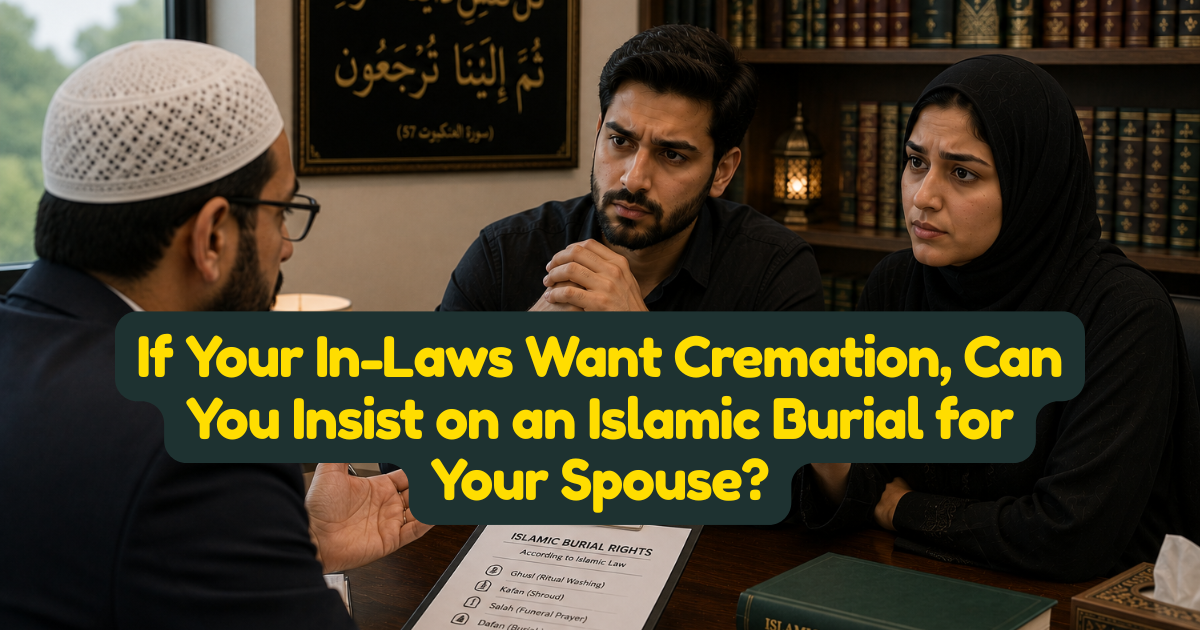
Islam requires burial, not cremation — but in interfaith and convert families, a surviving spouse's wishes can collide head-on with a non-Muslim in-law's plans. Here's who actually has the legal authority to decide.
Cremation, Burial, and Interfaith In-Laws: Who Has the Final Say?
For converts and interfaith couples, this is one of the hardest conversations to have in advance — and one of the most urgent to have anyway. Islamic teaching requires burial; some non-Muslim families have a strong preference, or even a religiously rooted expectation, for cremation. When death actually arrives, whoever has legal authority decides — not whoever feels morally entitled to.
The Surviving Spouse Generally Has the Strongest Legal Claim
Across most US states, the law is consistent on this point. According to Stimmel Law's overview of legal rights and obligations regarding human remains and burial, the surviving spouse holds the "paramount right" to control the disposition of a deceased spouse's body — a right that takes legal priority over parents, siblings, and other next of kin, and which courts have repeatedly upheld even against in-law objections, citing established case law such as Radomer Russ-Pol Unterstitzung Verein v. Posner.
This Right Can Be Waived — and Disputes Still Happen
The spouse's priority isn't absolute in every circumstance. As the same source notes, a spouse's preference can be waived by consent, by inaction, or under specific state statutes that allow it to fall to a previously designated agent if one was named. Practical guidance from Paige's overview of who has the right to make funeral arrangements confirms the typical hierarchy: spouse first, then adult children, then parents — but notes that funeral homes will require documentation proving the relationship before honoring instructions, which is exactly where an undocumented or religious-only nikah can become a real problem.
Why Civil Marriage Documentation Is the Real Safeguard Here
If a marriage was never civilly registered, a funeral home or hospital may have no legal record establishing the surviving partner as a "spouse" at all — leaving the decision to default to the deceased's parents or next of kin by blood, regardless of who the deceased actually wanted to make this decision. This is one of the starkest, highest-stakes examples of why religious-only marriage without civil registration creates real risk, not just paperwork inconvenience.
The Proactive Fix: Put It in Writing While Both Spouses Are Living
The clearest protection is a written, signed advance directive specifying burial according to Islamic rites, ideally referencing the relevant state's "designated agent" or "disposition directive" provisions where available — many states explicitly allow a person to name who controls their final arrangements, overriding the default next-of-kin hierarchy entirely. Combined with a properly civilly registered marriage, this removes almost all ambiguity, and prevents the worst version of this dispute: a grieving spouse and grieving parents fighting in the days immediately after a death over what should have been settled years earlier.
A Conversation Worth Having Early
This is an uncomfortable conversation to initiate with in-laws long before it's needed — but it is dramatically easier to have while everyone is calm than to resolve in a funeral home parking lot while everyone is grieving.