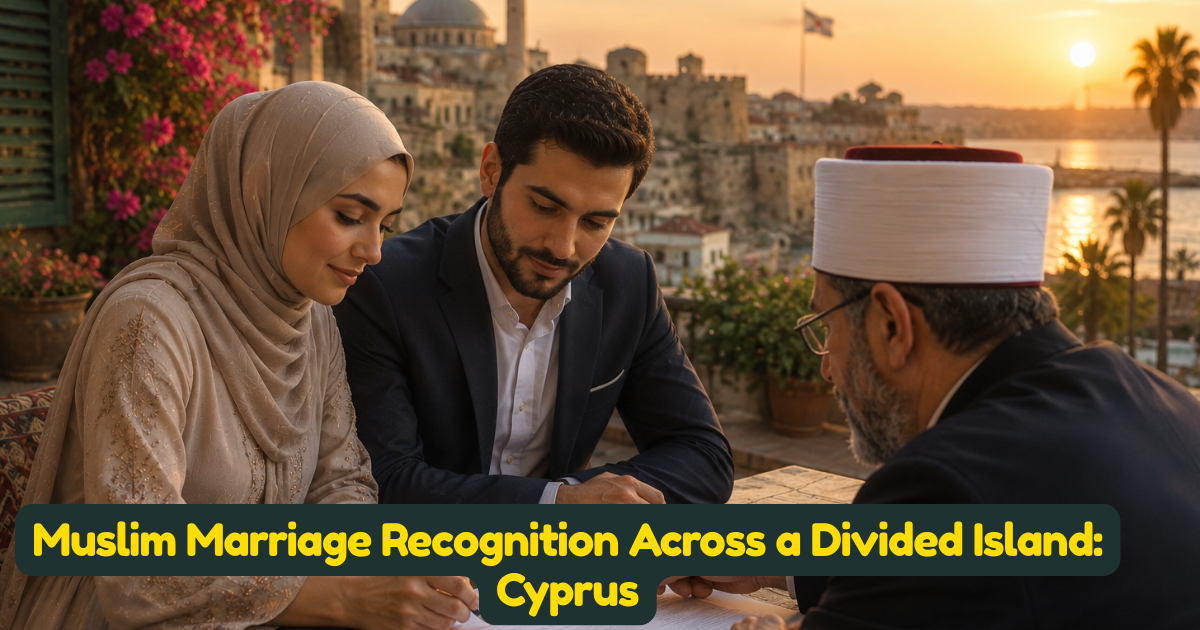
Muslim Marriage Recognition Across a Divided Island: Cyprus
Cyprus presents a genuinely unusual situation among the countries covered on this site: since 1974, when Turkey intervened militarily following a Greek-nationalist coup, the island has operated under two entirely separate governments and legal systems, divided by a UN-patrolled buffer zone. Understanding both sides matters for anyone with a connection to the island planning a nikah.
The Republic of Cyprus: Islamic Marriage With Direct Legal Recognition
This is worth highlighting specifically, because it's genuinely rare among EU member states: under the Republic of Cyprus's Marriage Law 104(I) of 2003, religious marriages performed according to the rites of specific constitutionally recognized religious communities — including the island's Muslim community, alongside the Greek Orthodox Church, the Maronite Church, and the Armenian Church — are directly recognized as legally valid marriages. This isn't a general "any religion" clause; it names the Muslim community specifically as one of a limited set of religious groups whose marriages carry this direct civil effect. The requirement is that the ceremony be performed by a registered cleric formally accredited by the Muslim community's own religious authority and approved by the Minister of the Interior, with the marriage subsequently published in the Official Gazette. This means a properly conducted nikah, performed by a recognized and accredited officiant in the Republic of Cyprus, can be the couple's legally binding marriage in an EU member state — a structure closer to Spain's 1992 cooperation agreement, covered elsewhere on this site, than to the civil-first model found across most of continental Europe.
The Turkish Republic of Northern Cyprus: A Separate System Entirely
North of the buffer zone, the self-declared "Turkish Republic of Northern Cyprus" (TRNC) — recognized as a state only by Turkey, with the United States and every other country continuing to recognize only the Republic of Cyprus as the island's legitimate government — runs its own entirely separate marriage registration system, closer in structure to Turkey's own civil marriage process. Couples marrying in the TRNC submit documentation to Turkish Cypriot authorities directly, and — notably — Turkish citizens specifically wanting to marry a foreigner in the TRNC must instead do so through the Turkish Embassy in Lefkoşa (Nicosia), reflecting the area's unusual, unrecognized diplomatic status.
A Shrine That Crosses the Green Line
One detail worth knowing captures something genuinely moving about Cyprus's divided religious life: Hala Sultan Tekke, a shrine near Larnaca in the internationally recognized south, is traditionally held to be the burial place of Umm Haram, a companion and relative of the Prophet Muhammad ﷺ — making it one of the most significant Islamic pilgrimage sites in all of Europe. Every year, hundreds of Turkish Cypriot Muslims from the north cross the Green Line to make pilgrimage there, particularly around Eid al-Adha, in a rare and consistent point of shared religious practice across an otherwise politically divided island.
An Older Institutional Layer: The Evkaf
Cyprus's Muslim community also carries deep institutional history through the Evkaf — the system of Islamic religious endowments (waqf) dating to Ottoman rule, formally recognized in an 1878 agreement between Britain and the Ottoman government when Britain took over administration of the island. This endowment system, still administering religious properties today, reflects a continuity of Islamic institutional life on Cyprus stretching back centuries before the 1974 division.
Where an Online Nikah Fits
For couples in the Republic of Cyprus, the underlying religious requirements — a clear offer and acceptance, the wali's role, two qualifying witnesses, and an agreed, documented mahr — remain the same as any nikah, with the added significance that a properly accredited officiant's ceremony there can directly satisfy both religious and civil requirements at once. For couples connected to the TRNC or navigating the island's political division more broadly, an online nikah offers genuine flexibility for family separated, in some cases literally, by the Green Line itself.
Who This Tends to Fit in Cyprus
- Couples in the Republic of Cyprus who want to understand whether their chosen officiant's accreditation would give their nikah direct civil effect.
- Turkish Cypriot families navigating the TRNC's separate registration system.
- Families split across the island's political division, for whom an online ceremony can meaningfully bridge distance the Green Line otherwise imposes.
- Couples who want a documented, recorded ceremony regardless of which side of the island they're connected to.
Frequently Asked Questions
Can a nikah be our legally recognized marriage in Cyprus?
In the Republic of Cyprus, yes — if performed by a cleric formally accredited by the Muslim community and approved by the Minister of the Interior, under Marriage Law 104(I) of 2003.
Does the same rule apply in Northern Cyprus?
No — the TRNC runs its own separate registration system, closer to Turkey's civil marriage process, and isn't governed by the Republic of Cyprus's Marriage Law.
Can family across the Green Line join the same online nikah?
Yes — this is one of the more meaningful practical advantages of the online format for a genuinely divided island.
Authority References Used (Live & Clickable)
- U.S. Department of State, 2022 Report on International Religious Freedom: Cyprus — official documentation of Cyprus's divided governance and religious framework
Suggested Internal Links
- Nikah With Legal Force in Madrid
- Online Nikah in Istanbul
- Documents Needed Before Booking an Online Nikah
- Is Online Nikah Legal? A Country-by-Country Guide
- Book Your Online Nikah
Why This Article Is Different
This page treats Cyprus's genuine political division as the actual substance of the story — two separate marriage systems on one island — rather than smoothing it into a single generic country profile, and surfaces the Republic of Cyprus's specific, EU-notable direct recognition of Islamic religious marriage alongside a real, moving detail about shared religious pilgrimage across the Green Line.
Zainab Butt
Author