Can a Nikah Ceremony Include a Moment of Silence for a Deceased Parent Who Isn't Present?
For a bride or groom whose father or mother has passed away before their wedding day, the absence can feel especially present during a moment as significant as the nikah — a father who would have been wali, a mother who would have sat beside her daughter, simply not there. Couples in this situation often ask whether there's an appropriate, meaningful way to acknowledge this loss within the ceremony itself, rather than treating it as something to quietly push past.
Islam's Approach to Remembering the Deceased
Islam encourages remembering the deceased through du'a — supplication asking Allah's mercy upon them — rather than through practices like a formal moment of silence, which isn't itself a distinctly Islamic tradition. This doesn't mean the sentiment behind wanting a moment of silence is unwelcome; it means there's a more spiritually meaningful and religiously grounded alternative available: a brief, sincere du'a for the deceased parent, incorporated naturally into the ceremony.
How a Du'a for a Deceased Parent Can Be Incorporated
Many officiants are glad to include a short supplication for a deceased parent as part of the khutbah or immediately following the completion of the marriage contract — asking Allah's mercy and forgiveness for the parent, and sometimes specifically noting their absence and the couple's wish that they could have witnessed this moment. This can be brief, sincere, and woven naturally into the ceremony's flow rather than treated as a separate, formal segment requiring its own extended pause.
Requesting This in Advance
As with other personalization requests covered elsewhere on our site, letting your officiant know ahead of time that you'd like a specific du'a for a deceased parent included gives them the opportunity to prepare thoughtful, appropriate wording rather than being asked to incorporate this meaningfully on the spot without any advance notice. Sharing the parent's name and, if comfortable, a little about them can help the officiant personalize the moment genuinely rather than offering something generic.
Who Might Lead This Moment
While the officiant often leads this brief supplication, some couples prefer that a close family member — a sibling, an aunt or uncle who was close to the deceased parent, or another relative — lead the du'a instead, giving the moment a more personal and family-centered quality. This is entirely something an officiant can accommodate, simply requiring a brief coordination beforehand about who will speak and roughly what will be said.
Acknowledging the Absence Without Overshadowing the Ceremony's Joy
A brief, sincere acknowledgment tends to strike the right balance — meaningful enough to honor the parent's memory genuinely, without extending into something so lengthy or emotionally heavy that it overshadows the ceremony's fundamentally joyful purpose. Most couples find that a short, well-placed du'a achieves exactly this balance, allowing space for both grief and celebration to coexist appropriately within the same moment.
Filling the Practical Role a Deceased Parent Would Have Held
Beyond the emotional acknowledgment, a deceased father's absence often raises the practical question of wali involvement, addressed in more depth in our dedicated article on this topic — the wali hierarchy provides for another appropriate relative or a wali al-hakim to step into this role, and couples can choose to explicitly and warmly acknowledge, as part of the ceremony, that this person is honoring the deceased parent's role in their stead.
Including Photos or Small Personal Touches
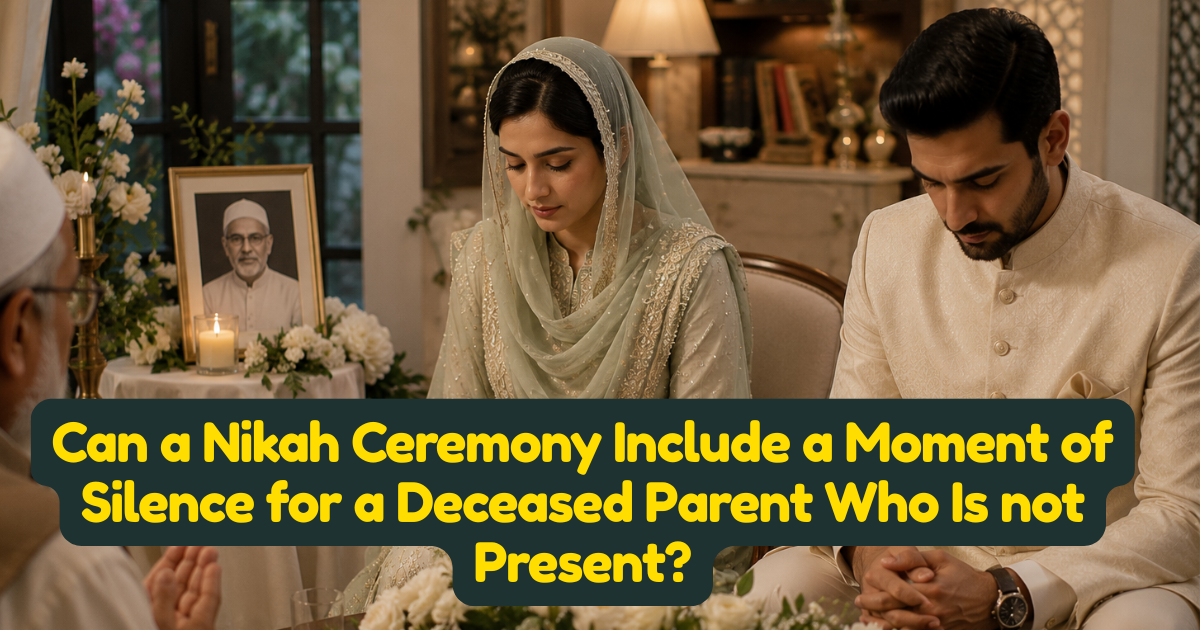
Some couples choose to display a small photo of the deceased parent during the online ceremony, visible on screen briefly during the du'a or khutbah, as a simple, personal way of including their presence visually even though they can't be there in person. This is a matter of personal preference rather than religious requirement, and couples should feel free to include or skip this kind of touch based on what feels right for them.
Managing the Emotional Weight of This Moment
It's worth preparing, gently, for the possibility that this moment may bring real emotion to the surface — tears are a natural, appropriate response to remembering someone significant during an important life event, and there's no need to feel that composure must be maintained throughout. A compassionate officiant will give the couple whatever space they need in this moment without rushing past it.
What If Multiple Family Members Have Passed Away
For couples who have lost more than one significant family member — both parents, a beloved grandparent, or others — the same approach applies, with the du'a simply extended to include each person by name if the couple wishes, rather than needing separate, individually structured moments for each loss.
How This Differs From a Secular Moment of Silence
It's worth understanding why we'd generally suggest a brief du'a rather than a formal, silent pause modeled on secular memorial traditions — a du'a actively asks for Allah's mercy on behalf of the deceased, which is understood as spiritually beneficial to them, while a silent pause alone, though respectful, doesn't carry this same active, spiritually meaningful dimension within Islamic practice.
How InstantNikah.com Supports This Request
We're glad to incorporate a brief, sincere du'a for a deceased parent or family member into any ceremony we conduct, working with the couple beforehand to personalize the wording appropriately and coordinating who will lead the moment, ensuring it feels genuinely meaningful rather than generic.
Admin User
Author