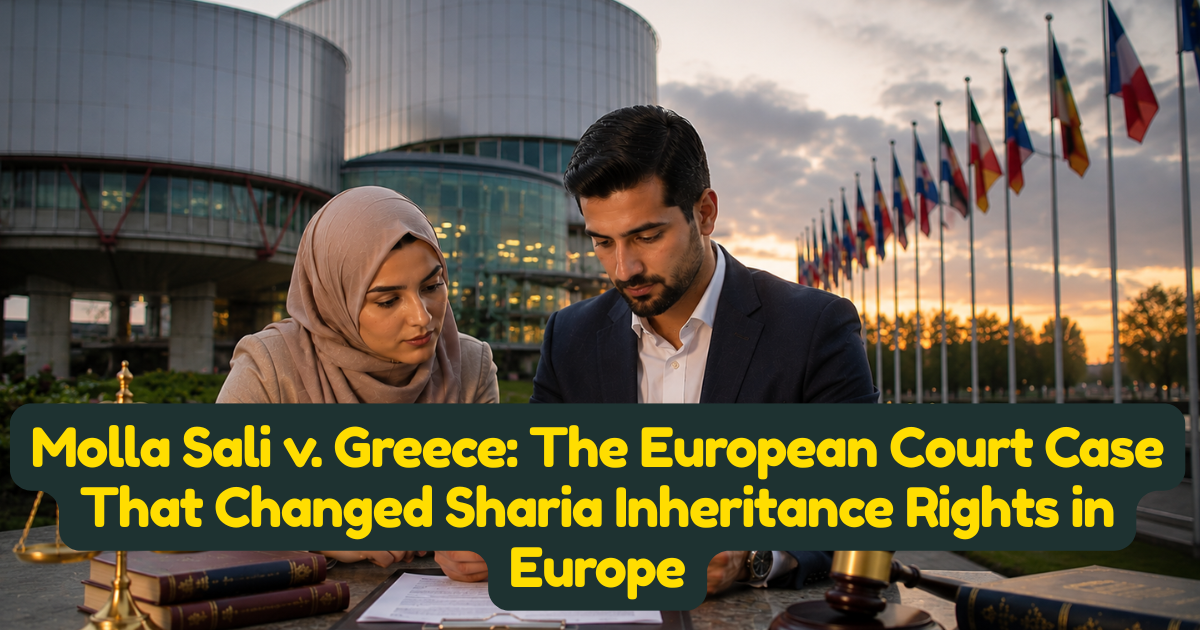
Molla Sali v. Greece: When a Civil Will Wasn't Enough Because the Testator Was Muslim
In 2003, a Greek Muslim man named Mustafa Molla Sali visited a notary and drew up a will, entirely in accordance with the Greek Civil Code, leaving his entire estate to his wife. When he died in 2008, his sisters challenged that will in court — not on the usual grounds of fraud or incapacity, but on the grounds that, because he was a member of the Muslim minority of Western Thrace, Islamic inheritance law should have applied to his estate regardless of what his civil will said. Remarkably, Greece's highest court agreed with them.
A Legal Relic of the Ottoman Empire, Still Active in 2008
According to the official case summary published by HUDOC, the official case-law database of the European Court of Human Rights, Greece's special legal regime for its Muslim minority traces back to the 1920 Treaty of Sèvres and the 1923 Treaty of Lausanne, which carved out the Muslim population of Western Thrace from the broader population exchange between Greece and Turkey and provided that Islamic customs and religious law would continue to apply to them. Under Law No. 2345/1920, this gave local muftis judicial authority specifically over Muslim Greek citizens' inheritance disputes — a parallel legal track that remained active for nearly a century.
How the Greek Courts Stripped Away a Valid Will
The full judgment, available via HUDOC's complete record of the Grand Chamber decision, details how Greece's Court of Cassation ultimately ruled that Mustafa Molla Sali's Muslim faith alone meant Islamic succession law governed his estate — regardless of his having deliberately drawn up a civil will specifically to direct his property to his wife. Because Islamic inheritance law, as applied by the Greek court, treats a will as only able to supplement intestate succession rather than override it, his sisters were awarded three-quarters of an estate he had explicitly and legally tried to leave entirely to his widow.
The European Court's Core Reasoning: "The Right Not to Be Treated as a Member of a Minority"
According to detailed academic analysis published in the Oxford Journal of Law and Religion, published by Oxford University Press, the Grand Chamber's reasoning centered on a concept it called the "right to free self-identification" — meaning both the right to be treated as part of a minority group, and the equally protected right not to be. Mr Molla Sali's deliberate choice to use a civil-law will rather than relying on Islamic intestate succession was, the Court held, itself an exercise of that right — one the Greek courts had no basis to override.
A Careful Distinction: The Court Did Not Rule Against Sharia Itself
This is the part of the ruling most often misunderstood. Detailed commentary from Strasbourg Observers' academic analysis of the judgment emphasizes that the Court explicitly held a state is permitted, though never obligated, to grant a religious community special legal status carrying its own rules — including Sharia-based family law. What the Court condemned was not the existence of that framework, but its compulsory, non-consensual application to someone who had clearly and legally chosen otherwise. The judgment found a violation of Article 14 (non-discrimination) combined with Article 1 of Protocol No. 1 (protection of property) — not a freestanding condemnation of Islamic law as incompatible with the Convention.
Greece's Legislative Response — Before the Judgment Even Landed
In a striking sequence of events, Greece changed its own law while the case was still pending before the Grand Chamber. According to the CUREDI comparative law database's case analysis, a new Greek law abolishing the compulsory application of Sharia to family-law matters came into force in January 2018 — nearly a year before the European Court's December 2018 judgment. Under the reform, recourse to a mufti for marriage, divorce, or inheritance matters became possible only with the agreement of all parties involved, ending automatic, non-consensual jurisdiction entirely. Notably, this change had no retroactive effect on Ms. Molla Sali's own case, which had already concluded under the old system — making her European Court application her only remaining path to a remedy.
Why This Case Matters Well Beyond Greece
Molla Sali v. Greece stands as the first time the European Court of Human Rights directly addressed whether a religious community's separate legal status — specifically including Sharia-based inheritance rules — is compatible with the Convention. The ruling establishes a clear principle with relevance across Europe wherever religious family law intersects with civil law: a state may accommodate religious legal pluralism, but it cannot compel an individual into a religious legal framework against their explicitly demonstrated wishes, especially where doing so produces serious, concrete financial harm.
The Practical Lesson for Muslim Families Across Europe
For Muslim families anywhere in Europe navigating the relationship between Islamic inheritance principles and civil estate planning, the case underscores a genuinely important and often overlooked point: a clearly drafted, properly executed civil will expressing one's actual wishes carries real legal weight and is now affirmatively protected by European human rights law against being overridden on the basis of religious identity alone — but only where that will is made, in the first place, with the clarity and formality the case turned on.
Admin User
Author