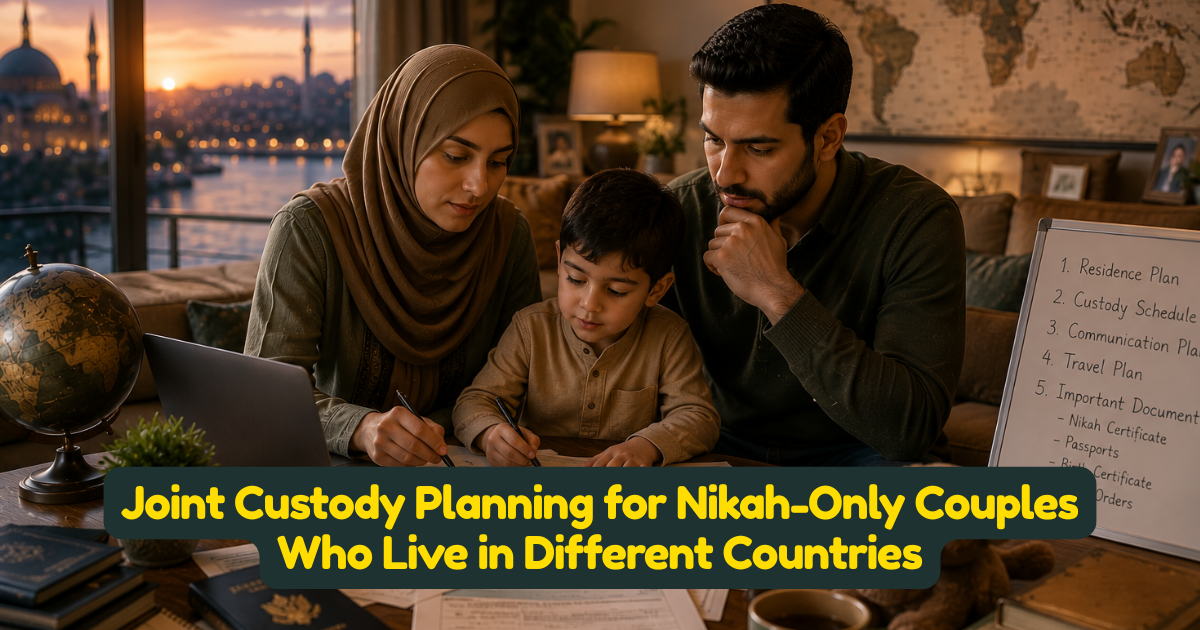
Joint Custody Planning for Cross-Border Nikah-Only CouplesJoint Custody Planning for Nikah-Only Couples Who Live in Different Countries
Couples who marry across borders rarely think about custody law on their wedding day, and understandably so — it is not a romantic topic. But for Nikah-only couples who continue living in different countries after marriage, whether by circumstance or by choice, custody planning is one of the few areas where waiting until it becomes urgent is genuinely dangerous. International custody disputes move fast, involve multiple legal systems at once, and can turn what should be a manageable co-parenting arrangement into a years-long cross-border legal fight. Planning ahead is not pessimism. It is the single most protective thing a cross-border couple can do for their children.
Why Cross-Border Custody Is a Different Legal Category
Domestic custody law generally assumes both parents live in the same legal system, so a single court's order settles the matter. Cross-border custody breaks that assumption immediately. Two different countries may each believe they have jurisdiction over the child, may apply completely different legal standards for what counts as the child's best interest, and may not automatically enforce each other's custody orders. This is precisely the vacuum that the international treaty framework described below was built to address — but couples need to understand its actual protections and its real limits before assuming it will simply take care of everything.
The Hague Abduction Convention: What It Actually Protects Against
The single most important international instrument in this space is the 1980 Hague Convention on the Civil Aspects of International Child Abduction. According to the Hague Conference's own Child Abduction Section, the Convention exists to protect children from the harmful effects of wrongful removal or retention across international borders by providing a standardised procedure for their prompt return to their country of habitual residence. It is worth being precise about what this treaty does and does not do. It is not a custody-determination mechanism — it does not decide who should ultimately have custody. It is a return mechanism, designed to restore the situation that existed before a wrongful removal so that the correct court, in the correct country, can then decide custody properly. This distinction matters enormously for cross-border Nikah couples: the Convention is a safeguard against one parent unilaterally relocating a child to gain a legal advantage, not a substitute for a proactive custody agreement.
The Limits Worth Understanding Early
The Convention only functions between countries that are both parties to it. If either spouse's country of residence has not ratified the treaty, its protections simply do not apply, and a wrongful relocation to or from that country becomes a much harder legal problem to resolve. This is exactly why cross-border couples benefit from knowing, well before any dispute arises, whether both of the countries relevant to their family are Hague Abduction Convention parties — a fact worth confirming directly with each country's designated Central Authority rather than assuming.
How Islamic Guidance on Hadana Fits Into the Picture
Islamic jurisprudence has its own well-developed framework for child custody, known as hadana, which addresses who is responsible for a child's day-to-day care following a separation. Comparative research from Musawah, a global movement for equality in the Muslim family, summarises the classical position clearly: most schools of fiqh grant mothers custody of young children up to a certain age, with variation between schools, while framing this as a right tied to the child's welfare rather than an automatic, unconditional entitlement. It is worth being direct with couples about a key practical point: hadana is a religious and ethical framework, not a mechanism enforceable in most secular family courts. A cross-border couple's actual custody outcome will be decided under whichever country's civil family law has jurisdiction — which makes it all the more important to build a parenting plan that reflects both the couple's religious values and the civil legal reality they will actually face.
What a Cross-Border Custody Plan Should Actually Cover
A genuinely useful plan, drafted while the relationship is stable rather than during a crisis, should address several specific questions: which country will be treated as the child's habitual residence for legal purposes, what process either parent must follow before relocating internationally with the child, how holiday and travel time will be split given the distances involved, and what happens to the plan if one parent later moves to a third country. None of this needs to be adversarial to draft — treating it as a piece of family administration, similar to a will, tends to produce a calmer and more thorough document than treating it as a negotiation only prompted by conflict.
Relocation: The Single Most Common Trigger for Disputes
A large share of cross-border custody conflicts start with a relocation request — one parent wanting to move, permanently or for an extended period, to a different country with the children. Canada's Department of Justice, in its own research on this exact issue, found something genuinely useful for cross-border families to know: its analysis of relocation cases found that international moves, while more disruptive to a child on paper, actually succeed in court at a higher rate than purely domestic relocation requests. This is a useful, if counterintuitive, data point for planning purposes — it suggests courts are often willing to permit international moves where a clear, well-supported case is presented, which is exactly what a documented parenting plan and clean custody paperwork help provide.
Building the Paper Trail Before You Need It
Courts asked to make fast decisions about a child's welfare rely heavily on documentation, and cross-border couples benefit enormously from having that documentation ready before any dispute begins. This includes: the Nikah certificate itself as proof of the marriage, any existing written parenting or custody agreement, records establishing which country has been the child's actual habitual residence, and clear evidence of each parent's ongoing involvement in the child's life regardless of which country they are based in. Courts in self-help guidance, such as California's own judicial branch resource on relocating with a child, consistently emphasise that a documented, cooperative history between parents makes court intervention faster and less contentious when it is needed — a principle that applies just as strongly across international custody cases as it does within a single state.
When to Bring in Professional Help
A cross-border custody plan involving two different legal systems is genuinely worth drafting with input from a family law professional licensed in at least one of the relevant countries, ideally reviewed against both systems' requirements. This is not a document to improvise from a template, given how much weight courts place on a plan's specificity and enforceability. The cost of proper legal input early is consistently smaller than the cost — financial and emotional — of resolving an actual cross-border custody dispute without one.
Frequently Asked Questions
Does the Hague Abduction Convention decide who gets custody? No. It is a return mechanism that restores a child to their country of habitual residence after a wrongful removal, so that the appropriate court can then decide custody — it does not determine custody outcomes itself.
Is hadana legally enforceable in secular courts? Generally not directly. Hadana is an Islamic ethical and jurisprudential framework; actual custody decisions in most countries are made under civil family law, though couples can reflect hadana principles within a civil parenting plan.
When should we draft a cross-border custody plan? As early as possible — ideally well before any relocation is being considered, since courts consistently respond better to plans built cooperatively than to ones assembled during an active dispute.
Suggested Internal Links
Admin User
Author