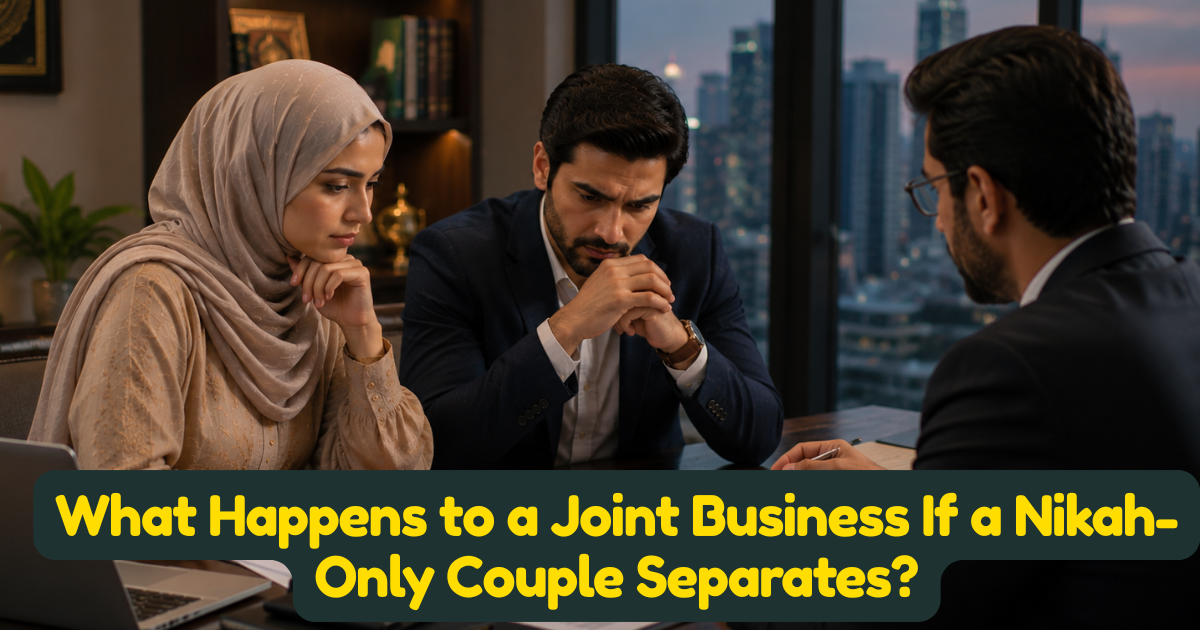
A husband and wife running a business together rarely think about what happens to the LLC if the marriage ends — and if the nikah was never civilly registered, business law, not family law, decides everything.
Co-Owned Businesses and a Nikah-Only Breakup: Why Business Law Takes Over
Many couples build a business together early in marriage — a restaurant, a consulting practice, an online store. If the nikah behind that partnership was never civilly registered and the relationship ends, the business doesn't get divided by family law at all. It gets divided by business law, exactly as it would for any two strangers who happened to co-found a company.
Ownership Follows the Business Documents, Not the Relationship
According to Business.com's guide to dissolving a business partnership, if a written operating agreement or partnership agreement exists, its dissolution and buyout terms control — regardless of the partners' personal relationship. Without one, state default partnership law fills the gap, typically dividing ownership according to each partner's formal equity stake, not their contribution to the relationship or household.
This Differs Sharply From How a Civil Divorce Would Handle It
If the marriage had been civilly registered in a community property state, a jointly built business started during the marriage would typically be treated as marital property, subject to equitable division regardless of whose name is formally on the ownership documents. Without civil registration, that protection doesn't exist — a spouse who worked in the business for years but was never formally listed as an owner or partner may have no legal ownership claim at all, regardless of how essential their contribution was.
One Partner Generally Can't Force the Other Out Unilaterally
According to an attorney's overview of withdrawing from an LLC partnership, withdrawal or dissolution generally requires either following the operating agreement's specific procedures or, absent one, complying with state statutory default rules — which usually require formal written notice and a vote among partners, not a simple personal decision by one spouse to walk away or lock the other out.
Why Documentation Matters Even More Here Than in a Bank Account or Lease
A business carries ongoing liabilities — vendor contracts, leases, loans, tax obligations — that don't simply pause when a personal relationship ends. A spouse with no formal ownership stake but significant informal involvement (working unpaid in the business, co-signing loans, or being publicly held out as a co-owner to customers and vendors) may have a harder, costlier legal path to recognition than if their role had been documented in writing from the start.
The Protective Step Every Couple Co-Founding a Business Should Take
Regardless of the marriage's civil status, any couple building a business together should formalize ownership percentages, roles, and a buyout or dissolution procedure in a written operating or partnership agreement at the time the business is formed — not after a relationship has already become strained. This single document protects both spouses' interests far more reliably than informal trust ever can, and it remains valid and enforceable whether or not the marriage itself is ever civilly registered.