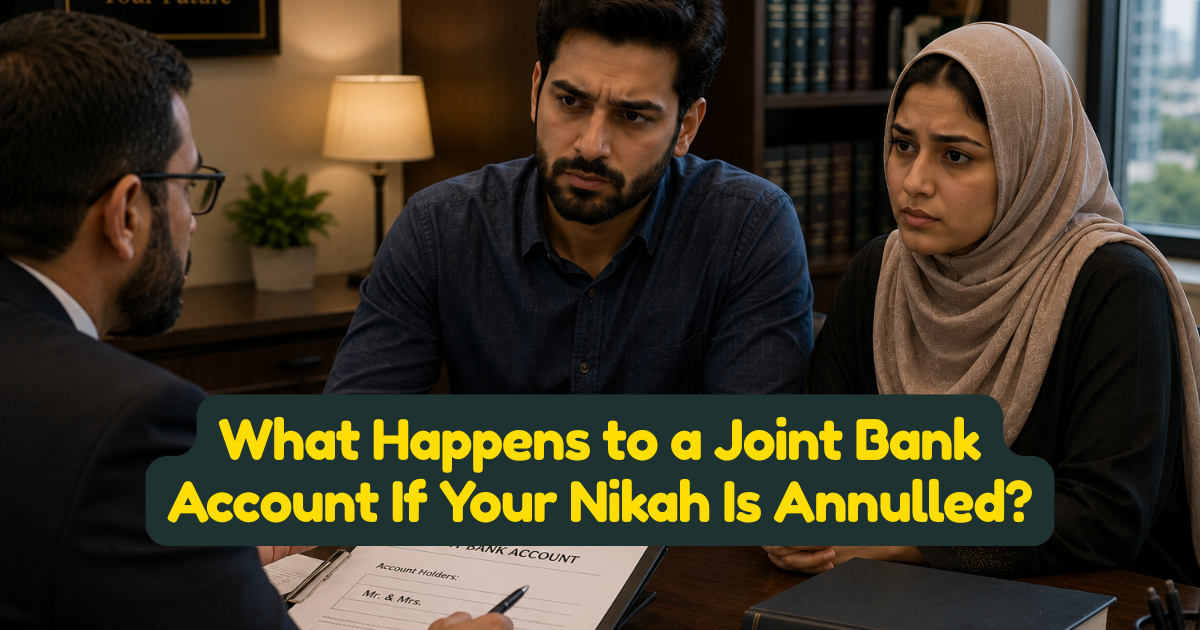
Annulment isn't divorce — and the difference matters enormously for joint finances. If your nikah is annulled rather than dissolved by divorce, here's what actually happens to the money you shared.
Joint Accounts and Annulment: Why "Never Married" Changes Everything
Divorce and annulment sound like two paths to the same destination, but financially they are nothing alike. Divorce ends a marriage that existed. Annulment declares that, legally, it never existed at all — and that single distinction reshapes everything about how joint money gets treated.
Why "It Never Happened" Changes the Math
According to LegalMatch's legal library article on asset division in annulment, the property rights that apply in divorce — community or equitable distribution of "marital property" — simply don't exist in most annulment cases, because there was no valid marriage during which property could become "marital" in the first place. In several states, when a marriage is void from the start, courts hold there is no marital estate to divide at all.
What Usually Happens to the Joint Account
In practice, this typically means assets and accounts revert toward their pre-marriage ownership status rather than being split as they would in a divorce. A clear summary of this default outcome is laid out by DivorceNet's comparison of annulment and divorce, which notes that judges ordinarily will not divide property in an annulment, and that whoever contributed funds, or whoever's name the account was opened in, generally keeps them — unless the marriage lasted long enough, or the court applies an exception, to treat it differently.
The Important Exceptions
There are two real exceptions worth knowing. First, several states apply the "putative spouse" doctrine — protecting a spouse who entered the marriage in good faith, unaware of the defect that voided it, by allowing the court to treat jointly accumulated assets more like a divorce would. Second, where the annulment itself was caused by one spouse's fraud — for example, the marriage was entered to access the other spouse's finances under false pretenses — courts have shown willingness to act more like a civil fraud court and award compensation to the deceived spouse out of the deceiver's own property, rather than simply returning everyone to their starting position.
Why This Matters Specifically for Nikah Annulments
This distinction is particularly relevant where a nikah is later annulled (rather than dissolved through khula or talaq) due to concealment, fraud, or a defect that existed at the time of contracting — the exact situations where joint finances are most likely to already be tangled. Because the legal outcome depends heavily on whether the annulment is treated as retroactive (void from the start) or limited going forward, and on which spouse the court considers to have acted in good faith, this is not a situation to navigate without a family law attorney reviewing the specific facts.
The Practical Lesson for Every Couple
Whatever the eventual outcome, the cleanest position to be in is one with clear documentation: which spouse opened which account, when funds were added, and what each contribution was for. A nikah certificate and contract that clearly documents the date and terms of the marriage gives both spouses — and any court later asked to sort this out — a far easier starting point than ambiguity.