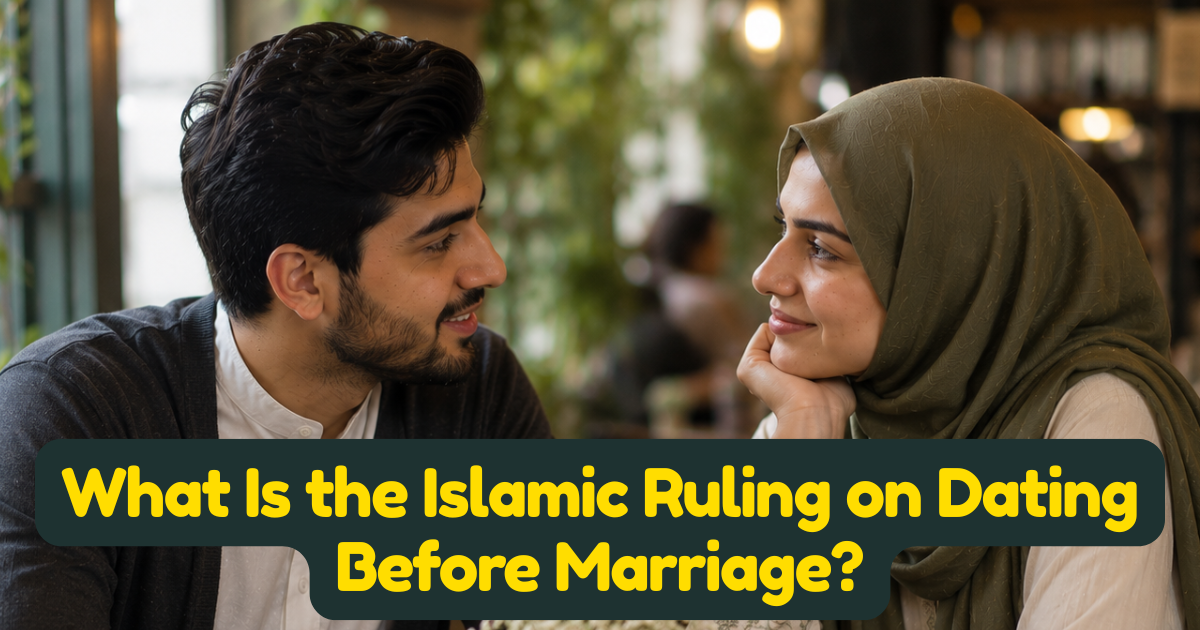
What Is the Islamic Ruling on Dating Before Marriage? A Complete Guide for Muslims and Their Partners
It is one of the most common questions young Muslims ask — quietly, privately, often without knowing who to ask or whether asking is itself a problem. It is a question shaped by the reality of being Muslim in a world where dating is not merely normalised but expected — where the path from single to married runs, in the surrounding culture, almost universally through a period of romantic involvement, physical proximity, and progressive emotional and physical intimacy that Islamic ethics approaches very differently.
The question is also one that carries significant weight beyond academic interest. Millions of young Muslims across the United Kingdom, the United States, France, Germany, Canada, Australia, and every country where Muslim minorities exist are navigating real relationships — with Muslim and non-Muslim partners — in real time, trying to reconcile genuine feelings with genuine faith commitments, often without access to Islamic guidance that takes their situation seriously rather than simply telling them what they already know they should not be doing.
This guide takes that situation seriously. It states the Islamic ruling clearly and explains it fully. It addresses the most common situations Muslims find themselves in. It explains what Islamic ethics actually permits in the path toward marriage. And it provides the practical framework that bridges the gap between where many young Muslims are and where Islamic ethics asks them to be — not with dismissiveness, but with the genuine care for both their faith and their wellbeing that this question deserves.
What Islam Actually Prohibits: Being Precise About the Ruling
The Islamic ruling on pre-marriage relationships is frequently stated in a way that is technically correct but practically unhelpful: Islam prohibits dating. While this statement is directionally accurate, it lacks the precision necessary for Muslims to understand what specifically is prohibited, why it is prohibited, and what the Islamic alternative actually looks like in practice.
What Islam specifically prohibits in the context of pre-marriage male-female relationships can be organised around three core principles established in the Qur'an and authentic Sunnah:
The Prohibition of Zina and Its Approaches
The most foundational prohibition is that of zina — unlawful sexual relations — and, significantly, the prohibition extends to the conditions and approaches that lead to it. In Surah Al-Isra (17:32), Allah commands: "And do not approach unlawful sexual intercourse. Indeed, it is ever an immorality and is evil as a way." The verb taqrabu — do not approach — is understood by scholars as extending the prohibition beyond the act itself to the relational contexts and behaviours that lead to it. Physical intimacy, romantic seclusion, and the progressive emotional and physical entanglement of an unmarried man and woman outside of nikah are all understood as falling within the scope of this prohibition.
The Prohibition of Khalwa
The Prophet Muhammad, peace be upon him, is authentically reported to have prohibited khalwa — the private seclusion of an unmarried man and woman who are not mahram to each other. This narration appears in multiple authentic hadith collections and represents one of the most consistently applied practical boundaries in Islamic ethics governing male-female interaction. The rationale scholars have consistently identified is preventive: seclusion creates the conditions in which the prohibitions of physical and romantic intimacy become far more difficult to maintain.
The Positive Obligation to Guard Modesty
Beyond specific prohibitions, Islam establishes a positive obligation to guard modesty — hifz al-farj — which scholars have understood as extending to the entire relational context that surrounds the protection of chastity. In Surah An-Nur (24:30-31), both men and women are commanded to lower their gaze and guard their modesty. This positive obligation shapes the Islamic framework for pre-marriage interaction — not merely by identifying what is prohibited but by articulating the disposition and conduct that Islamic ethics calls Muslims toward in all their interactions.
What Islam Does Not Prohibit: The Islamic Alternative to Dating
Understanding what Islam prohibits in pre-marriage relationships must be accompanied by a clear understanding of what Islam does not prohibit — because the Islamic alternative to dating is not simply the absence of any pre-marriage interaction. Islamic ethics does not require that two people marry as strangers. It establishes a framework within which genuine getting-to-know-you interaction can occur — one that protects both parties from the harms that Islamic ethics identifies with unrestricted pre-marriage intimacy while allowing them to make an informed, freely chosen decision about marriage.
The following are permitted within the Islamic framework for pre-marriage interaction:
Meeting and Conversing With the Purpose of Marriage in Mind
Islam does not require that marriage proposals be accepted or rejected in ignorance of the person being proposed to. The Prophet, peace be upon him, specifically encouraged prospective spouses to look at each other before the marriage is contracted — there is an authentic narration in which a companion mentioned he was engaged to marry an Ansari woman, and the Prophet advised him: "Go and look at her, for it is more likely that love and harmony will be established between you."
This hadith establishes a clear prophetic permission — indeed, encouragement — for prospective spouses to meet and observe each other. The meeting should be purposeful — directed toward the specific question of marriage — and conducted in a manner consistent with Islamic modesty. It is not a licence for unlimited romantic interaction. But it is a genuine permission for the kind of getting-to-know encounter that allows two people to make an informed and genuine decision about whether they wish to marry.
Communication With Appropriate Boundaries
Contemporary scholars across multiple madhab traditions have acknowledged that communication between prospective spouses — including through modern means such as phone calls and video conversations — is permissible within appropriate boundaries when the purpose is marriage consideration. The boundaries that apply include: the communication should be purposeful rather than idle, the content should be appropriate and not involve the romantic, flirtatious, or intimate discourse that would be problematic in any Islamic context, and where possible the involvement of family members or trusted third parties provides an additional layer of appropriate accountability.
Many Muslim couples today conduct their getting-to-know period through a structured series of conversations — sometimes with family members present in the same room, sometimes through the involvement of an intermediary who facilitates communication — that allows them to genuinely assess compatibility without entering the relational territory that Islamic ethics identifies as problematic.
Family Involvement and the Process of Consideration
The Islamic framework for pre-marriage interaction is fundamentally one in which family involvement is not an intrusion but a support. The wali's role — the bride's guardian — and the broader framework of family consultation in marriage decisions are not designed to prevent genuine choice but to provide the accountability, wisdom, and protection that two individuals considering marriage, in a state of heightened emotion and potentially limited life experience, genuinely benefit from. A family that is involved in the marriage consideration process provides a check on impulsive decisions, a source of relevant knowledge about the prospective spouse, and a social network that supports the marriage once it is contracted.
Why Islam Establishes These Boundaries: The Reasoning Behind the Guidance
Islamic ethics does not establish these boundaries arbitrarily. The maqasid al-Shariah framework — the higher objectives of Islamic law — provides a coherent account of why these specific boundaries serve genuine human goods, and why violating them tends to produce genuine harms.
The Protection of Both Parties From Premature Emotional Investment
Prolonged pre-marriage romantic involvement creates strong emotional bonds that can significantly impair both parties' ability to make a genuinely free, rational, and informed decision about whether to marry. A couple who have been in an intense romantic relationship for two years before deciding to marry may find that the emotional investment they have made effectively removes the genuine freedom to choose not to marry — even if objective assessment of compatibility suggests they should not. Islamic ethics, by limiting pre-marriage emotional entanglement, preserves the genuine freedom of choice that both parties need to make a truly informed marriage decision.
The Protection of Women From Exploitation and Abandonment
Pre-marriage sexual and romantic relationships carry specific and documented risks for women — including the risk of physical and emotional intimacy with a partner who subsequently does not commit to marriage, leaving the woman with the consequences of the relationship without the protections the nikah would have provided. Islamic ethics, by channelling the relationship immediately toward the nikah, ensures that the commitment and the intimacy occur together — within the framework of a contract that establishes the woman's rights before the relationship deepens, not after.
The Protection of Lineage and Children's Rights
The possibility of children being conceived in a pre-marriage relationship — outside the nikah's framework of acknowledged paternity, defined rights, and formal obligation — is one of the most concrete harms that Islamic ethics' pre-marriage boundaries are designed to prevent. The nikah ensures that children are born within a framework that establishes their lineage, their rights, and their identity from the outset.
The Preservation of the Marriage's Unique Character
The Islamic framework for pre-marriage interaction preserves the nikah as the threshold of a qualitatively different relationship — one that is uniquely intimate, uniquely committed, and uniquely protected. When the progression of physical, emotional, and romantic intimacy occurs within the marriage rather than before it, the nikah retains its character as a genuine threshold — a beginning rather than a formalisation of what has already happened. Islamic ethics' pre-marriage boundaries protect the distinctive character and significance of the nikah itself.
The Specific Situations Muslims Most Commonly Face
Stating the Islamic framework is necessary but not sufficient for the millions of Muslims who are not approaching this question from a position of full compliance but from the middle of real situations that require honest, compassionate, and practically grounded guidance.
Situation One: A Muslim in an Existing Relationship Who Wants to Do Things Right
Many Muslims find themselves already in a relationship that began — or developed — outside the Islamic framework, and who now want to move toward a properly conducted nikah. They are not asking whether dating is permissible as an abstract question. They are asking what to do about a relationship they are already in.
The Islamic guidance for this situation is not retrospective punishment but forward-looking resolution: move toward the nikah as promptly as the circumstances allow. The Islamic principle of tawbah — sincere repentance — addresses the past. The nikah addresses the present and future. A couple who were in an impermissible pre-marriage relationship and who now genuinely want to regularise their relationship within Islam's framework should do exactly that — and the nikah, conducted correctly and promptly, is the resolution the Islamic framework provides.
The nikah does not need to wait for a large ceremony, for family approval that may be slow in coming, or for a perfect set of circumstances. It needs to be conducted correctly — with the wali's involvement or a wali al-amr arrangement, two qualified witnesses, a specified mahr, and qualified Islamic oversight. A properly conducted nikah, simple and private if necessary, immediately regularises the relationship within the Islamic framework.
Situation Two: A Muslim Who Has Feelings for Someone and Does Not Know How to Proceed Islamically
For a Muslim who has developed feelings for someone — a colleague, a fellow student, a person they have met through family or community — but who has not yet entered a relationship with them, the Islamic framework provides a clear path: express the interest in marriage through the appropriate channels — whether through a direct approach to the family, through a trusted intermediary, or through a direct conversation about marriage intention — rather than through the informal progression of romantic involvement that the surrounding culture normalises.
This path may feel awkward, particularly for Muslims who have grown up in cultures where such directness is unusual. But the awkwardness of the approach is significantly preferable to the Islamic and personal risks of the alternative — a prolonged romantic involvement whose escalating emotional and physical intimacy makes the eventual decision about marriage progressively harder to make freely and rationally.
Situation Three: A Muslim Whose Partner Is Non-Muslim
A Muslim who is in a relationship with a non-Muslim partner faces the intersection of the pre-marriage relationship question and the interfaith marriage question simultaneously. The Islamic ruling on marriage between a Muslim woman and a non-Muslim man is clear and consistent across all four madhabs: such a marriage is not valid in Islamic law. For a Muslim woman in a relationship with a non-Muslim man, the Islamic guidance is unambiguous — regardless of the sincerity and depth of the relationship, marriage is not possible within the Islamic framework without the man's genuine conversion to Islam.
For a Muslim man in a relationship with a Christian or Jewish woman, a marriage may be possible within the Islamic framework — but requires careful scholarly guidance on the specific conditions, the implications, and the responsibilities involved. The relationship as it currently exists outside of nikah remains impermissible regardless of the potential Islamic permissibility of the eventual marriage.
For both situations, the Islamic resolution involves honest conversation with the partner, access to scholarly guidance, and a willingness to prioritise the Islamic framework over the emotional and social comfort of the existing arrangement.
Situation Four: A Muslim Convert Navigating a Pre-Existing Relationship
A Muslim convert who was in a relationship before their conversion faces a situation that Islamic scholarship has addressed with both clarity and compassion. The general scholarly guidance — as discussed in the context of pre-nikah cohabitation — is that Islam does not require immediate and disruptive unwinding of all previous life arrangements. The expectation is that the convert will move promptly toward the Islamic regularisation of their relationship — through nikah if both parties are Muslim or become Muslim, through honest resolution if an Islamic marriage is not possible — without treating the existing relationship as indefinitely grandfathered from Islamic requirements.
The Question of Online and Digital Interaction
A dimension of the pre-marriage relationship question that has become increasingly important — and that classical scholars did not address — is the question of online interaction: messaging, social media communication, video calls, and the digital relationships that often precede in-person meeting in contemporary life.
Contemporary scholars addressing this question have generally applied the same principles that govern in-person interaction to digital contexts: purposeful communication directed toward marriage consideration is permissible within appropriate content and conduct boundaries; romantic, flirtatious, or intimate digital interaction falls under the same concerns as its in-person equivalent; and the progressive deepening of emotional intimacy through sustained digital communication creates similar risks to those that the khalwa prohibition was designed to prevent in in-person contexts.
The specific context of Islamic marriage apps and services — where Muslims interact with the explicit purpose of finding a spouse — represents a structured modern equivalent of the traditional intermediary and family introduction mechanisms. When used purposefully, with appropriate conduct, and with the goal of moving toward a properly conducted nikah, these platforms can function within the Islamic framework for pre-marriage interaction. When they become contexts for prolonged digital romantic relationships that substitute for the nikah rather than leading toward it, they carry the same concerns as any other pre-marriage romantic involvement.
What Global Scholarly Institutions Have Confirmed
Dar al-Ifta al-Misriyyah — Egypt's official government fatwa authority — has addressed pre-marriage relationships extensively in the context of Egyptian Muslim youth and Muslim minorities in Western countries. Their position is consistent: the Islamic prohibition of pre-marriage romantic and physical involvement reflects genuine goods — the protection of women, the protection of children, the preservation of the marriage's character — that serve both individuals and communities. Dar al-Ifta has specifically addressed the question of Muslims who are already in relationships — consistently providing the forward-looking resolution of prompt movement toward nikah rather than retrospective condemnation without practical guidance.
Al-Azhar University has addressed the pre-marriage relationship question within its broader engagement with the challenges facing Muslim communities in contemporary social contexts. Al-Azhar scholars have consistently affirmed the Islamic framework while engaging seriously with the practical realities of Muslims living in non-Muslim majority societies — emphasising the importance of accessible Islamic marriage facilitation as an alternative to the cultural norm of dating, and the importance of Islamic communities providing the support and structures that help young Muslims move toward marriage within the Islamic framework.
In the United Kingdom, the Muslim Council of Britain (MCB) has engaged with the pre-marriage relationship question specifically in the British Muslim context — where young Muslims navigate Islamic relationship standards within a British cultural norm of dating and cohabitation that is among the most permissive in Europe. The MCB has emphasised the importance of Islamic communities providing positive frameworks for marriage — including accessible nikah services and community-level support for couples moving toward marriage — as a constructive alternative to simply prohibiting the surrounding cultural practice.
In North America, the Islamic Society of North America (ISNA) has published extensive guidance on Islamic marriage and pre-marriage relationships specifically for American and Canadian Muslim youth — one of the most detailed and practically grounded bodies of institutional Islamic guidance on this question available in English. ISNA's approach emphasises both the Islamic framework's clarity and the importance of Muslim communities and families creating accessible, dignified, and genuinely supportive pathways toward marriage for young Muslims — so that the Islamic alternative is a genuinely available and attractive option rather than a theoretical standard that practical circumstances make impossible to achieve.
The Islamic Fiqh Academy of the Organisation of Islamic Cooperation (OIC) has addressed the situation of Muslim minorities in non-Muslim majority countries — affirming that the Islamic standards governing pre-marriage relationships apply to Muslims regardless of the civil legal or cultural context they inhabit, while calling on Muslim communities to create the supportive structures that make adherence to those standards practically achievable rather than theoretically required but practically impossible.
In Germany, the Zentralrat der Muslime in Deutschland has addressed the specific pressures facing German Muslim youth — navigating Islamic relationship standards within one of Europe's most secular cultural contexts. Their guidance affirms the Islamic framework while specifically acknowledging the genuine difficulty of the cultural environment and calling on German Muslim communities and families to provide the positive support structures that enable young Muslims to pursue marriage within Islam's framework.
In France, the Conseil Français du Culte Musulman (CFCM) has similarly engaged with the pre-marriage relationship question for French Muslim youth — emphasising both the Islamic framework's clarity and the importance of accessible, dignified, and practically achievable Islamic marriage pathways as the community-level response to the cultural norm of dating.
In Europe more broadly, the Council of Europe's research on Muslim communities in Europe has documented the specific challenges Muslim minority communities face in maintaining distinctive religious relationship standards within European cultural contexts — providing high-authority European institutional context for the pressures this article's primary audience navigates.
The Practical Path: From Where You Are to Where Islam Asks You to Be
For Muslims who have read this article not as an abstract exercise but because they are navigating a real situation — a relationship they are in, a person they have feelings for, a partner asking questions about what Islam requires — the following practical framework translates the Islamic guidance into concrete next steps.
If You Are in an Existing Relationship With a Muslim Partner
The resolution is the nikah — conducted as soon as circumstances allow. The nikah does not require a large ceremony or months of planning. It requires the essential Islamic conditions to be met: the wali's involvement or a wali al-amr arrangement, two qualified Muslim witnesses, a specified mahr, and qualified Islamic oversight. A properly conducted nikah through a verified Islamic service can be arranged quickly, conducted privately and simply, and followed by a larger celebration when circumstances are more favourable. The nikah and the wedding are separate events. Delaying the nikah while planning the wedding creates an unnecessary continuation of the current situation. The nikah can happen now.
If You Have Feelings for Someone and Have Not Yet Acted on Them
Express the interest in marriage — directly or through family or a trusted intermediary — rather than through the informal romantic progression that the surrounding culture normalises. A direct, honest communication about marriage intention is both more Islamic and more respectful of the other person's time, emotional investment, and genuine interests than a period of ambiguous romantic involvement that may or may not lead to marriage.
If Your Partner Is Not Muslim and Genuine Conversion Is a Real Possibility
Be honest about what Islam requires — not as an ultimatum, but as a genuine and respectful sharing of your religious commitments. Provide access to accurate, respectful information about Islam — from sources like Al-Azhar University's English-language resources or the guidance of a local imam — so that any conversion, if it occurs, is genuine and informed rather than performed for the purpose of the relationship. A conversion made out of love for a person rather than sincere acceptance of Islam does not produce a valid shahada and does not serve either party's genuine long-term wellbeing.
If You Are a Convert Navigating a Pre-Existing Relationship
Seek guidance from a qualified Islamic scholar who has experience with the specific challenges converts face — not a generic fatwa that does not engage with your particular circumstances. Move toward the Islamic resolution of your situation — either through nikah if that is possible, or through honest resolution if it is not — with as much promptness as your circumstances genuinely allow. The Islamic framework extends genuine compassion to those who come to it mid-journey, but it also asks them to continue moving in the right direction.
A Note on Compassion and Judgment
Islamic ethics on pre-marriage relationships is frequently communicated in Muslim communities with a tone that produces shame, defensiveness, and disengagement rather than the genuine movement toward Islamic practice that is the actual goal of the guidance. Young Muslims who are navigating real relationships in real cultural contexts do not benefit from being told only what they should not be doing, without acknowledgement of how difficult the cultural environment makes doing otherwise, and without practical guidance on how to move toward what Islam asks.
The Islamic framework for pre-marriage relationships is not a set of arbitrary restrictions designed to make young Muslims' lives difficult. It is a coherent ethical system designed to protect genuine human goods — women's rights, children's rights, the integrity of the marriage contract, the preservation of genuine free choice in one of life's most important decisions. Understanding it as such — and communicating it as such — produces engagement and genuine change. Communicating it as prohibition without purpose produces exactly the pattern of private transgression and public compliance that no one benefits from.
Every Muslim navigating this question deserves both the clarity of the Islamic ruling and the compassion of being seen as a person who is genuinely trying to honour their faith in a culture that makes that difficult. This guide has tried to provide both.
How InstantNikah.com Provides the Islamic Alternative
At InstantNikah.com, the most common practical barrier that leads Muslim couples to prolong pre-marriage relationships — the perception that a properly conducted nikah is complex, expensive, and logistically demanding — is directly addressed. A properly conducted, Shariah-compliant nikah is available through a verified video call, from anywhere in the world, with a qualified online qazi presiding, all Islamic conditions properly met, and a comprehensive nikah certificate issued immediately after the ceremony.
For couples who want to move toward the nikah quickly — because they understand that the nikah is the Islamic resolution to their current situation and they want to reach it without unnecessary delay — the same day nikah service and the express nikah service provide properly structured, professionally overseen ceremonies with minimal advance notice required.
For couples navigating the wali question — including converts without a family wali — the complete guidance on the wali requirement and alternatives and the guide to finding a wali as a Muslim convert provide practical pathways through the most complex element of the nikah preparation.
For those who want to understand the full process before booking, the complete nikah process explains every stage — from initial consultation through to the issuance of the certificate. For those who want to hear from couples who have navigated exactly the situations this article addresses, verified reviews from couples worldwide provide the authentic reassurance that the Islamic alternative is not merely theoretically available but practically achievable.
Book your nikah today — and take the step that transforms the situation from one that needs to be resolved into one that has been.
Admin User
Author