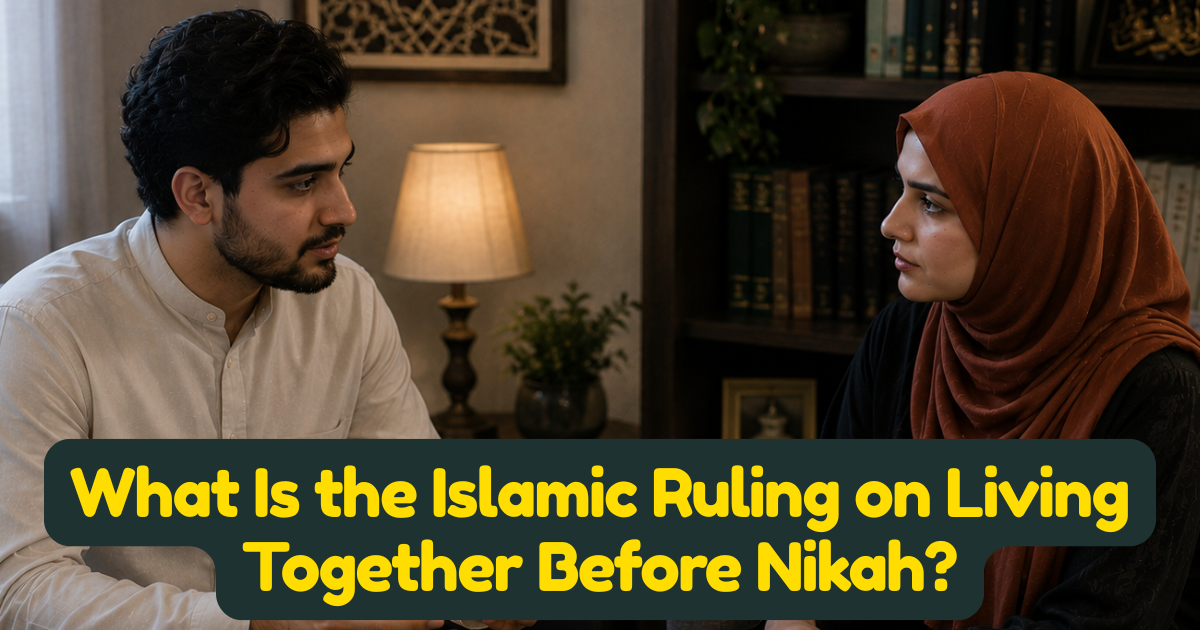
What Is the Islamic Ruling on Living Together Before Nikah? A Complete Guide for Muslims and Their Partners
The question arrives in many forms. A young Muslim man and woman who have been together for two years, living in the same flat in London, who have decided they want to marry Islamically but are not sure whether their current situation affects that process. A Muslim woman whose non-Muslim partner has moved in while they discuss whether he will take the shahada. A Muslim convert who has been cohabiting with their partner since before their conversion and now wants to understand what Islam requires of them going forward. A family that has discovered their son or daughter is living with a partner and wants to understand the Islamic position before deciding how to respond.
The question is not new. But it is being asked more urgently, more often, and from a wider range of situations than ever before — particularly among Muslims in the United Kingdom, the United States, Germany, France, Canada, Australia, and across every country where Muslim communities exist within a broader culture that treats cohabitation as normal, expected, and often preferable to marriage as a starting point for a committed relationship.
Islamic scholarship has a clear position on this question. Understanding that position fully — not just as a ruling to be accepted or rejected, but as a framework with reasons, with nuance, and with practical implications for real situations — is what this guide provides.
The Islamic Position: What the Qur'an and Sunnah Establish
The Islamic position on sexual relations and cohabitation outside of marriage is clear and consistent across all four major schools of jurisprudence: sexual relations between a man and a woman who are not bound by a valid nikah are prohibited. This prohibition — established in the Qur'an and confirmed in the authentic Sunnah — is not a cultural convention or a historically contingent ruling. It is a foundational principle of Islamic ethics governing the relationship between men and women.
The Qur'anic basis is explicit. In Surah Al-Isra (17:32), Allah commands: "And do not approach unlawful sexual intercourse. Indeed, it is ever an immorality and is evil as a way." The Arabic verb used — taqrabu, meaning "do not come near" — is significant. Islamic scholars have noted that the prohibition extends beyond the act itself to the circumstances and conditions that lead to it. It is a prohibition of approach as much as a prohibition of the act — reflecting Islamic law's concern with preventing harm at its roots rather than addressing it only at its fullest expression.
In Surah An-Nur (24:3), the Qur'an addresses the moral character of those who engage in unlawful sexual relations. In multiple authentic hadith, the Prophet Muhammad, peace be upon him, is reported to have prohibited khalwa — the seclusion of a man and a woman who are not in a mahram relationship — as a prophylactic measure designed to prevent the conditions in which unlawful relations become possible.
The specific question of cohabitation — living in the same household as a man and woman who are not in a valid nikah — is addressed by scholars through this framework. Cohabitation between an unmarried Muslim man and woman who are not mahram to each other creates the conditions — sustained daily intimacy, shared private space, mutual dependency — that Islamic ethics consistently seeks to prevent for those outside of a nikah. The Islamic ruling is therefore not merely about sexual relations narrowly defined but about the relational conditions that surround them.
Why Islam Establishes This Ruling: The Reasoning Behind the Prohibition
Islamic ethics is not a system of arbitrary prohibitions. Every significant ruling in Islamic law has reasoning — purposes that scholars have articulated through the framework of maqasid al-Shariah, the higher objectives of Islamic law. Understanding why Islam prohibits pre-nikah cohabitation helps Muslims engage with the ruling as intelligent, informed believers rather than as passive recipients of instructions.
The Protection of Lineage and Family Structure
One of the five foundational objectives of Islamic law — recognised across all four madhabs — is the protection of lineage (hifz al-nasl). The nikah contract is the mechanism through which Islamic law establishes the legal, social, and spiritual framework within which children are born, acknowledged, and raised with defined rights and identified parents. Pre-nikah cohabitation — particularly when it involves sexual relations — creates the possibility of children being born outside this framework, with the consequent uncertainty about lineage, rights, and identity that Islamic law has always sought to prevent.
The Protection of Women's Rights and Dignity
The nikah contract is the mechanism through which Islamic law establishes the wife's rights — to the mahr, to maintenance, to kind treatment, to acknowledged status as a spouse. A woman who cohabits with a man without a nikah holds none of these rights in Islamic law. She is in a relationship that may feel committed but that lacks the contractual structure that gives her enforceable protections. If the relationship ends, she has no mahr claim, no maintenance claim, and no Islamic legal standing as a spouse. Islamic law's insistence on the nikah as the condition for cohabitation is, in significant part, a protection of the woman's rights rather than a restriction of her freedom.
The Social and Psychological Purposes of Marriage
The Qur'an describes marriage as a relationship of sakan — tranquillity — and as a source of mawaddah wa rahmah — love and mercy (30:21). Islamic scholars have understood these descriptions as identifying purposes that the nikah contract is designed to serve and that pre-nikah cohabitation cannot reliably provide. The commitment, stability, and mutual accountability of the nikah create the conditions for these goods to develop. A cohabitation arrangement without nikah lacks the formal commitment that the nikah embodies — and research across a range of social contexts has consistently found that formal commitment affects the quality and stability of relationships in ways that informal arrangements do not replicate.
What "Living Together" Means in Practice: Different Scenarios
The question of pre-nikah cohabitation arises in several distinct practical scenarios, each of which requires slightly different engagement from an Islamic guidance perspective.
Scenario One: A Muslim Couple Planning to Marry
The most common scenario is a Muslim couple — both Muslim, both intending to marry — who are currently living together before their formal nikah. The Islamic ruling is clear: the nikah should be conducted as soon as possible. The couple is not in a permissible cohabitation arrangement under Islamic law, regardless of their intention to marry. Their sincere intention to marry is not, in Islamic jurisprudence, a substitute for the nikah itself.
The practical resolution is straightforward: conduct the nikah now, rather than waiting for a larger ceremony or a more convenient occasion. A nikah can be conducted simply, privately, and quickly — through a qualified scholar or online nikah service — and the larger celebration can follow at whatever time is appropriate. The nikah and the wedding celebration are different events, and delaying the nikah while planning the celebration creates an unnecessarily prolonged period of Islamic impermissibility.
Many Muslim couples in exactly this situation have found that a properly conducted nikah through a verified online service — before the formal wedding — provides the Islamic validity they need immediately, with the celebration following when the family arrangements are complete. This approach has deep roots in Islamic practice, where the nikah and the walima have always been separate events that can be separated significantly in time.
Scenario Two: A Muslim and a Non-Muslim Partner
A Muslim who is cohabiting with a non-Muslim partner faces a situation with additional complexity. A Muslim man may marry a woman from among the People of the Book — a Christian or Jewish woman — under specific conditions recognised in Islamic law. A Muslim woman may not marry a non-Muslim man under any mainstream scholarly position. In both cases, where a valid Islamic marriage cannot yet be contracted — either because the non-Muslim partner has not yet taken the shahada or because the Islamic conditions for an interfaith marriage are not met — the cohabitation arrangement is not Islamically permissible.
For a Muslim woman cohabiting with a non-Muslim man, the path forward in Islamic law involves the man's genuine conversion to Islam before a nikah can be contracted. A nikah between a Muslim woman and a non-Muslim man is not valid in Islamic law regardless of the sincerity of their relationship. This is one of the most difficult situations for Muslims in mixed-faith relationships to navigate — and one where compassionate but clear Islamic guidance is essential.
For a Muslim man cohabiting with a Christian or Jewish woman, the path forward involves the nikah being conducted as soon as both parties are prepared to do so — with the Islamic conditions for such a marriage properly addressed and with qualified scholarly guidance on the specific requirements and implications of an interfaith nikah in his madhab tradition.
Scenario Three: A Muslim Convert Already Cohabiting
A Muslim convert who was cohabiting with a partner before their conversion faces a specific situation that Islamic scholarship has addressed with care and nuance. The general scholarly principle is that Islam does not require new Muslims to immediately and disruptively unwind all of their previous life arrangements. The istislah principle — consideration of public interest and harm prevention — and the principle of gradual implementation both inform how scholars advise converts in exactly this situation.
The practical guidance for a convert who is cohabiting with a partner they intend to marry is to conduct the nikah as promptly as reasonably possible — ideally very soon after the conversion, so that the cohabitation is regularised within the Islamic framework with minimal delay. The nikah itself resolves the situation entirely and permanently. What Islamic scholarship consistently advises against is an indefinite continuation of the cohabitation without nikah, treating the conversion as a point of Islamic identity without addressing the relational situation it changes.
For a convert cohabiting with a non-Muslim partner who is not yet ready or willing to convert or marry, the situation is more challenging and requires genuine scholarly guidance tailored to the specific circumstances. A qualified Islamic scholar should be consulted — not because there is a single simple answer, but because the specific details of the situation significantly affect what guidance is appropriate.
Scenario Four: Two Non-Muslims Who Have Since Converted
Where both parties to a cohabiting relationship convert to Islam simultaneously or in close succession, the question arises of what their relationship status is in Islamic law and what steps are required. The scholarly guidance in this situation generally holds that a previous valid civil marriage between the two parties — if one exists — may be recognised as valid within the Islamic framework under the principle that the contracts of non-Muslims are recognised in their own frameworks. However, the nikah should still be conducted to establish the marriage within the Islamic contractual structure and to provide the formal Islamic documentation of the relationship.
Where no civil marriage existed — where the two parties were simply cohabiting — the nikah should be conducted as promptly as possible following their conversion, regularising the relationship within the Islamic framework without unnecessary delay.
Addressing the Common Objections
Muslims who receive Islamic guidance on cohabitation frequently encounter — in themselves or from partners and family members — a set of objections that are worth addressing directly and honestly.
"We Are Already Committed — How Is a Nikah Different?"
The commitment a couple feels toward each other is not in question. What a nikah provides is not emotional commitment — which may already exist fully — but a formal, contractual structure that gives the commitment legal substance in Islamic law. The nikah establishes rights and obligations that exist independently of the parties' feelings toward each other at any given moment. It is the difference between a relationship that depends entirely on mutual goodwill and one that is anchored in a contract that protects both parties regardless of how circumstances change. The mahr, the maintenance obligation, the acknowledged status as spouses — these are not provided by emotional commitment. They are provided by the nikah contract.
"We Cannot Have a Big Wedding Right Now"
This objection reflects a widespread confusion between the nikah and the wedding celebration. They are entirely separate events in Islamic tradition. The nikah is the contract — simple, short, and requiring only the essential parties and conditions. The wedding celebration — the walima — is a separate event that can take place at any convenient time after the nikah. A couple who cannot afford or arrange a large wedding celebration right now can conduct their nikah today — privately, simply, through a qualified scholar or online service — and hold their celebration when circumstances allow. Postponing the nikah while waiting for a convenient time to celebrate is a choice that creates an unnecessary period of Islamic impermissibility when the contract itself could be conducted immediately.
"My Family Does Not Know About This Relationship Yet"
This objection is common among couples whose families are not yet aware of their relationship. While family involvement in the nikah is important — particularly the wali's role — it is not an insurmountable obstacle. For a couple in this situation, the options include: approaching the bride's father or next-available wali to conduct the nikah, even if the relationship is being disclosed for the first time; approaching a qualified Islamic scholar or online qazi to act as wali al-amr where the wali is not available or will not be involved; or seeking guidance from a qualified scholar about the specific circumstances and what approach is most appropriate. The family not yet knowing about the relationship is a reason to have a conversation with the family — not a reason to delay the nikah indefinitely.
"We Want to Make Sure We Are Compatible First"
Islamic law does not require cohabitation as a mechanism for assessing compatibility. It provides extensive opportunities for couples to meet, speak, and assess compatibility within permissible boundaries — with the involvement of family members, through chaperoned meetings, through the extended process of istikhara and sincere reflection. The Islamic position is not that compatibility is unimportant — it is that cohabitation outside nikah is not the appropriate mechanism for assessing it, and that the nikah itself provides the stable, committed framework within which genuine compatibility develops over time.
What Global Scholarly Institutions Have Confirmed
Dar al-Ifta al-Misriyyah — Egypt's official government fatwa authority — has addressed the question of pre-nikah cohabitation in the context of Muslim communities in the West and in the context of Egyptian Muslims in contemporary social circumstances. Their position is consistent with the classical scholarly tradition: cohabitation outside of a valid nikah is not permissible in Islamic law, and the resolution is the prompt conduct of a properly structured nikah rather than an indefinite continuation of the impermissible arrangement. Dar al-Ifta has specifically addressed the practical accessibility of the nikah — emphasising that the simplicity of the Islamic marriage contract means that practical barriers to an immediate nikah are rarely as significant as couples believe them to be.
Al-Azhar University — the world's most globally recognised centre of Sunni Islamic scholarship — has consistently affirmed the prohibition of cohabitation outside of nikah and the importance of conducting the nikah promptly when a couple intends to marry. Al-Azhar scholars have specifically addressed the situation of Muslim couples in Western countries where cohabitation is culturally normalised — emphasising that the cultural normalisation of a practice does not affect its Islamic ruling, and that Muslims living in non-Muslim majority societies have a particular responsibility to understand and maintain the Islamic framework governing their relationships.
In the United Kingdom, the Muslim Council of Britain (MCB) has addressed the situation of British Muslims navigating the tension between Islamic marriage requirements and the cultural norms of British society — where cohabitation rates are among the highest in Europe. The MCB has emphasised the importance of the nikah as the Islamic foundation for Muslim relationships and has specifically addressed the practical accessibility of properly conducted nikah ceremonies for British Muslims, including those in urban areas where large communities and qualified scholars are readily available.
In North America, the Islamic Society of North America (ISNA) has published guidance on Islamic marriage and pre-marriage relationships specifically addressing the American Muslim context — where dating and cohabitation norms among young people create significant pressures on Muslim youth. ISNA scholars have emphasised that the Islamic framework for relationships — while different from the surrounding cultural norm — provides genuine protections and goods that cohabitation outside nikah does not, and that the accessibility of properly conducted Islamic marriage through Islamic centres across North America means that practical barriers to the nikah are rarely insuperable.
The Islamic Fiqh Academy of the Organisation of Islamic Cooperation (OIC) has addressed the situation of Muslim minorities in non-Muslim majority countries — specifically the challenge of maintaining Islamic standards for personal relationships in social contexts where those standards are neither legally required nor culturally expected. Their framework consistently affirms that the Islamic rulings governing marriage and cohabitation apply to Muslims regardless of the civil legal or cultural context they inhabit.
In Germany, the Zentralrat der Muslime in Deutschland has addressed the specific pressures facing German Muslim youth navigating Islamic relationship standards within German cultural contexts where cohabitation before marriage is widespread and socially normalised. Their guidance affirms the Islamic ruling while specifically addressing the practical pathways available to German Muslims who wish to conduct their nikah promptly and properly — including the availability of qualified Islamic scholars and institutions across Germany.
In France, the Conseil Français du Culte Musulman (CFCM) has similarly addressed the situation of French Muslim youth navigating Islamic relationship standards within a French cultural context that strongly normalises secular cohabitation. Their guidance emphasises the Islamic nikah as the appropriate framework for Muslim relationships and provides direction toward properly conducted Islamic marriages as the resolution for Muslims currently in impermissible cohabitation arrangements.
In Europe more broadly, the Council of Europe's research on family law and religious communities has documented the specific challenges faced by Muslim communities in European countries — where Islamic marriage standards exist in tension with civil cohabitation norms. Their research has specifically noted the importance of accessible, properly conducted Islamic marriage services for Muslim minority communities as a means of supporting community members who wish to regularise their relationships within their religious framework.
The Path Forward: How to Resolve the Situation
For Muslims who are currently in a cohabitation arrangement outside of nikah — regardless of the specific circumstances — the Islamic guidance is consistent: the resolution is the nikah, conducted as promptly as reasonably possible. The path to that resolution is more accessible than many Muslims assume.
Step One: Understand That the Nikah Can Be Conducted Now
The nikah does not require a large ceremony, an expensive event, or months of planning. It requires the essential conditions to be met: the wali's involvement or a wali al-amr arrangement, two qualified Muslim witnesses, a specified mahr, and the ijab and qabool conducted correctly under qualified Islamic oversight. These conditions can be met in a private, simple ceremony conducted through a verified online nikah service — accessible from anywhere in the world, at a time that suits the couple's circumstances.
Step Two: Address the Wali Question
For many couples in cohabitation situations, the wali question is the most complex element. If the bride's family is not yet aware of the relationship, this requires addressing — either by informing the family and involving the father or next available male relative, or by approaching a qualified Islamic scholar to act as wali al-amr. The wali question is not an insurmountable obstacle. It is a practical matter that requires planning and, in many cases, honest conversation with family members.
Step Three: Conduct the Nikah
Once the wali question is resolved and the other conditions are in place, the nikah can be conducted — simply, privately, with proper Islamic oversight and full documentation. The nikah resolves the Islamic situation immediately and completely. From the moment the contract is properly concluded, the couple is Islamically married, with all the rights and obligations that entails.
Step Four: Consider Civil Registration
In countries where the nikah does not automatically carry civil legal standing — including the UK, USA, Germany, and France — the couple should also consider civil registration to ensure their marriage has the full protection of civil law as well as Islamic law. This is particularly important for the practical protections it provides to the wife in areas of property, inheritance, and legal status as a spouse.
Step Five: Plan the Walima When Ready
The celebration — the walima — can take place at whatever time is appropriate for the couple's circumstances. It may be immediately after the nikah, or it may be months later when the family situation, the finances, or the logistics are more favourable. The nikah and the walima are separate events, and there is no Islamic requirement that they occur simultaneously.
A Note for Non-Muslim Partners of Muslims
For non-Muslim partners of Muslims who are navigating this question — who may have received information about the Islamic ruling from their Muslim partner and are trying to understand what it means and what it requires of them — the following points are offered with genuine respect for the complexity of their situation.
The Islamic ruling on cohabitation before nikah is not a statement about the non-Muslim partner's character, commitment, or worth. It is an expression of the Islamic framework governing Muslim relationships — a framework that exists to protect both parties and to establish the committed, contractually structured relationship that Islam considers the appropriate context for a shared life.
For a non-Muslim partner who is considering conversion to Islam — sincerely, out of genuine conviction rather than as a prerequisite for marriage — the resources of globally respected Islamic institutions are available to provide honest, complete information about what Islam is and what it requires. Conversion made for the purpose of marriage without genuine conviction is not a sincere conversion and does not serve either party's long-term wellbeing.
For a non-Muslim partner who is not considering conversion — who wishes to understand what the Islamic requirement means for the relationship without contemplating Islam themselves — honest conversation with the Muslim partner, guided by genuine mutual respect for each other's frameworks and commitments, is the foundation from which any lasting resolution must be built.
How InstantNikah.com Provides an Accessible Path to a Valid Nikah
At InstantNikah.com, the barriers that lead Muslim couples toward prolonged cohabitation without nikah are directly and practically addressed. A properly conducted, Shariah-compliant nikah is accessible through a verified video call — from anywhere in the world — with a qualified online qazi presiding, witnesses confirmed, the wali condition properly addressed, the mahr formally agreed and recorded, and a comprehensive nikah certificate issued immediately after the ceremony.
For couples who need the nikah conducted urgently — because they are in a situation they want to resolve promptly within the Islamic framework — the same day nikah service and the express nikah service provide fast, properly structured, professionally overseen nikah ceremonies with minimal advance notice required.
For converts navigating the cohabitation question alongside the many other adjustments that conversion involves, the complete guide to online nikah for converts and the pre-nikah checklist for Muslim converts provide the foundational guidance needed to approach the nikah with confidence and clarity.
For couples with questions about the wali, the witnesses, the mahr, or any other element of the nikah, the full range of InstantNikah's scholarly resources provides detailed, authoritative, and practically grounded guidance across every dimension of Islamic marriage law.
The nikah is not a distant, complex, expensive aspiration. It is an accessible reality — available today, properly conducted, fully documented, and genuinely protective of both parties. Explore the full process here, read verified reviews from couples worldwide, or book your nikah today.
Admin User
Author