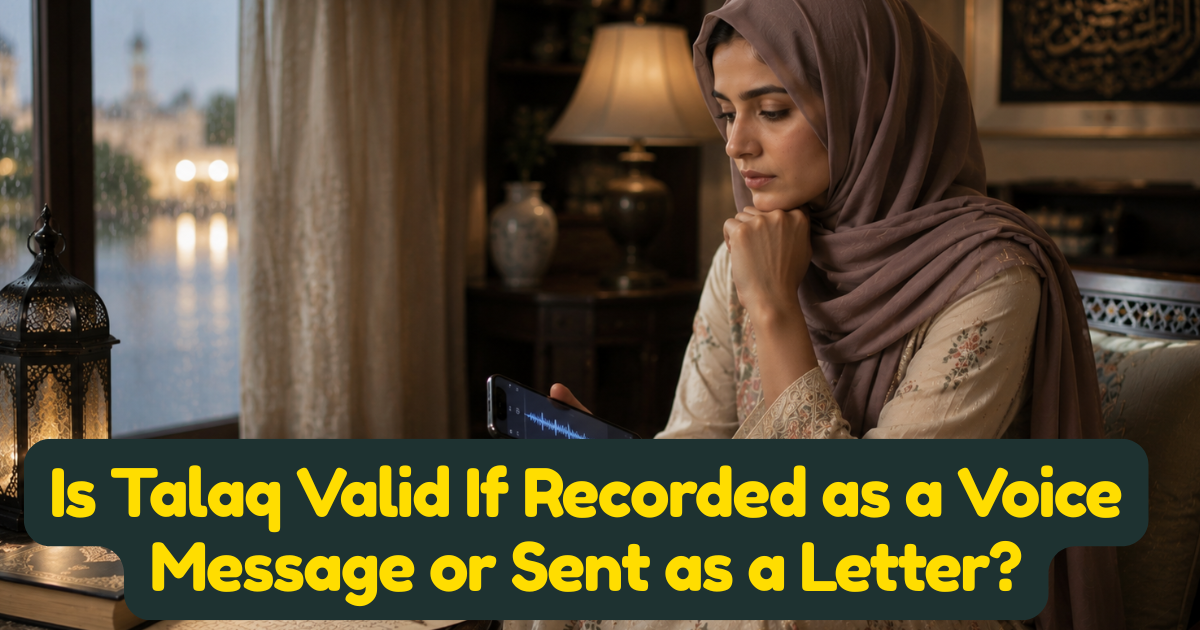
Is Talaq Valid If Recorded as a Voice Message or Sent as a Letter?
Plenty has been written about talaq by text message, but two close cousins of that question rarely get a proper answer: what about a voice note recorded and sent later, and what about an old-fashioned written letter? Both formats are common in real marriages — a husband travelling for work leaves a voice message instead of calling, or a man writes a letter rather than confront his wife directly. The good news is that Islamic jurisprudence has actually thought this through in detail, just not always under headings that mention "voice notes."
Written Talaq Has Its Own Detailed Classification
A letter is, legally speaking, the easier of the two cases, because written divorce has been a recognised category since the classical period. A detailed academic paper from the University of Cape Town's Department of Religious Studies, "The Moral and Legal Dimensions of Talaq by SMS: A Critical Reading", lays out the Hanafi classification clearly: written talaq is divided into mustabinah (clear, manifest writing that leaves a permanent trace, such as ink on paper) and ghair mustabinah (writing with no lasting trace, such as tracing letters in the air or on water). Mustabinah writing is further split into marsumah — writing properly addressed and directed to the wife by name, in the conventional form of a letter or document — and ghair marsumah, which lacks that direct address. A handwritten letter, addressed to the wife and containing clear divorce wording, sits squarely in the marsumah category, which is the strongest and most universally accepted form of written talaq across all four Sunni schools, according to the same paper.
The same source notes an important caveat on the Shafi'i side: an explicit written talaq without genuine intention behind it is considered invalid in that school, and the Ja'fari (Twelver Shia) position is markedly more restrictive overall, generally rejecting written talaq except where the husband is physically unable to speak. So a letter's validity, like so much else in this topic, depends partly on which school the couple follows — but for the Hanafi majority, a properly addressed written letter is about as solid a form of talaq as exists.
Where a Voice Recording Actually Fits
A recorded voice note isn't writing at all — it's the husband's own spoken voice, captured and delivered later rather than heard live. That distinction matters, because Islamic law has already settled the closely related question of real-time spoken divorce delivered remotely. A detailed Hanafi ruling published on Darul Ifta Birmingham's answer on talaq given over the phone confirms that being in the physical presence of one's spouse is not a precondition for talaq to take effect, and that a phone-pronounced talaq — whether revocable or irrevocable — occurs exactly as it would face-to-face, provided the husband is sane, mature, and uses clear (sarih) wording.
A recorded voice message extends this reasoning quite naturally: it is still the husband's own spoken words, in his own voice, simply played back rather than heard in real time. If anything, a voice recording offers stronger evidentiary value than a live phone call, since the wife can replay the exact wording rather than relying on her memory of what was said. A separate fatwa on Darul Fiqh's ruling on talaq via SMS reinforces the underlying principle from a different angle: a single clear pronouncement, delivered through whatever medium, materialises one talaq the moment it's received — the medium is incidental to the legal act itself.
The Real Risk Isn't Validity — It's Verification
Where digital and recorded formats genuinely complicate things isn't usually the religious ruling, but proving what was actually said and by whom. This is a live concern among Islamic scholarly bodies dealing with modern communication. A US-based family law perspective from a Houston, Texas divorce attorney's overview of digital talaq notes that scholars broadly accept written declarations such as "I divorce you" as constituting valid talaq when properly evidenced, while flagging that the lack of face-to-face communication in digital and recorded mediums raises real practical concerns about confirming authenticity and intent, particularly when a recording or message could plausibly be edited, sent by someone else, or taken out of context.
- For a voice note: save the original audio file and the metadata around it (date sent, number it came from) rather than relying on a transcript alone.
- For a letter: a letter that is signed, dated, and clearly addressed to the wife by name carries far more weight than an unsigned note, precisely because it satisfies the marsumah standard discussed above.
- In both cases: if there's any doubt about authenticity — a recording with unclear audio, a letter with disputed handwriting — the matter should go to a scholar or qazi for verification before either spouse acts as though the marriage has definitively ended.
Key Takeaway
A clearly worded letter addressed to the wife is one of the strongest classical forms of written talaq, and a recorded voice message extends the same reasoning that already makes a real-time phone call valid — both are recognised in mainstream Sunni fiqh, with the Shia position remaining notably stricter on written and remote divorce generally. The genuine modern challenge isn't whether these formats can carry a valid talaq; it's making sure both spouses can verify, beyond doubt, exactly what was said, by whom, and with what intention.
Admin User
Author