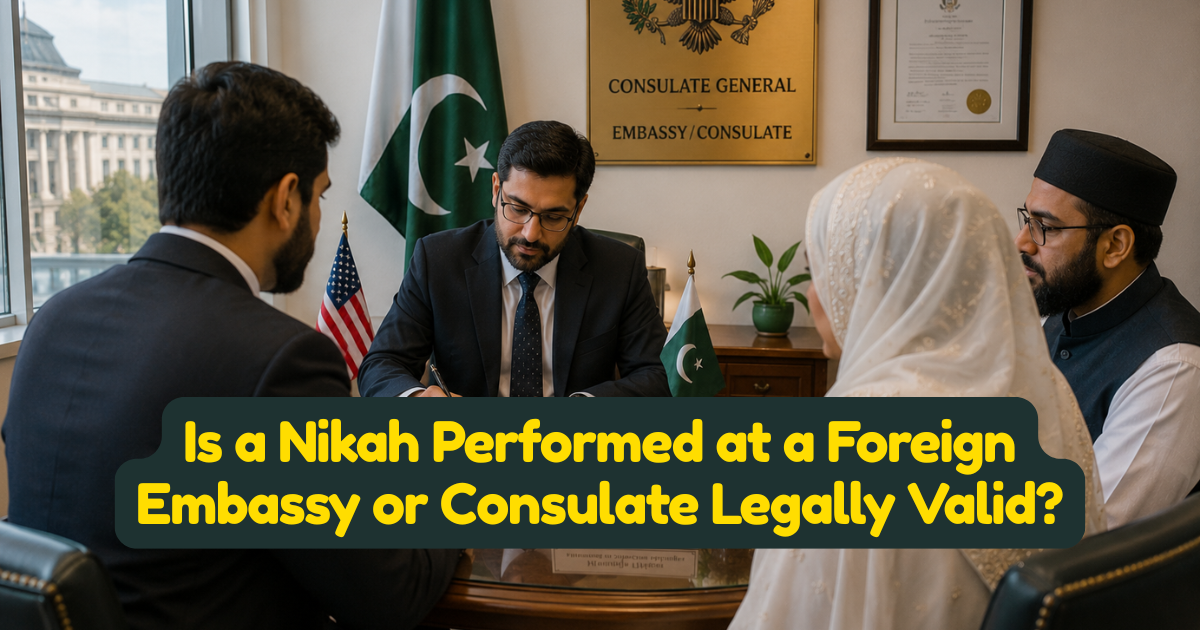
Can You Get Married at an Embassy or Consulate? What the Law Actually Says
There's a persistent myth that marrying "at the embassy" is a fast, neutral shortcut when a couple is dealing with two different nationalities and two different countries' paperwork. For most nationalities, it is the opposite of a shortcut.
US Citizens: Embassies Do Not Perform Marriages
According to the US Department of State's official guidance on marriage abroad, US embassy and consulate employees are not permitted to perform marriages in foreign countries under any circumstances. The validity of a marriage abroad depends entirely on whether it complies with the local law of the country where it takes place — not on any American official's presence. The State Department's Foreign Affairs Manual, in its section on marriage of US citizens abroad, confirms this is governed by federal regulation (22 CFR 52.1), and that consular officers' only role is notarizing an "affidavit of eligibility to marry" — not officiating.
UK Citizens: A Genuine Exception, With Strict Conditions
The UK is the notable exception. Under GOV.UK's official guidance on consular marriage, British nationals unable to marry locally in their destination country can, in a specific list of countries, marry at a British embassy, high commission, or consulate — a "consular marriage" that is recognized in UK law exactly as if it took place in England, Wales, Scotland, or Northern Ireland. This requires giving notice in person, a 14-day public notice period, and completion within three months — it is a formal civil process, not a walk-in ceremony.
Embassy Marriages Performed on UK Soil for Other Nationals — A Trap
There's a separate and frequently misunderstood scenario: a foreign embassy located inside the UK performing a marriage under its own country's law for two foreign nationals. According to a detailed legal analysis by the International Family Law Group's review of embassy and consulate marriage recognition, such a marriage is treated as taking place in England — meaning it must comply with English marriage law to be recognized in England, regardless of whether it satisfied the laws of the embassy's home country. The Home Office has confirmed that couples married this way, without separately satisfying English requirements, are not treated as spouses for immigration purposes — a gap that has derailed more than one spousal visa application.
The Islamic Ceremony Sits Alongside, Not Instead Of
None of this changes the validity of the nikah itself as an Islamic contract — wali, witnesses, mahr, and offer/acceptance remain the standard regardless of geography. What it changes is whether the marriage is recognized by the relevant civil authorities for visa, inheritance, tax, and benefit purposes. For diaspora and long-distance couples, the safest sequence is almost always: complete the civil marriage requirements in whichever jurisdiction is simplest (often the home country of one spouse, or via the consular marriage route where available), and have the Islamic nikah performed either alongside it or shortly after, with full documentation tying the two together.
Why This Trips Up So Many Couples
Couples planning an international nikah frequently assume the embassy can solve the "which country's law applies" problem in one step. It almost never does — and assuming otherwise has led to marriages that are religiously valid but civilly invisible, with all the downstream visa and inheritance complications that follow.
Admin User
Author