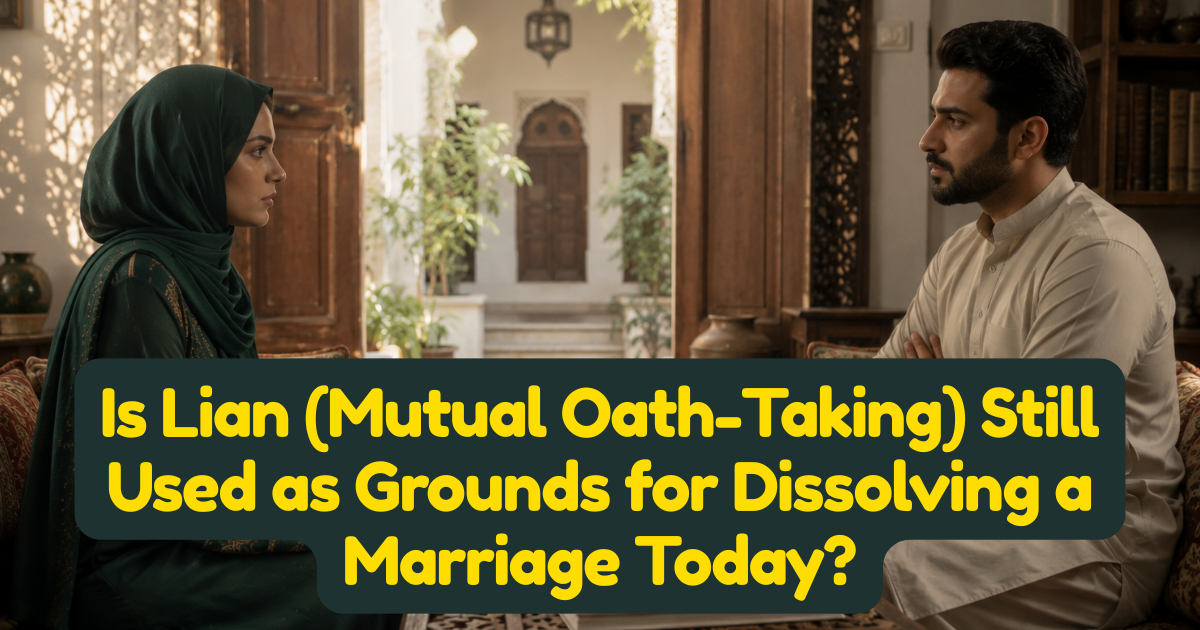
Is Lian (Mutual Oath-Taking) Still Used as Grounds for Dissolving a Marriage Today?
Lian addresses a genuinely difficult problem: what happens when a husband believes his wife has committed adultery but has no witnesses to prove it? Without a real mechanism to resolve this, he'd be stuck choosing between silently suffering a suspicion he can't prove, or making an accusation that could itself bring serious punishment if he can't substantiate it. Lian, established directly in the Quran, provides a formal, solemn way through this impasse — and it remains a real, recognised legal mechanism, even if it's invoked far less often than ordinary divorce.
The Quranic Procedure Itself
A detailed explanation of li'an as the Quranic oath of condemnation describes the mechanism set out in Surah An-Nur (24:6-9) precisely: the husband testifies four times that he is telling the truth, with a fifth oath invoking Allah's curse upon himself if he is lying. The wife is then given the chance to avert the punishment for adultery by testifying four times that he is lying, with her own fifth oath invoking Allah's wrath upon herself if he is, in fact, telling the truth. The same source describes lian aptly as a kind of "social safety valve" — without it, a husband faced an impossible choice between suffering in silence, divorcing his wife while paternity remained suspect, or making a public accusation and facing corporal punishment for slander if he couldn't produce the otherwise-required four witnesses.
What Happens If a Spouse Refuses to Swear
The classical schools differ meaningfully on what happens if the wife declines to take her oath. A detailed comparative explanation on the Islamic legal procedure following an accusation of adultery notes that Abu Hanifah held she should simply be imprisoned until she complies, while Al-Shafi'i, the Shafi'i school, and Malik held she should instead face the punishment for adultery directly — stoning if the marriage had been consummated, or flogging if it hadn't — making this a genuinely high-stakes process for both spouses, not a routine procedural formality.
Three Permanent Consequences Once Both Oaths Are Completed
Once both spouses have completed their respective oaths, classical jurists agree the outcome is immediate and final, producing three distinct effects: it averts the prescribed corporal punishments for both slander and adultery, it permanently and irrevocably dissolves the marriage, and — per the majority view, including the Shafi'i school and Malik — it bars the couple from ever remarrying each other afterward. Notably, a divorced wife in this situation retains her mahr; classical reasoning, attributed to the Prophet, holds that even an unproven accusation doesn't strip her of payment owed for the marital relationship that did genuinely take place.
Why Lian Is Rare in Modern Practice
- Modern courts and Sharia councils generally prefer faskh or khula for marital breakdown, since these don't require either spouse to make or face an irreversible public accusation under religious oath.
- The procedure's solemnity and severity make it a genuinely heavy step — most disputes, even ones touching on suspected infidelity, are more commonly resolved through ordinary divorce mechanisms instead.
- Lian remains specifically relevant when paternity is genuinely in question — its core function, denying a child's paternity in the absence of proof, has no real substitute in other divorce mechanisms.
- A husband considering this route should understand that lian ends the marriage permanently and irrevocably the moment both oaths are completed — there is no reconciliation period or revocation available afterward, unlike a single revocable talaq.
Key Takeaway
Lian remains a genuine, Quranically established mechanism rather than a purely historical curiosity — it still exists in Islamic legal procedure specifically for the situation it was designed to address: an unprovable adultery accusation, often tied to a paternity dispute. In practice today, most marital disputes — even ones touching on suspected infidelity — are resolved through more common routes like faskh, khula, or talaq, since lian's permanence and severity make it a genuinely heavy, rarely invoked step rather than a routine option. Where paternity itself is the central, unresolved issue, however, lian remains the specific tool Islamic law provides for that exact problem.
Admin User
Author