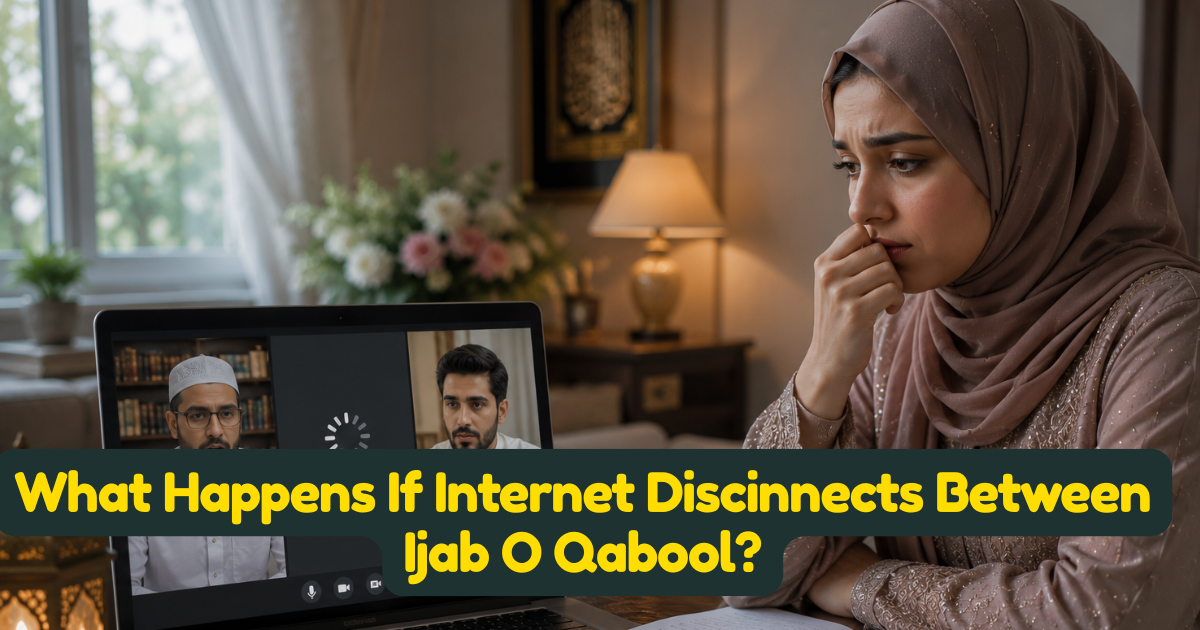
What Happens If the Officiant's Internet Disconnects Right After Ijab but Before Qabul?
It's precisely the kind of scenario that keeps couples up the night before an online ceremony: the officiant delivers the offer, and right at that pivotal moment, the connection freezes, drops, or cuts out entirely before the groom's acceptance can be clearly heard. It's a real technical risk inherent to any video-based process, and understanding exactly what happens in this situation — and why it doesn't actually threaten the marriage's eventual validity — should ease much of that pre-ceremony worry.
Why an Incomplete Exchange Simply Isn't Yet a Completed Contract
This is the most important thing to understand: if a connection drops between the offer and the acceptance, no marriage contract has actually been formed at that point. The nikah requires both the offer and a corresponding, clearly heard acceptance to constitute a valid contract — an offer alone, without acceptance, is simply an incomplete exchange, not a partially valid or ambiguously valid marriage. There is nothing to undo, correct, or worry retroactively affected, because nothing was completed in the first place.
What a Properly Trained Officiant Does When This Happens
A qualified officiant, upon a connection interruption at this stage, simply pauses the ceremony, works to restore the connection, and once everyone is reconnected and re-confirmed as present and attentive, repeats the full exchange from the beginning — the offer is stated again clearly, and only then is the acceptance given, ensuring witnesses hear a single, complete, uninterrupted exchange rather than a fragmented one pieced together across a technical interruption.
Why Repeating the Full Exchange Matters, Rather Than Just Resuming From Where It Dropped
It might seem more efficient to simply pick up where the connection dropped — having the groom give his acceptance once reconnected, treating the earlier offer as still standing. However, best practice among careful officiants is to restate the full offer and acceptance together as one continuous, clean exchange once the connection is stable again, since this removes any ambiguity about whether the original offer was heard clearly enough by all witnesses before the interruption, and about whether witnesses remained genuinely continuously attentive across the gap.
What Happens to Witnesses During the Interruption
If witnesses also lost connection during the interruption, or even if they remained connected but the disruption created genuine uncertainty about what exactly was heard clearly, the safest and standard approach is the same: restart the full offer-and-acceptance exchange once everyone is confirmed reconnected and attentive, rather than trying to reconstruct or debate what portions were adequately witnessed before the interruption occurred.
Technical Safeguards That Reduce This Risk in the First Place
Reputable online nikah services take several practical steps to minimize the chance of this happening at all: confirming a stable connection for all core participants before beginning the formal ijab-qabul exchange, having a backup communication platform ready in case the primary one fails, and structuring the ceremony so the officiant can clearly see connection status for all participants before proceeding with the core exchange rather than beginning it the moment everyone appears to have joined the call.
What If the Interruption Happens Repeatedly
In situations with genuinely unreliable connectivity — particularly relevant for couples in the deployment or maritime scenarios covered elsewhere on our site — repeated interruptions may require the officiant to switch to an audio-only fallback, where a more stable but lower-bandwidth connection type can support a clean, complete exchange even where full video proves unreliable, always prioritizing a clean, complete, and clearly witnessed exchange over rushing through a fragmented one purely to finish on schedule.
Why Rushing Through a Fragmented Exchange Should Never Happen
It's worth being direct about this: an officiant should never treat a technically fragmented, interrupted exchange as sufficient simply to avoid the inconvenience of restarting. Doing so risks creating genuine ambiguity about whether witnesses heard a complete, coherent offer and acceptance — exactly the kind of ambiguity that, as covered in our article on contradicting witness accounts, can create real uncertainty about a marriage's validity years later. A brief delay to properly restart the exchange is always the better path.
How This Affects the Certificate and Documentation
The certificate ultimately issued reflects the ceremony as it was actually and completely conducted — meaning the date and details recorded reflect the successful, complete exchange, not the earlier interrupted attempt. There's no need to note the technical interruption on the certificate itself, since it doesn't affect the validity of what was ultimately and properly completed.
Reassurance for Couples Worried About This Beforehand
If you're feeling anxious about this exact scenario before your own ceremony, it's worth remembering that officiants who conduct online ceremonies regularly have encountered connection issues before and know exactly how to handle them calmly — a brief technical pause is a minor logistical hiccup, not a threat to your marriage, and a well-prepared officiant will guide you smoothly through restarting the exchange without any lasting concern about what occurred.
How InstantNikah.com Handles Connection Interruptions
Our officiants are trained to pause immediately if a connection issue interrupts the offer-and-acceptance exchange at any point, restoring stable connectivity for all core participants before restarting the full exchange cleanly from the beginning — ensuring the certificate we ultimately issue always reflects a genuinely complete, properly witnessed ceremony.
Admin User
Author