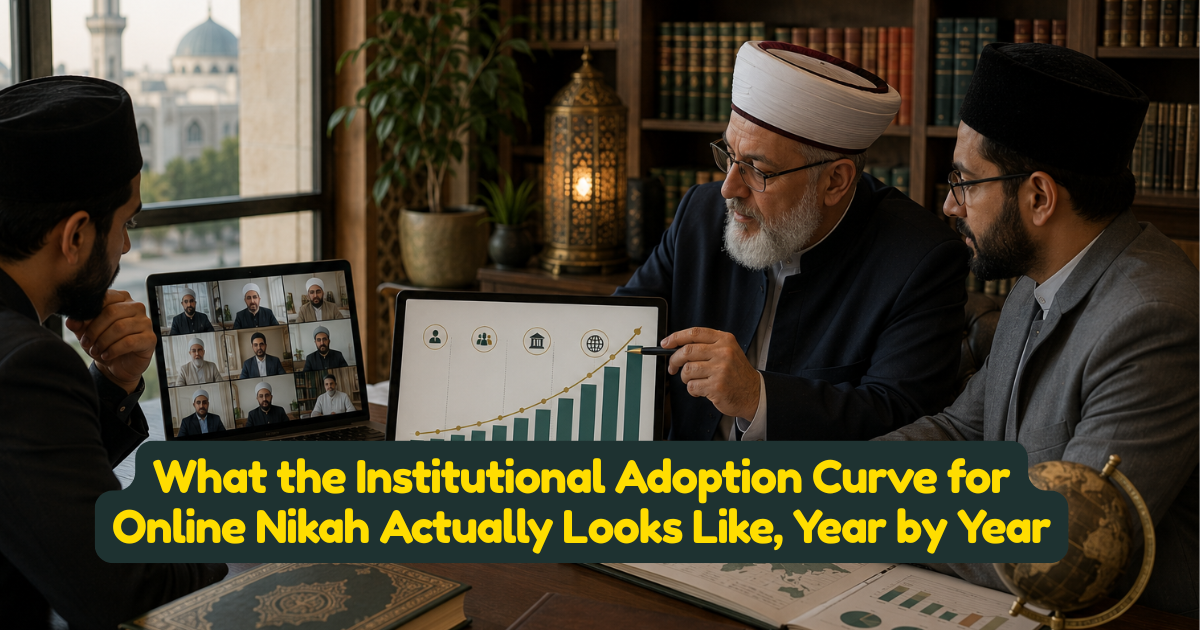
What the Institutional Adoption Curve for Online Nikah Actually Looks Like, Year by Year
The most common skeptical objection to online Nikah is that it's a pandemic-driven shortcut that will fade as normal life resumes. The real, dated chronology of formal institutional decisions tells a genuinely different story — one that starts well before COVID-19, continues well after it, and shows no sign of the pattern reversing.
2011: The Real Starting Point, Nine Years Before Anyone Had Heard of COVID-19
This is the real, dated fact that undercuts the "pandemic workaround" framing most directly. Malaysia's National Fatwa Council formally ruled in 2011 that video-conference solemnisation of marriage is permissible where a designated location is obstructed, provided the ceremony meets standard conditions of certainty and freedom from fraud. The same year, Mali's Code of Persons and the Family gave religiously-celebrated marriage the same legal force as civil marriage — a separate, independent 2011 development in a different country and legal system entirely.
2016: Rwanda's Digital Civil Registry Framework
Rwanda's Law No. 32/2016 established the legal framework its IremboGov digital marriage booking platform now operates under — a genuine, real mid-decade development, again well before the pandemic created any acute pressure toward remote solutions.
2020: The Genuinely Documented Acceleration Point
This is the real, well-known inflection point — but the chronology shows it as an acceleration of an existing trend, not its origin. Malaysia's Jawi created its specific "Jawi Marriage Permit" in April 2020, and Singapore's MUIS issued its own formal advisory around the same period. Real UK marriage statistics from the same year — an 87-year-low collapse to 85,770 marriages — show exactly why this specific period produced such concentrated institutional activity: genuine, acute infrastructure failure forcing formal responses.
2022: Reform Continuing Well After the Acute Crisis Passed
This is the detail that most directly refutes the "temporary crisis measure" framing. Saudi Arabia's Personal Status Law, formally codifying its Najiz e-marriage system with video-conference officiant participation as standard national infrastructure, was enacted in 2022 — two years after the initial pandemic emergency, at a point when in-person gatherings had already resumed widely across the region. This is a government building permanent infrastructure well after any acute crisis-driven need had passed.
2024-2026: The Pattern Still Actively Continuing
This is genuinely current, ongoing evidence the trend hasn't plateaued. Guinea's mosque-document reform, formalising how religious ceremonies feed into civil registration, has been actively rolling out into 2026. Iraq's 2025 Personal Status Law reform restructured how marriage registration itself works nationally. These are real, current, still-unfolding developments — not historical footnotes from a closed chapter.
What the Real Shape of This Curve Actually Shows
Plotted honestly, this is not a spike that rises sharply in 2020 and falls back afterward. It's a real, gradual, multi-decade curve that begins in 2011, continues through a genuine mid-decade development in 2016, accelerates sharply during the documented 2020 infrastructure crisis, and then — critically — keeps producing new, permanent institutional commitments in 2022, 2024, 2025, and 2026, well past any point where "pandemic emergency" remains a plausible explanation.
Why the Post-Crisis Continuation Is the Most Important Data Point
If this were genuinely a temporary crisis accommodation, the real, dated record should show new institutional commitments stopping once in-person gatherings resumed widely — roughly 2021-2022 onward. Instead, the record shows the opposite: Saudi Arabia's most comprehensive infrastructure commitment came in 2022, and genuinely new developments continued through 2025 and 2026. This specific pattern — continued, accelerating institutional investment well after the original crisis passed — is the strongest available evidence against the "temporary workaround" framing.
What This Means for How Skeptics Should Weigh This Objection
Given this real, dated chronology, the "isn't this just pandemic-driven" objection doesn't hold up against the actual record: the trend predates the pandemic by nine years, and has continued producing genuinely new institutional commitments for years after the acute crisis passed.
Frequently Asked Questions
Did institutional recognition of online/civilly-integrated Nikah start with the pandemic? No — Malaysia's National Fatwa Council ruling and Mali's Family Code provision both date to 2011, nine years before COVID-19.
Has institutional investment continued after the pandemic ended? Yes — Saudi Arabia's most comprehensive commitment came in 2022, and Guinea's and Iraq's reforms have continued rolling out through 2025 and 2026.
What's the strongest evidence this isn't just a temporary crisis measure? The fact that new, permanent institutional commitments kept appearing well after in-person gatherings had already resumed widely.
Suggested Internal Links
Zainab Butt
Author