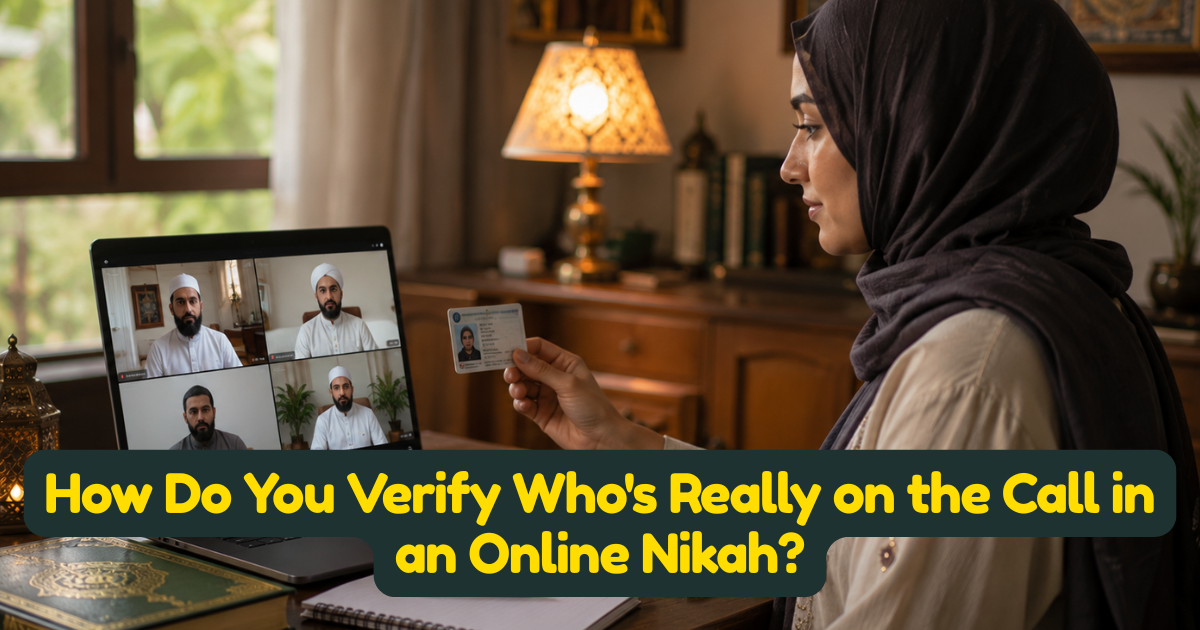
There's a real, direct overlap between two concerns that might seem separate at first: the scholarly caution around online nikah's validity, and the broader, well-documented world of romance and marriage fraud. Both concerns trace back to the same root issue — that a screen makes it genuinely possible to misrepresent who someone actually is.
Why This Is a Validity Question, Not Just a Safety Question
A detailed ruling on online nikah makes this connection explicit. The Islamic Fiqh Council's more cautious position notes specifically that deceit and trickery are widespread, and that some people are skilled at imitating others' voices convincingly enough that a listener could mistake one person for several, or be deceived about who is actually speaking — concerns the council raised specifically to protect the integrity of marriage contracts from exactly this kind of manipulation. Even the more permissive scholarly position that allows online nikah builds in the same condition directly: it's permissible specifically where there's no danger of tampering and the identities of the husband and wali are properly established. Identity verification isn't an extra precaution layered on top of the ceremony — for many scholars, it's a condition of the ceremony's validity itself.
The Same Pattern Shows Up in Ordinary Romance Fraud
This concern isn't unique to religious marriage contracts — it's the exact mechanism behind a well-documented category of fraud. The FBI's guidance on romance scams describes how scammers build trust over time, often avoiding video calls or in-person meetings with elaborate excuses, before eventually requesting money once that trust is established. A detailed guide to avoiding online matrimony fraud specifically recommends scrutinising a person's broader online presence for inconsistencies, and treating any reluctance to involve family or appear on video as a genuine red flag rather than something to politely overlook.
Practical Verification Steps for an Online Nikah Specifically
- Insist on live video, not voice-only, for every key participant — the bride, groom, wali, and both witnesses — well before the ceremony itself, not just on the day.
- Check government-issued ID against the person on screen, ideally in a separate verification call before the actual ceremony, rather than assuming a name alone is sufficient.
- Involve family members directly in the verification process, since they often recognise inconsistencies a stranger or even an officiant might miss.
- Be cautious of any reluctance to appear clearly on camera, or repeated technical excuses for not doing so — this is one of the most consistently cited red flags across both matrimonial fraud guidance and the classical concern about voice manipulation.
- Use a reputable, experienced online nikah service rather than an informal arrangement, since established services typically have verification steps already built into their process.
Why This Protects Everyone, Not Just the Vulnerable Party
Proper identity verification doesn't just protect against deliberate fraud — it also protects the marriage's own religious standing. A ceremony conducted with genuine, confirmed identities on all sides removes any later question about whether the contract was properly formed, which matters enormously if the marriage is ever challenged or questioned years down the line. The same verification habits that prevent a scam also build a stronger, more defensible record of a genuinely valid nikah.
Key Takeaway
Identity verification in an online nikah isn't a separate safety add-on — it's directly tied to the scholarly concern that originally shaped how online nikah is even judged to be valid in the first place. The same practical steps that satisfy that religious condition — live video, ID checks, family involvement, watching for reluctance to appear on camera — are exactly the steps that protect against the broader, well-documented pattern of romance and matrimonial fraud. Treating verification as a serious step, not a formality, protects both the marriage's validity and the people entering into it.
```Admin User
Author