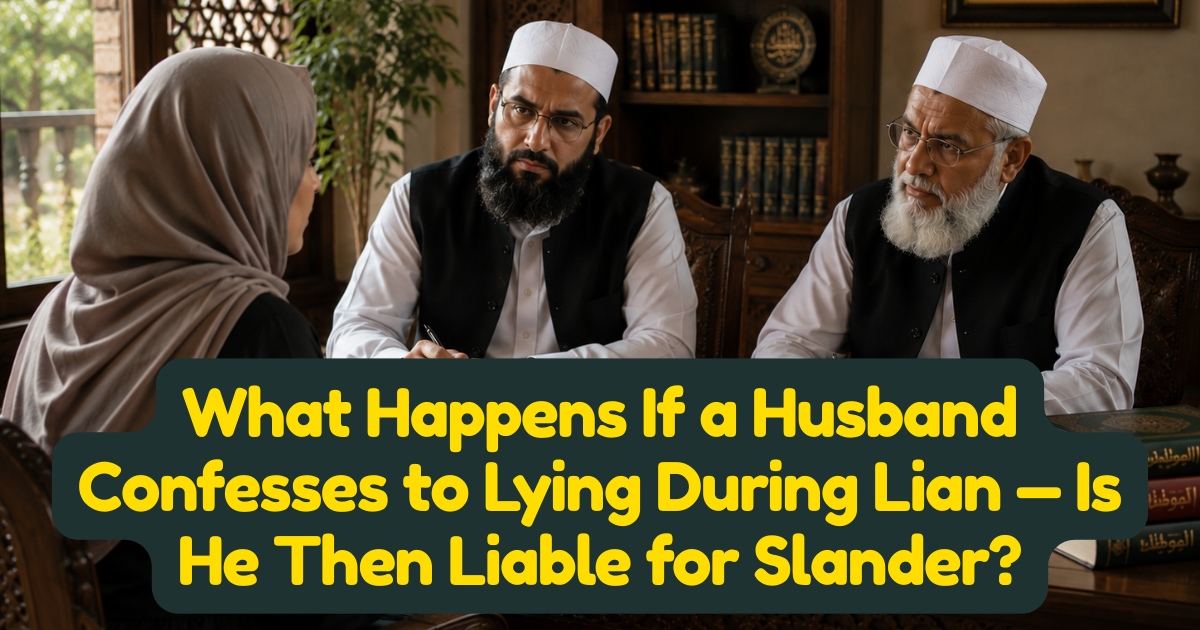
Lian exists specifically because a husband's solitary, unsupported accusation of adultery would otherwise expose him to the punishment for false accusation (qadhf) — eighty lashes — unless he can produce four witnesses. The entire oath procedure is what allows him to avoid that punishment while still raising the accusation formally. So what happens if, at some point during this process, he simply admits the accusation wasn't true? The answer is direct: that admission reactivates the very liability the oath procedure was designed to suspend.
Confession Restores the Original Slander Liability
A detailed explanation of public imprecation (al-li'an) drawn from The Reliance of the Traveler states this principle plainly, in the context of a husband who refuses to follow through with his oath: according to Abu Hanifah's position, such a husband shouldn't be punished for slander outright but should instead be imprisoned until he either agrees to testify or admits that he has lied — and if he does call himself a liar, he is then whipped for slander. The completed oath is what shields a husband from the qadhf punishment in the first place; the moment he abandons that shield by confessing the accusation was false, the original liability simply applies as though the oath protection had never been invoked.
This Applies Even After the Oaths Have Begun
This isn't limited to a husband who never starts the process — it applies even partway through. A detailed scholarly response on the method of ending a marriage due to adultery through lian confirms this directly: if the husband breaks his swearing after the mulaana process, in the presence of the judge, he is given the punishment of qazf — meaning a partial or interrupted oath, abandoned through confession, carries the same consequence as never having sworn at all. The protection lian offers is conditional on actually completing it, not on simply having attempted or begun it.
Why This Reflects Lian's Core Purpose
This consequence makes complete sense once you understand what lian is actually for. It isn't a procedural loophole that lets a husband make an accusation risk-free — it's a solemn mechanism that replaces ordinary evidentiary proof with an oath invoking divine judgment, specifically because the husband has no witnesses. If he then admits, at any stage, that the accusation was false, he's effectively telling the judge that the entire premise for needing this special mechanism in the first place was itself untrue. At that point, there's no remaining reason to extend him the protection lian was designed to provide, and the underlying qadhf liability simply resumes.
What This Means in Practice
- A husband considering raising an accusation he isn't fully certain of should understand that backing out through confession doesn't simply end the matter quietly — it activates the slander punishment that the accusation itself would have carried without the oath process.
- This liability attaches regardless of timing — whether he confesses before starting, partway through, or after completing his own oaths but before his wife completes hers.
- The judge's role in this process includes specifically warning the husband, before his final oath, of the gravity of swearing falsely — a built-in moment for genuine reconsideration before the irreversible final oath is given.
- This is precisely why scholars consistently caution against raising such an accusation lightly — there is no cost-free way to test the waters with a lian accusation and simply withdraw if conviction wavers.
Key Takeaway
A husband who confesses, at any point during the lian process, that his accusation was false becomes liable for the punishment of slander (qadhf) — the same consequence he would have faced had he made the unsupported accusation without ever invoking lian at all. The oath procedure offers protection only for as long as it's genuinely completed; abandoning it through confession simply restores the original liability the entire mechanism existed to manage. This is a serious, real consequence, and it's exactly why a husband should be genuinely certain before initiating this process at all.
```Admin User
Author