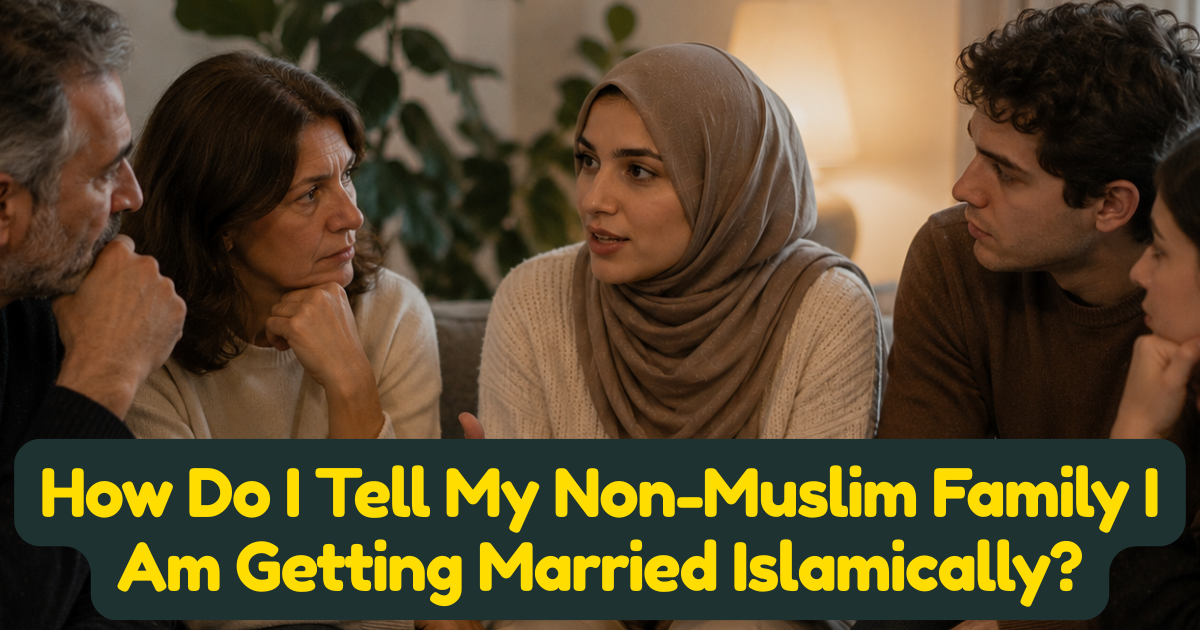
How Do I Tell My Non-Muslim Family I Am Getting Married Islamically? A Practical Guide for Muslim Converts
You have found someone. You are ready to marry. You know what an Islamic marriage means and why it matters to you. And then comes the conversation you have been quietly dreading — the one with your parents, your siblings, your closest friends from before Islam. The people who love you and who, in all likelihood, have very little framework for understanding what a nikah is, why it is different from what they imagined your wedding would look like, and what it means that you are doing this now.
This conversation is not simple. It is not something a single sentence can resolve. For many converts, it is one of the most emotionally complex conversations of their lives — sitting at the intersection of their love for their family, their commitment to Islam, their excitement about their marriage, and their very understandable fear of all three things colliding badly.
There is no script that works for every family. But there are principles — drawn from Islamic wisdom about relationships, from the lived experience of convert communities across the world, and from the practical realities of interfaith family dynamics — that can make this conversation clearer, kinder, and more likely to preserve the relationships that matter most while protecting the integrity of your Islamic marriage.
Before the Conversation: Understanding What Your Family Is Actually Afraid Of
The most useful thing a convert can do before having this conversation is spend time genuinely thinking about what their family's fears and concerns are likely to be — not what they should be, but what they realistically will be. Because most of the difficulty in this conversation does not come from your family being unsupportive of your happiness. It comes from their not understanding what you are telling them, and filling that gap of understanding with the fears and assumptions they already carry.
Non-Muslim families in the West — in the UK, the USA, Germany, France, Australia, Canada, and across Europe — typically arrive at this conversation with a set of assumptions shaped by media representations of Islam and Muslim marriage that are, at best, incomplete and at worst, deeply misleading. Their fears are often not about Islam per se. They are about specific things they believe Islam requires or permits — things that may have nothing to do with your actual situation.
Common fears non-Muslim families bring to this conversation include:
- That their child is being controlled or pressured — that Islam requires submission in marriage and that their son or daughter will lose autonomy
- That they will be excluded — that an Islamic marriage means a ceremony they cannot attend, do not understand, and are not welcome at
- That the relationship will change — that their child is becoming someone different, moving away from the family's shared identity and history
- That this is too fast or not properly thought through — particularly if the convert is relatively new to Islam and the family does not yet have a framework for how seriously you take your faith
- That the legal situation is unclear — whether an Islamic ceremony is legally recognised and what protections exist for their child
Understanding these fears before the conversation allows you to address them proactively — rather than discovering them mid-conversation when emotions are already running high. The more you understand your family's specific concerns, the more you can tailor what you share and how you share it.
When to Have the Conversation: Timing Matters More Than Most Converts Realise
One of the most common mistakes converts make in approaching this conversation is leaving it too late — either telling family members so close to the ceremony that they feel ambushed and disrespected, or delaying out of anxiety until the marriage is imminent and the family has no time to process, ask questions, or feel genuinely included.
The timing of this conversation is itself a signal of how much you value your family's relationship. Telling your parents or closest family members early — with enough time for multiple conversations, for their questions to be answered, and for them to feel genuinely consulted rather than merely informed — communicates respect. It gives them the gift of time to understand, adjust, and find their place in something they did not expect.
There is no single right timeline — it depends on your family's specific dynamics, how far your relationship with your partner has progressed, and your own circumstances. But as a general principle, the earlier you can begin the conversation in a natural, undramatic way, the better the outcomes tend to be. A conversation that begins months before a ceremony is very different from a phone call two weeks before one.
How to Begin: The First Conversation
The first conversation does not need to be comprehensive. It does not need to answer every question. It needs to do three things: introduce the news in a way that feels like connection rather than announcement, establish your emotional seriousness, and open the door to further conversation without demanding an immediate reaction.
Begin with what your family already knows and cares about — your relationship with your partner. They may not understand what a nikah is, but they understand that you have found someone you love. Starting there — with the relationship, with who this person is, with why you want to spend your life with them — grounds the conversation in something familiar before introducing the unfamiliar.
Then introduce the Islamic dimension honestly and simply. You might say something like: "Getting married Islamically is really important to me. It is the way I want to make this commitment, and it is part of my faith. I want to explain what it means and how it works, because I want you to understand it and be part of it."
What this phrasing does is make clear three things simultaneously: that this is a sincere religious commitment, not a legal workaround or a cultural performance; that you want your family to understand it, not just accept it; and that you want them involved, not excluded. All three of these are things most families need to hear before they can begin to process what you are telling them.
Explaining What a Nikah Actually Is
Most non-Muslim family members have no framework for what a nikah is. They may have vague impressions from media coverage that are neither accurate nor reassuring. Part of the work of this conversation — and it is worth thinking of it as work, genuinely important work — is giving your family an honest, clear, and accessible explanation of what a nikah actually involves.
Here is the kind of explanation that tends to be both accurate and accessible for non-Muslim family members:
"A nikah is an Islamic marriage contract. It is a formal, legal agreement between two people that establishes the marriage in Islam. It requires both people to give their genuine, free consent — no one can be pressured or forced into it. It involves an agreed gift from the groom to the bride, called a mahr, which belongs to her. It is witnessed by people we choose. And it is usually led by an Islamic scholar or qazi who makes sure everything is done correctly. It is not a complicated or exclusive ceremony — it is meaningful and dignified, and I want you there."
This explanation addresses several of the fears identified earlier. It establishes that consent is required and protected. It explains the mahr in terms that suggest rather than diminish the bride's rights. It frames the ceremony as meaningful and dignified — not alien or exclusionary. And it ends with an invitation.
Be prepared for questions. And be prepared for questions that feel uncomfortable or even offensive — questions shaped by media stereotypes, by cultural assumptions, or by genuine worry. Try to hear the concern behind the question rather than reacting to the phrasing. A parent who asks "Are you sure you are not being pressured?" is expressing love in the form of fear. That deserves a genuine, reassuring answer — not an argument.
Addressing the Legal Recognition Question Honestly
One concern that non-Muslim family members — particularly parents — frequently raise is the legal recognition question. In the United Kingdom, the United States, Germany, France, and most Western countries, a religious ceremony alone does not automatically carry civil legal standing. A nikah conducted through an Islamic service may be fully valid in Islamic law while requiring a separate civil registration to be legally recognised by the state.
In England and Wales, the UK Government's official guidance on marriages makes clear that religious ceremonies must meet specific civil requirements to be legally registered. The same principle applies across most European jurisdictions and in most US states, where a marriage licence and a civilly authorised officiant are required for legal recognition.
Be honest with your family about this. If you are planning to register the marriage civilly as well — which many couples do — tell them that. If you are not, explain your reasons clearly and without defensiveness, and acknowledge that they may have concerns about your legal protections. These are legitimate concerns, and addressing them honestly builds more trust than deflecting them does.
For families worried specifically about their child's legal protections in the marriage, it may help to explain what the nikah's mahr provision means — that the bride has a formally agreed financial right within the Islamic contract — and to point them toward the resources of organisations like the Muslim Council of Britain in the UK, which provides publicly accessible information on Islamic marriage and the civil registration question for British Muslim families.
Involving Non-Muslim Family Members in the Ceremony
One of the most powerful things a convert can do to ease their family's experience of an Islamic wedding is to involve them meaningfully — not in ways that compromise the Islamic validity of the ceremony, but in ways that make them feel genuinely present and genuinely celebrated as part of this milestone.
As discussed in earlier guides, non-Muslim family members cannot serve as the formal Islamic witnesses — that role requires two adult Muslim males. But there is a great deal they can do:
- Attend the nikah ceremony as honoured guests — their presence is welcomed, valued, and meaningful
- Be introduced and acknowledged by the presiding scholar — many qualified qazis will take a moment to welcome non-Muslim family members and acknowledge their presence
- Speak at the walima — the post-nikah celebration feast, which is an entirely appropriate occasion for family speeches, toasts, and expressions of love and blessing from all traditions
- Help plan and host the walima — involving parents in planning the celebration feast is a way of giving them genuine ownership over part of the occasion
- Give gifts and blessings — there is nothing in Islamic tradition that restricts the giving of gifts, blessings, or expressions of love at a wedding from people of any faith
- Participate in cultural traditions — many Muslim communities combine the nikah with cultural celebrations that are accessible to all guests regardless of faith background
For many non-Muslim parents, the fear of exclusion is the deepest fear. Showing them concretely — not just telling them — that they are welcome, valued, and genuinely part of this occasion is the most effective thing a convert can do to ease the transition.
When Family Members React Badly: What to Do
Not every family reacts well. Some parents express shock, anger, or grief. Some siblings are dismissive or hostile. Some family members make hurtful comparisons or express fears that feel like rejections of your faith, your partner, or your choices. This is painful — and it is worth naming honestly that it is painful, rather than pretending the ideal approach always produces ideal outcomes.
If a family member reacts badly, the principles that apply are these:
Give them time. A bad initial reaction is not necessarily the final reaction. People process significant news at different speeds, and a parent who is angry today may, with time, become genuinely supportive. Responding to a bad initial reaction with patience — not silence, but patient continued engagement — is almost always more effective than either forcing the issue or withdrawing entirely.
Distinguish between the concern and the expression. A parent who says something hurtful about Islam is usually expressing fear, loss, or confusion — not genuine hostility. Try to respond to what they are actually feeling rather than to the specific words they used. "I can hear that you are worried about me. Can you tell me what specifically concerns you?" often opens more productive conversation than responding directly to the offensive phrasing.
Maintain the relationship through the disagreement. Family relationships are long. A disagreement about a wedding — however painful — does not have to define the relationship permanently. Maintaining regular, warm contact through the period of tension communicates that the relationship is more important to you than winning the argument.
Seek support from your Muslim community. Converts who are navigating family tension around their Islamic marriage benefit enormously from the support of other Muslims who have been through similar experiences. Convert support organisations, mosque communities, and online Muslim convert networks provide both practical guidance and emotional sustenance for exactly this situation.
Know your limits. Maintaining a relationship does not mean accepting abusive treatment or allowing family pressure to compromise your genuine consent to your marriage. There is an important difference between managing a difficult reaction with patience and kindness, and allowing family opposition to override your own free choices. Islam protects your right to choose your own marriage — and that protection is relevant here too.
The Islamic Perspective on Maintaining Family Ties
Islam places extraordinary emphasis on the maintenance of family ties — silat al-rahm — even across differences of faith. The Qur'an and authentic Sunnah both address the responsibility of Muslim converts to maintain kind, respectful, and loving relationships with non-Muslim family members, even while holding firm to their religious commitments.
The Prophet Muhammad, peace be upon him, is reported to have maintained and encouraged the maintenance of family ties with non-Muslim relatives in multiple contexts documented in authentic hadith. The companion Asma bint Abi Bakr, may Allah be pleased with her, asked the Prophet whether she should maintain ties with her non-Muslim mother who had come to visit her. He said yes — she should maintain ties with her. This narration, recorded in Sahih al-Bukhari, establishes clearly that the Islamic instruction is toward relationship maintenance, not separation, across faith lines.
For a convert navigating family tension around their Islamic marriage, this prophetic guidance is both a religious instruction and a practical framework: the goal is not to win an argument but to preserve a relationship while remaining faithful to your commitments. These two goals are compatible — and pursuing both simultaneously, with patience and love, is the distinctly Islamic approach to this challenge.
Resources That Can Help
For Muslim converts navigating this conversation and the broader experience of an Islamic marriage within a non-Muslim family context, several organisations provide genuinely useful support across different countries.
In the United Kingdom, New Muslims Project UK provides practical guidance and community connection specifically for British Muslim converts — including support for the marriage process and the family dynamics it often involves. Their resources are specifically designed for the convert experience and reflect a deep understanding of the specific challenges this community faces.
In the United States, the Islamic Society of North America (ISNA) provides resources specifically for Muslim converts, including guidance on the nikah process, the wali question, and navigating Islamic marriage within non-Muslim family contexts. ISNA's convert support resources are among the most widely accessible in North America.
Across Europe, the Zentralrat der Muslime in Deutschland in Germany and the Conseil Français du Culte Musulman (CFCM) in France both have resources and referral networks for Muslim converts navigating marriage within non-Muslim family contexts in their respective countries.
For converts who want to give their non-Muslim family members accessible, accurate information about Islam and Islamic marriage from a reputable source, the Al-Azhar University's English-language resources and the Dar al-Ifta al-Misriyyah website both provide scholarly, publicly accessible information that can help demystify Islamic marriage for curious or concerned family members.
What the Nikah Itself Can Do for Family Relationships
Something that many converts discover — sometimes to their own surprise — is that the nikah ceremony itself, when conducted with warmth, with welcome, and with genuine effort to include non-Muslim family members as honoured guests, can become a turning point in the family relationship rather than a point of rupture.
A well-conducted nikah, presided over by a knowledgeable and articulate scholar who takes a moment to explain what is happening and why, can give non-Muslim family members their first genuine encounter with Islam as something dignified, meaningful, and recognisably about love and commitment — rather than the alien or threatening thing their assumptions had constructed.
Many non-Muslim parents have attended a child's nikah with dread and left with something approaching wonder. The ceremony's emphasis on consent, on the bride's rights, on the formal and public commitment of the groom — these are things that speak to universal parental hopes regardless of religious background. A nikah that is explained clearly, conducted beautifully, and celebrated with genuine hospitality toward all guests has a remarkable capacity to bring families together across the faith difference rather than divide them along it.
This is not guaranteed. Some families remain distant or resistant regardless of how well the occasion is handled. But the possibility — and it is a real possibility — is worth working toward with intention.
How InstantNikah.com Supports Converts Through Every Stage
At InstantNikah.com, the specific experience of Muslim converts — including the family dynamics that surround their nikah — is understood and taken seriously. Every ceremony is conducted by a qualified online qazi who is experienced in working with convert couples, in welcoming non-Muslim family members as honoured guests, and in presiding over a nikah that is both Islamically rigorous and humanly warm.
For converts who need a wali al-amr — whose non-Muslim families cannot fulfil this Islamic role — InstantNikah provides this as part of the complete ceremony service. For converts with questions about witnesses, about the mahr, about what their non-Muslim family can and cannot do within the ceremony, the complete online nikah guide for converts provides detailed, scholarly, and practically grounded answers.
For converts navigating the wali question specifically, the guide on how a Muslim convert finds a wali for their nikah provides a step-by-step framework. For those whose family relationships are complicated by opposition or uncertainty, the resources on nikah without family support and nikah facing family opposition offer both Islamic grounding and practical pathways.
A formal nikah certificate is issued after every ceremony — providing documentation that can be shared with family members as tangible evidence of a properly conducted, fully verified Islamic marriage.
Explore the full process here, read verified reviews from convert couples worldwide, or book your online nikah at a time that works for you and your family.
Admin User
Author