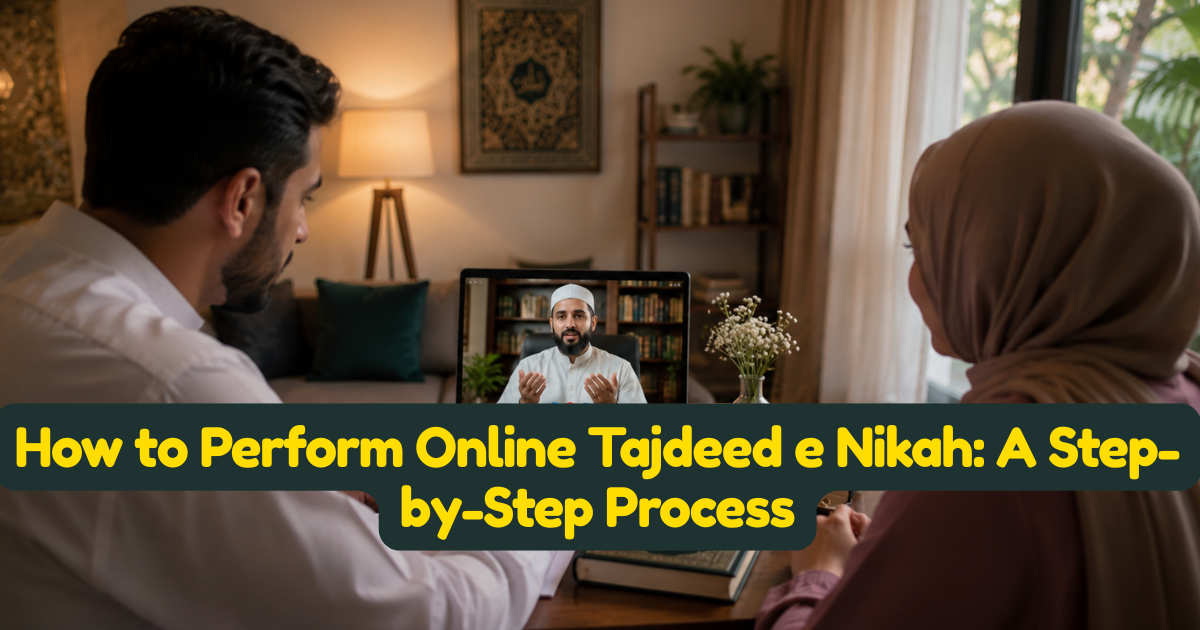
How to Perform Online Tajdeed e Nikah: A Step-by-Step Process
Couples who decide to renew their nikah often ask the same practical question once they've settled the "why": what actually happens during the ceremony itself, and how do we make sure it's done correctly online? Since a renewal carries the same religious weight as an original nikah, the process deserves the same care — not a shortcut version of it. Here is exactly how a properly conducted online Tajdeed e Nikah unfolds.
Step 1: Initial Consultation and Eligibility Review
Before any ceremony is scheduled, a certified officiant reviews the couple's situation: are they renewing out of caution, correcting a specific defect (such as missing witnesses), reconciling after a lapsed iddah, or marking a conversion to Islam? This determines whether the renewal needs to reference the original marriage explicitly, whether a wali is required for this specific renewal, and how the certificate should be worded to avoid any future ambiguity about which contract governs the marriage.
Step 2: Identity Verification
Both spouses submit government-issued identification ahead of the ceremony. This step protects against fraud, ensures the certificate matches the couple's legal names for any subsequent civil registration, and aligns with the documentation standards expected by immigration authorities such as U.S. Citizenship and Immigration Services when a renewed marriage certificate is later submitted as supporting evidence.
Step 3: Confirming Witnesses and Wali
Two qualified witnesses are arranged — either family or friends the couple selects, or witnesses provided through the platform if the couple cannot source their own. Where the wife's madhab requires a wali's involvement and one was not properly engaged in the original marriage, this is arranged for the renewal as well. All participants, including witnesses and wali where applicable, join the same secure video call as the officiant and both spouses.
Step 4: Mahr Discussion
The couple and officiant confirm whether the renewal will restate the original mahr, agree on a new amount, or use a symbolic token mahr, depending on the purpose of the renewal. This is documented clearly so there is no future confusion about whether a mahr obligation from the original marriage still stands or has been superseded.
Step 5: The Live Ceremony
On the scheduled date, the officiant opens the ceremony, confirms the presence and attentiveness of both witnesses, and conducts the ijab (offer) and qabul (acceptance) live, in real time, with both spouses clearly affirming their consent. This live, real-time requirement is non-negotiable — a recorded or asynchronous exchange does not satisfy the witnessing condition recognized across Hanafi, Shafi'i, and Hanbali jurisprudence.
Step 6: Khutbah and Du'a
Many couples choose to include a short khutbat al-nikah (marriage sermon) and du'a as part of the renewal, even though it is not a strict pillar of the contract. For renewals tied to spiritual milestones — anniversaries, recovery from hardship, post-Hajj gratitude — this part of the ceremony often carries the most emotional significance for the couple.
Step 7: Certificate Issuance
Following the ceremony, a digital certificate is issued documenting the date, officiant, witnesses, mahr terms, and — where relevant — a clear reference to the original marriage being renewed or corrected. This certificate is designed to support subsequent civil registration where the couple's jurisdiction requires it, in line with documentation standards described in the UK government's marriage registration guidance and similar frameworks elsewhere.
Step 8: Civil Registration (If Needed)
The Islamic certificate alone does not automatically constitute civil marriage recognition in most Western jurisdictions. Couples who need their renewed marriage to carry civil legal weight — for spousal benefits, taxation, or immigration purposes — should pursue separate civil registration or recognition through their local authority, using the religious certificate as supporting documentation. Guidance from bodies such as the U.S. Department of State's Bureau of Consular Affairs outlines how religious marriage documentation is typically treated alongside civil requirements for couples abroad.
What Makes Online Tajdeed e Nikah Different From a Casual Re-Vow
The difference between a meaningful, religiously and legally sound renewal and an informal "let's just say our vows again" moment comes down entirely to these structural elements — real witnesses, real-time consent, proper documentation. Skipping any of these steps may feel emotionally satisfying in the moment but leaves the couple without the protection a properly executed contract provides.
Typical Timeline
For most couples, the entire process — from initial consultation to certificate issuance — can be completed within a few days to a week, depending on document verification and witness availability. Couples facing urgent documentation deadlines, such as an upcoming visa interview, should communicate this timeline upfront so the renewal can be scheduled accordingly.
Admin User
Author