How Sharia Councils Evaluate Requests for Marriage Contract Renewal
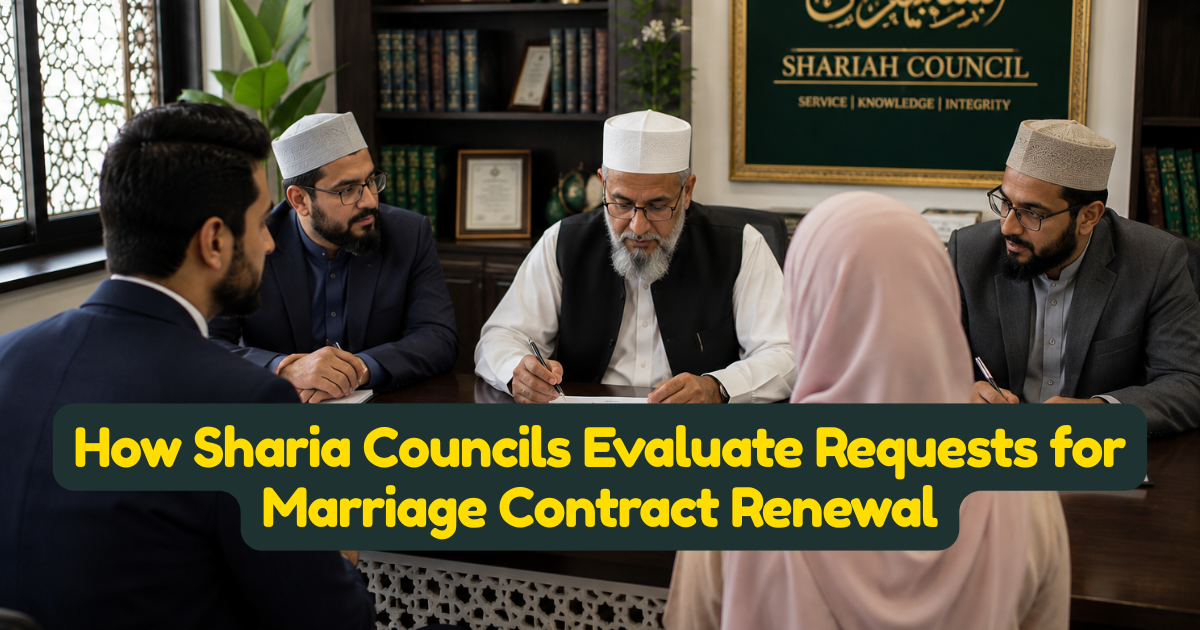
Most Tajdeed e Nikah ceremonies are simple, uncontested, and require nothing beyond a willing couple and a qualified officiant. But a meaningful subset of renewal requests are more complicated — cases where one spouse disputes whether the original marriage was valid, where a family member challenges the marriage's status, or where civil legal proceedings depend on a clear determination of the couple's Islamic marital history. In these cases, a Sharia council, rather than a single officiant, typically becomes involved before any renewal proceeds.
What Triggers Sharia Council Involvement
- One spouse believes the original nikah was invalid (due to missing witnesses, an improperly involved wali, or coercion) while the other disagrees.
- A family member or third party formally disputes the marriage's validity, often in the context of an inheritance or custody matter.
- A civil court or immigration authority requests a formal determination of Islamic marital status as part of a broader legal proceeding.
- A couple's talaq and iddah history is unclear or contested, making it uncertain whether ruju or a fresh Tajdeed e Nikah is the correct path.
The Evidence-Gathering Stage
Sharia councils, such as the Islamic Sharia Council in London, typically begin by gathering documentary and testimonial evidence: any existing nikah certificate, witness statements (if witnesses can still be located), records of mahr payment, and a written or verbal account from both spouses about the circumstances of the original ceremony. Where the original witnesses are available, the council may contact them directly to confirm what they observed.
Applying Madhab-Specific Standards
Because Sunni schools differ in some details — particularly around wali requirements and the precise conditions for valid witnessing — councils generally apply the standard relevant to the couple's own madhab or the school the council itself follows, while remaining transparent with the couple about which standard is being applied and why. This matters because a marriage considered defective under one school's conditions may be considered valid under another's, and councils take care not to apply an unfamiliar standard to a couple without explaining the reasoning.
The Presumption of Validity Principle
Across this evaluation process, councils generally apply the classical legal presumption that a contract, once entered into, is presumed valid unless clear evidence establishes a specific defect — a principle long affirmed by institutions including Al-Azhar Al-Sharif. This means the burden generally falls on the party alleging invalidity to demonstrate it, rather than the couple needing to prove their marriage was valid from scratch. This protects couples from having a long, stable marriage thrown into doubt based on vague or unsubstantiated claims.
Determining the Appropriate Remedy
Once a council reaches a conclusion, it typically falls into one of three outcomes: the original marriage is confirmed valid and no renewal is needed; the original marriage is found to have a genuine, confirmable defect and a corrective Tajdeed e Nikah is recommended; or the facts remain genuinely unclear, in which case the council often recommends a precautionary renewal as the safest path forward for both spouses, rather than leaving the matter unresolved indefinitely.
How Long This Process Typically Takes
Straightforward cases, where documentation is available and both spouses largely agree on the facts, can often be resolved within a few weeks. Genuinely disputed cases — particularly those involving conflicting accounts, unavailable witnesses, or interaction with an ongoing civil legal proceeding — can take considerably longer, sometimes several months, since councils generally prioritize thoroughness over speed in contested matters.
What Couples Can Do to Make the Process Smoother
- Gather any existing documentation from the original ceremony before approaching a council, even if it seems incomplete.
- Provide honest, consistent accounts of the original ceremony's circumstances, even where the details are uncomfortable.
- Approach the council jointly where possible, rather than only one spouse engaging with the process.
- Be prepared for the council to take the time it needs rather than expecting an immediate determination.
How InstantNikah.com Works Alongside Sharia Council Determinations
For couples who have already received a Sharia council's determination — whether confirming a defect requiring renewal or recommending a precautionary one — our officiants are able to conduct the resulting Tajdeed e Nikah ceremony online, with documentation that explicitly references the council's prior review, giving the couple a clean, well-supported record going forward.
Admin User
Author