How Online Nikah With Witnesses Actually Works
"Online nikah with witness" is searched constantly by couples wanting reassurance on a genuinely important point: that a remote ceremony doesn't compromise one of the most essential conditions of a valid Islamic marriage. It's a fair concern to have, and understanding exactly how witnessing functions in a properly conducted online ceremony resolves it clearly.
Why Witnesses Are Non-Negotiable in Islamic Marriage
Two qualified witnesses observing the offer and acceptance is a foundational requirement across mainstream Sunni jurisprudence, rooted in the broader Islamic preference for marriages to be public and verifiable rather than secret. This requirement doesn't soften or disappear simply because a ceremony happens over video — it applies with exactly the same force to an online nikah as it does to an in-person one.
How Witnesses Actually Participate in an Online Ceremony
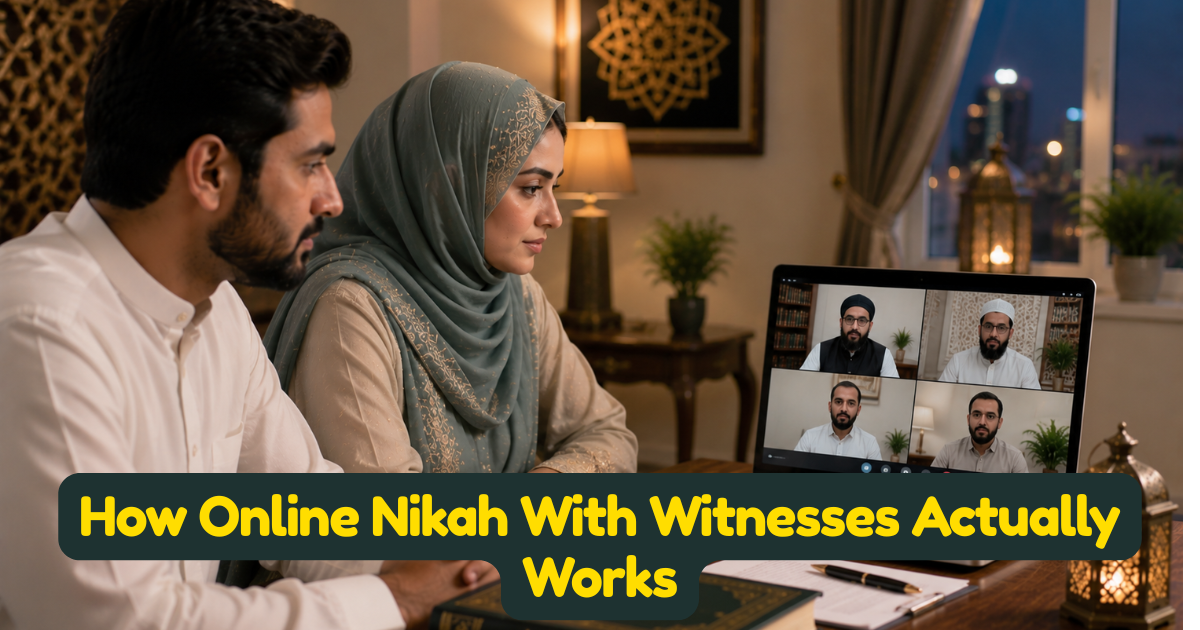
In a properly conducted online nikah, witnesses join the same live video call as the officiant and both spouses, observing the ceremony in real time — hearing the khutbah, watching the offer and acceptance exchange, and confirming their attentiveness before this pivotal moment begins. This is functionally identical to witnessing an in-person ceremony, simply conducted through a video connection rather than shared physical space.
Who Can Serve as a Witness for an Online Nikah
The standard qualifications apply regardless of format: witnesses should generally be of sound mind, practicing or believing Muslims, and capable of understanding and later confirming what they observed. Depending on the couple's madhab, this typically means either two adult Muslim men, or one man and two women. As covered in our detailed guides, witnesses can be family members, friends, or arranged through the officiating service itself if the couple doesn't have their own available.
Do Witnesses Need to Be in the Same Location as Each Other
No — witnesses can join the video call from entirely different locations, even different countries, as long as they're genuinely present and attentive on the same live call as the ceremony itself. This is one of the practical advantages online nikah offers diaspora families, allowing witnesses spread across multiple countries to participate in a single ceremony together.
Confirming Witness Attentiveness Before the Core Exchange
A properly run officiant confirms, immediately before the offer and acceptance begins, that both witnesses are visible, connected, and genuinely attentive — not simply logged into the call in the background while distracted by something else. This deliberate check is what separates a properly witnessed ceremony from one where witnessing is treated as a formality rather than a genuine requirement.
Why a Recording Doesn't Satisfy the Witnessing Requirement
It's worth being direct about this: a witness who reviews a recording of the ceremony after the fact has not fulfilled the witnessing function, since the requirement is to observe the exchange as it happens live, in real time, with the capacity to confirm it directly. A recording can serve as a useful supplementary record, but it cannot substitute for genuine, live witnessing.
What If a Couple Doesn't Have Their Own Witnesses Available
For couples without family or friends readily available to serve as witnesses — particularly relevant for converts or those in areas with a small local Muslim community — reputable online nikah services can arrange qualified witnesses on the couple's behalf, ensuring this requirement is fully met even without the couple needing to source witnesses independently.
Documenting Witnesses on the Nikah Certificate
A properly issued certificate should clearly name both witnesses, providing a lasting record that protects the couple if the marriage's validity is ever questioned later — whether in a family dispute, an inheritance matter, or a civil or immigration process requiring documentation of the marriage's proper witnessing.
Common Witness-Related Questions Couples Ask
Beyond the basics, couples often want to know whether siblings can witness together, whether elderly relatives qualify, and what happens if a witness's connection drops momentarily — all addressed in depth throughout our broader content, but the general theme across each answer is the same: what matters is genuine, individual capacity to observe and confirm the exchange, not incidental factors like relatedness or age alone.
Why This Matters More Than Couples Sometimes Realize
Proper witnessing isn't merely a ceremonial formality — it's part of what makes a marriage verifiable and protected over the long term, mattering for everything from a Sharia council review years later to a civil court's assessment of marital status in an unrelated legal matter. Choosing a service that treats witnessing with genuine seriousness, rather than as a box to check quickly, protects the couple's interests well beyond the ceremony itself.
How InstantNikah.com Handles Witnessing for Every Ceremony
Every ceremony we conduct includes two qualified witnesses confirmed present and attentive on the same live call before the core exchange begins, with their details clearly documented on the resulting certificate — treating witness verification as a core, non-negotiable part of our process, not an afterthought.
Admin User
Author