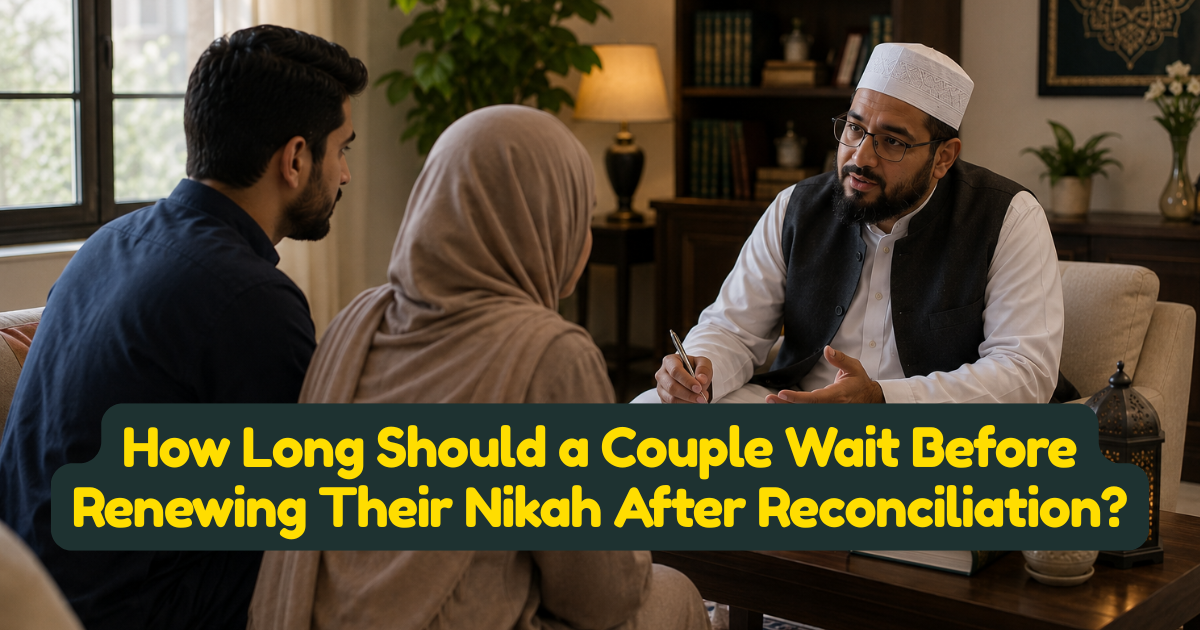
How Long Should a Couple Wait Before Renewing Their Nikah After Reconciliation?
There is no fixed Islamic waiting period specifically governing how long a couple must wait after reconciling before performing a Tajdeed e Nikah — unlike iddah, which has clearly defined timeframes tied to talaq. But "no fixed rule" does not mean timing is irrelevant. Couples navigating this decision benefit from thinking through a few distinct considerations rather than defaulting to either extreme: rushing into a renewal the moment things feel better, or delaying indefinitely out of uncertainty.
If the Reconciliation Follows a Revocable Talaq Within Iddah
This is the one scenario where timing is genuinely governed by clear religious rules rather than personal judgment. If a single or second talaq was pronounced and the wife's iddah has not yet ended, the couple does not need — and should not perform — a Tajdeed e Nikah at all. Ruju, the husband's revocation of the talaq, is both sufficient and the correct mechanism during this window. Attempting a full renewal ceremony here is not just unnecessary; it can create confusion about the marriage's actual legal history, since a "new" mahr or contract implies the couple treated a still-valid marriage as if it had fully ended.
If Iddah Has Already Lapsed
Once the iddah period has ended without ruju, the marriage has lawfully concluded, and there is no religious requirement to wait any further before performing a fresh Tajdeed e Nikah, should the couple wish to remarry. From a strictly fiqh perspective, the couple could proceed immediately. The more relevant consideration at this stage becomes emotional and practical readiness rather than religious permissibility.
Emotional Readiness: Why Rushing Can Undermine the Renewal's Purpose
Couples reconciling after significant conflict sometimes want to renew quickly, treating the ceremony itself as proof that the relationship has healed. Family counselors and Sharia council caseworkers, including those who work alongside bodies like the Islamic Sharia Council, frequently caution against this instinct — a renewal performed before the underlying issues that caused the separation have genuinely been addressed risks becoming a symbolic gesture layered over an unresolved problem, rather than a true reflection of restored trust.
A Reasonable Framework for Deciding When You're Ready
- Has the specific issue that caused the separation been directly discussed and addressed, not just avoided?
- Have both spouses had time to genuinely process what happened, individually and together, rather than reconciling out of urgency, loneliness, or pressure from family?
- If counseling or mediation was recommended, has it actually taken place, or is the couple hoping the renewal itself will substitute for that work?
- Do both spouses feel — independently, not just as a joint decision made under social pressure — genuinely ready to recommit?
There is no universally "correct" amount of time this process takes; for some couples it is weeks, for others it is many months. What matters more than the calendar is whether these questions have honest answers.
Practical and Documentation-Driven Timing
Separate from emotional readiness, some couples have external deadlines shaping their timeline — an immigration application, a civil registration requirement, or a family event they'd like the renewal to coincide with. Where these practical factors exist, it is worth being honest with your officiant about them during the initial consultation, so the ceremony can be scheduled appropriately without compromising on the underlying diligence described elsewhere in this series.
Signs a Couple May Be Renewing Too Soon
- The renewal is being used as a way to avoid a difficult conversation rather than follow one.
- One spouse is noticeably more hesitant or ambivalent than the other but is going along with the timeline anyway.
- The couple has not discussed what, if anything, will be different this time.
How InstantNikah.com Approaches Timing With Reconciling Couples
Our officiants do not impose a mandatory waiting period, since none is religiously required outside the iddah scenarios described above. But during consultation, we do ask reconciling couples some of the readiness questions outlined here — not to delay them unnecessarily, but to make sure the renewal genuinely reflects where the marriage stands, rather than papering over something that still needs attention.
Admin User
Author