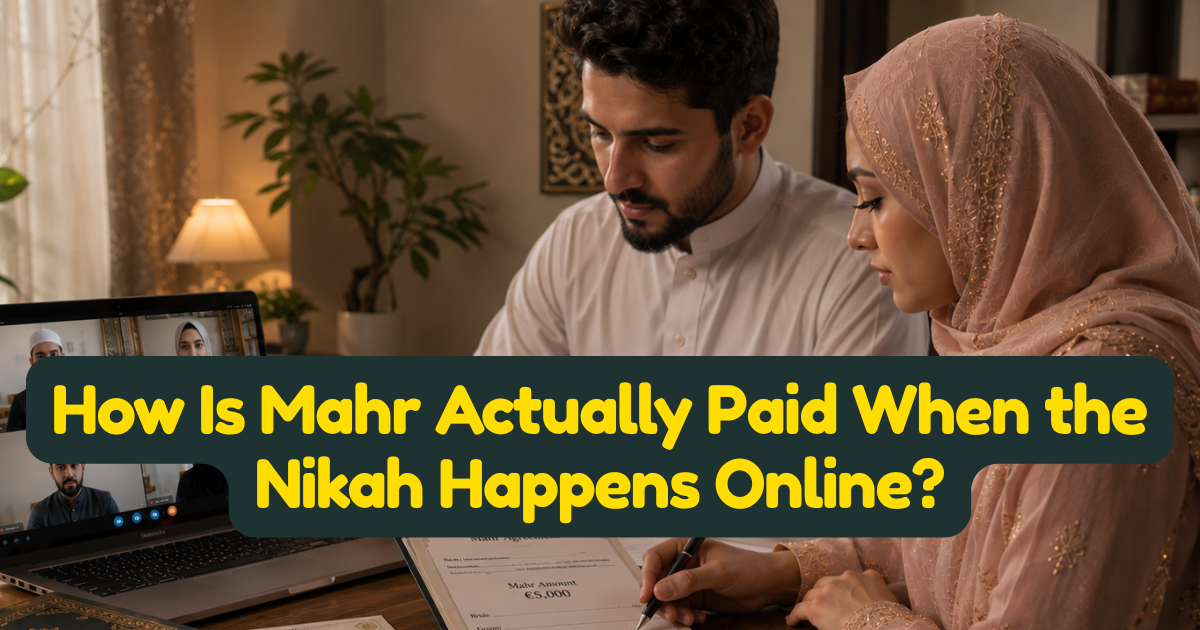
The traditional image of mahr involves a physical handover at the moment of the nikah — cash, jewellery, or an agreed item passed to the bride right there in the room. An online nikah makes that literal moment impossible when the couple is in different countries, which raises a genuinely practical question: does mahr need to be physically paid during the ceremony itself, or can it work differently?
Classical Fiqh Already Separates Agreement From Payment Timing
This isn't actually a new problem created by online nikah — Islamic law has long structured mahr around a prompt and deferred split that already separates the act of agreeing on mahr from the act of physically transferring it. According to this structure, mu'ajjal is the portion paid at the time of the marriage contract, while mu'akhar is the portion promised but deferred to a later point, commonly tied to consummation, divorce, or death. Crucially, a deferred promise to pay doesn't make the full amount any less legally required — it's simply a timing arrangement built into the contract from the start.
What This Means for an Online Ceremony
This existing structure maps naturally onto an online nikah: the mahr amount and form need to be clearly agreed and recorded in the contract at the time of the ceremony, but the actual physical transfer doesn't have to coincide with that exact video call moment. A bank transfer, sent around the time of the ceremony rather than literally during it, satisfies the same underlying obligation a hand-to-hand exchange would in person — what matters is that the amount is clear, agreed, and genuinely paid according to the timeline set in the contract, not that the payment technically happens while the camera is on.
Changing the Form of Mahr Requires Clear Consent
One detail worth being careful about: if the form of mahr ends up different from what was originally agreed — gold instead of the cash that was specified, for instance — a detailed ruling on this exact question confirms that the change must be clearly communicated and the wife must actually accept it; if she agrees, the substitution is valid, but it can't simply be assumed. This matters for online nikah specifically because cross-border payment logistics sometimes make the originally planned form harder to deliver exactly as intended — a couple might agree cash, then find a bank transfer in equivalent value is actually easier to arrange. That's fine, but it needs the same clear communication and consent any other mahr substitution would require.
Practical Considerations for Cross-Border Mahr Payment
- Agree the mahr amount and form clearly in the contract at the time of the ceremony, regardless of when the actual transfer happens.
- If paying via international bank transfer, account for exchange rates and transfer fees in advance, and agree clearly whether the bride receives the full agreed amount net of any fees, or whether fees are deducted from it.
- If switching from a planned form (cash, gold, etc.) to a more practical cross-border method, communicate that change clearly and get the bride's actual agreement, rather than assuming the equivalent value makes it automatically fine.
- Document when and how the mahr was actually paid, alongside the nikah certificate, so there's a clear record beyond just the contract's stated terms.
- If part of the mahr is genuinely deferred, make sure that's explicitly recorded as mu'akhar in the contract, rather than left ambiguous about whether it's been paid or simply postponed.
Key Takeaway
Mahr for an online nikah works through the same mu'ajjal/mu'akhar structure that's always existed in Islamic law — the agreement happens at the time of the contract, while the actual payment can follow a separate, clearly defined timeline that doesn't need to coincide with the video call itself. International bank transfer is a perfectly workable method for the prompt portion, provided the amount, timing, and any changes to the originally agreed form are communicated clearly and genuinely accepted by the bride.
```Admin User
Author