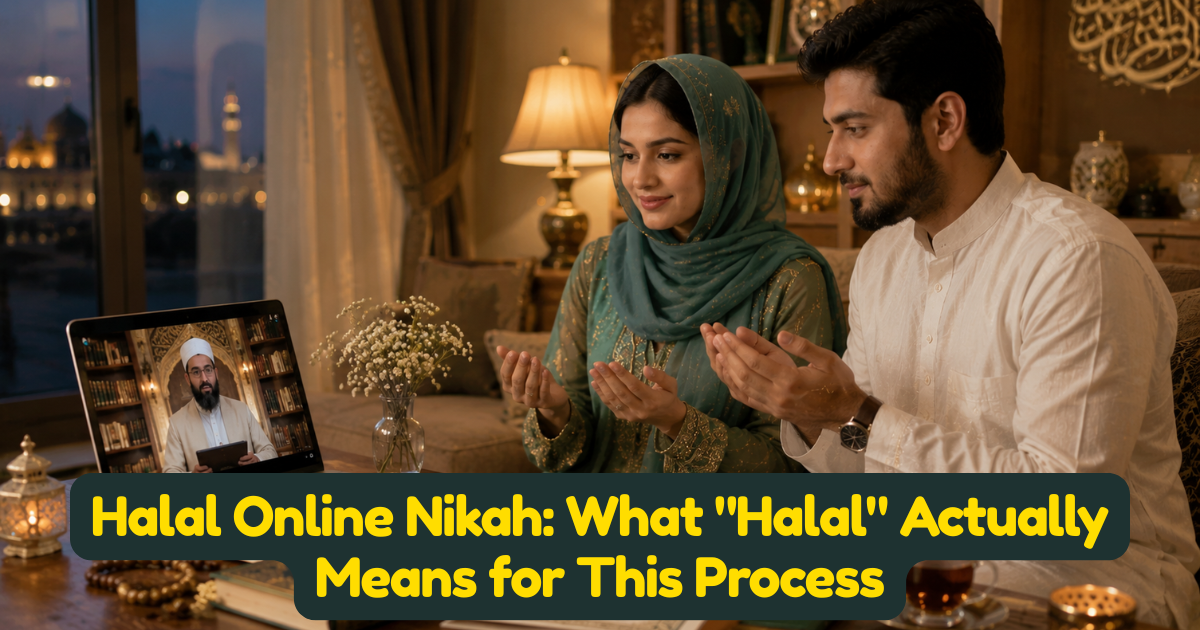
Halal Online Nikah: What "Halal" Actually Means for This Process
"Halal online nikah" appears constantly in marketing across this entire industry — nearly every service, from certified platforms to individual freelancers, uses the phrase somewhere in their advertising. But labeling something halal doesn't make it so, and couples deserve a clear understanding of what actually needs to be true for an online nikah to be genuinely, substantively halal, rather than simply marketed that way.
Halal Isn't a Marketing Adjective — It's a Set of Conditions
In the context of nikah, "halal" simply means the marriage satisfies the conditions that make it permissible and religiously sound under Islamic law. This isn't a subjective quality a service can claim through branding alone; it's determined by whether specific, well-established conditions are actually met during the ceremony itself. A service calling itself "100% halal" while skipping proper witness verification or mahr documentation isn't halal in any meaningful sense, regardless of the label.
The Actual Conditions That Determine Halal Status
- Free, informed consent from both spouses, given without coercion.
- Two qualified witnesses, genuinely present and attentive during the offer and acceptance, as covered in our detailed guide on how this works over video call.
- A clearly agreed mahr, discussed and confirmed by both parties, not simply announced by one side.
- Wali involvement, where the bride's madhab requires it.
- Both parties being legally free to marry — not already validly married to someone else, and having reached puberty and the capacity for informed consent.
A ceremony that genuinely satisfies each of these conditions is halal, regardless of what the service calls itself. A ceremony that skips any of them isn't rendered halal simply by being labeled that way.
Why "Halal" Sometimes Gets Used Loosely in Marketing
Because the term carries strong positive religious connotation, some services use it broadly to signal general Islamic legitimacy without necessarily demonstrating that each specific condition is being rigorously applied. This isn't always deliberate deception — sometimes it reflects genuine but insufficiently rigorous practice — but it means couples shouldn't treat the word "halal" in a service's marketing as, by itself, sufficient reassurance.
Questions That Actually Test Halal Compliance
Rather than accepting a "halal" label at face value, ask specifically: How do you confirm witnesses are genuinely attentive during the exchange, not merely logged into the call? How do you verify both spouses' free consent, particularly in cases where family pressure might be a concern? How is mahr discussed and confirmed — directly with both spouses, or relayed through family without the bride's own input? These questions reveal whether "halal" reflects genuine substance or just branding.
The Halal-Haram Framing Around Interfaith Marriage
Some services use "halal" specifically in the context of confirming they won't facilitate a marriage outside Islamic permissibility — for instance, correctly declining to officiate a marriage between a Muslim woman and a non-Muslim man, which falls outside what's religiously permitted, while properly handling the more nuanced considerations around a Muslim man marrying a woman from the Abrahamic faiths, as covered in our dedicated articles on this topic. A service's clarity and consistency on these boundaries is a genuine signal of substantive religious rigor, not just marketing language.
Halal Compliance and Documentation
A genuinely halal ceremony should also produce documentation reflecting the actual conditions met — as covered in our companion article on certificate standards, a thin or vague certificate can be a sign that the underlying ceremony's halal compliance wasn't taken as seriously as the marketing suggests.
Why Speed Claims Sometimes Conflict With Halal Rigor
Some services heavily emphasize extremely fast turnaround — ceremonies completed in minutes — as part of their broader appeal alongside "halal" branding. Speed itself isn't inherently a problem, as covered in our article on same-day and express booking, but couples should be alert to whether genuine diligence steps (identity verification, mahr discussion, witness confirmation) are actually happening within that fast timeline, or being skipped entirely in the name of speed.
How to Verify a Service's Halal Claims Independently
Beyond asking direct questions, couples can look for concrete signals of genuine religious rigor: an officiant able to clearly explain their credentials and training, a service that discusses madhab-specific requirements rather than applying a single generic approach, and documentation that reflects real substance rather than vague, generic wording.
Why This Matters Beyond Just Word Choice
Understanding the substance behind "halal" protects couples from services that use the term as a marketing shortcut rather than a genuine commitment to religious rigor — and it equips couples to ask the right questions before entrusting one of the most significant moments of their lives to a service they've only encountered through an advertisement.
How InstantNikah.com Approaches Genuine Halal Compliance
Rather than relying on the word "halal" as a marketing claim, we build every ceremony around the actual conditions that determine religious validity — genuine consent confirmed directly with both spouses, properly verified and attentive witnesses, clearly documented mahr, and correct wali involvement — so that our ceremonies are halal in substance, not just in how they're described.
Admin User
Author