What Should You Do If a Guest Behaves Disruptively During the Online Ceremony?
Weddings, even joyful ones, sometimes carry family tension beneath the surface — a relative who never quite accepted the match, longstanding sibling friction, or simply someone who's had a bit too much to drink at a related gathering before joining the call. When this tension surfaces as actual disruption during the ceremony itself — talking over the officiant, making inappropriate comments, or otherwise derailing the moment — it's helpful to know in advance how this should be handled.
Distinguishing Disruption From a Genuine Objection
It's worth first distinguishing this scenario from the situation covered in our article on genuine objections during a ceremony. A guest raising a real, substantive concern about the marriage's validity is a different matter requiring careful consideration, as discussed there. This article addresses disruptive behavior that isn't a substantive objection at all — background noise, inappropriate jokes, unrelated arguing, or general disorderly conduct that has nothing to do with the marriage's actual validity but still interrupts the ceremony's flow and dignity.
The Officiant's Role in Managing Disruption
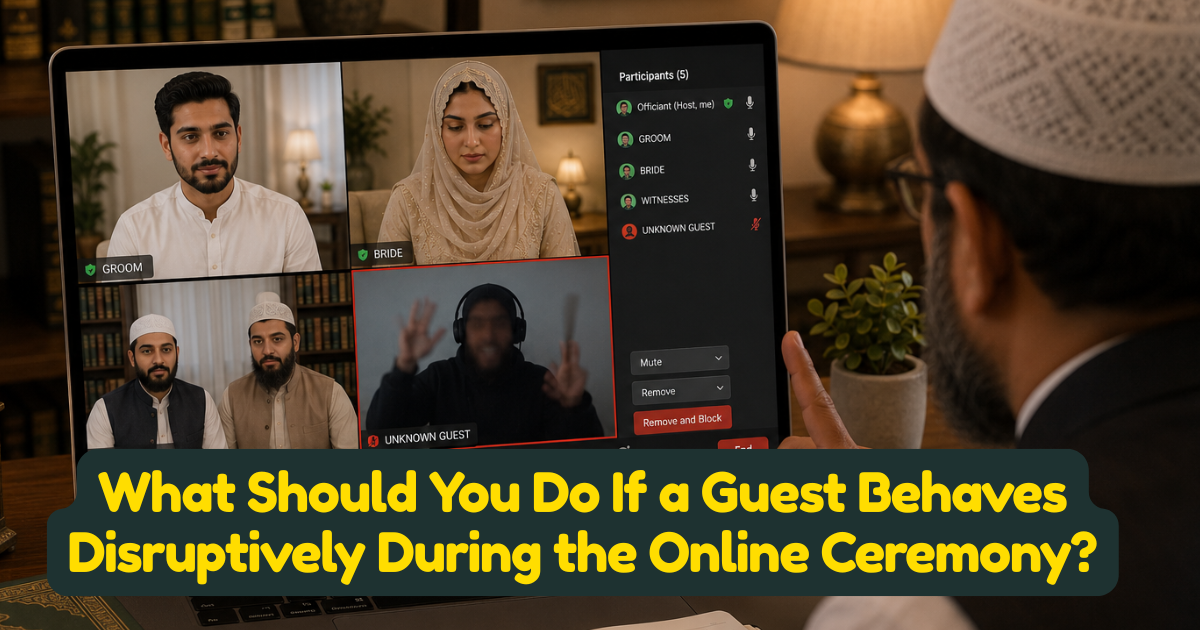
A qualified officiant conducting an online ceremony has practical tools available that an in-person officiant might lack as readily — the ability to mute a specific participant, temporarily remove someone from the call if truly necessary, or simply pause and calmly address the room (or screen, in this case) before proceeding. A good officiant should feel comfortable using these tools when needed, rather than awkwardly trying to continue over ongoing disruption.
Muting Non-Essential Participants During Key Moments
As discussed in our guide on managing larger guest lists, one practical safeguard is muting all non-essential participants during the core ijab-qabul exchange specifically, allowing only the officiant, couple, witnesses, and wali to have active microphones during this pivotal moment. This alone prevents most disruption from affecting the actual contractual exchange, even if it continues at a lower volume in the background among guests.
What the Couple Can Do in the Moment
If a couple notices a guest becoming disruptive, they're not obligated to personally manage the situation themselves — this is exactly the kind of moment where deferring to the officiant, or asking a trusted family member on the call to quietly address the person, protects the couple from having to divert their own attention and composure away from their own ceremony. A brief pause while the officiant or a family member handles the situation is far preferable to the couple trying to simultaneously manage family dynamics and their own vows.
Setting Expectations With Family Before the Ceremony
For couples with a reasonable expectation that a specific family member might cause disruption — based on prior history or known tension — having a candid conversation beforehand, either directly or through another trusted family member, about expected conduct during the ceremony can prevent problems before they arise. In more serious cases, couples might reasonably decide not to invite a specific individual to the ceremony call at all, reserving broader family inclusion for a separate celebratory gathering instead.
Removing a Disruptive Guest From the Call
In genuinely serious cases — repeated, deliberate disruption that a verbal request to settle down hasn't resolved — the officiant or host of the video call has the practical ability to remove the individual from the call entirely. This should be a last resort rather than a first response, but it remains available where truly needed to protect the ceremony's dignity and allow it to proceed properly.
How This Affects the Ceremony's Validity
It's worth reassuring couples directly: disruptive but non-substantive behavior from a guest — someone talking over others, making inappropriate remarks unrelated to the marriage's validity, or otherwise behaving poorly — does not affect the religious validity of the marriage itself, provided the core exchange between the couple, witnessed properly, still occurs clearly despite the surrounding disruption. The marriage's soundness rests on the couple's clear consent and the witnesses' clear observation, not on every guest behaving perfectly throughout.
Processing the Experience Afterward
If a ceremony is genuinely marred by a difficult moment involving a disruptive guest, it's normal for the couple to feel some disappointment about how the day unfolded, even once the actual marriage itself is properly completed. Giving yourselves space to acknowledge this feeling, rather than pretending it didn't affect the experience, and perhaps planning a separate, calmer celebratory moment later, can help the couple reclaim some of the joy the disruption may have overshadowed.
Preventing This in Future Family Gatherings
For couples anticipating ongoing family tension beyond just the wedding day, this experience sometimes becomes a useful, if unwelcome, signal about boundaries worth establishing going forward — a conversation worth having as a couple about how you'll navigate similar dynamics at future family events together.
How InstantNikah.com Handles Disruptive Guests
Our officiants are experienced in managing video calls with larger guest lists, including muting non-essential participants during the core exchange and calmly addressing disruption directly when it arises, always prioritizing the couple's ability to complete their ceremony with dignity and focus, regardless of what unfolds among the broader guest list.
Admin User
Author