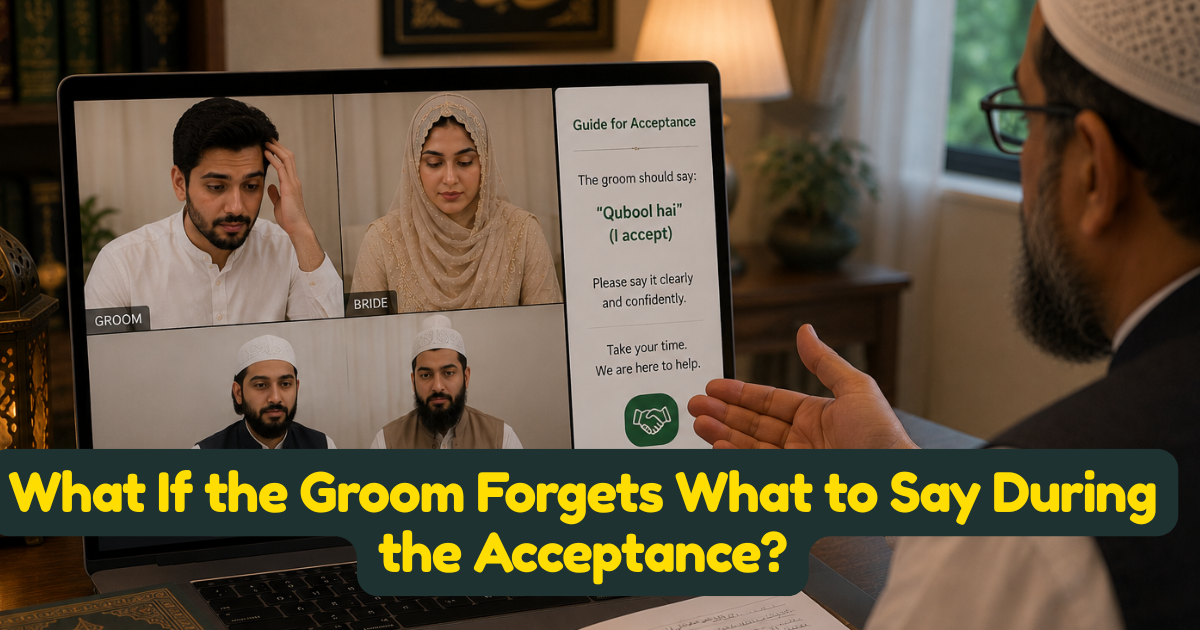
What If the Groom Forgets What to Say During the Acceptance?
It's one of the more universal pre-wedding fears, showing up across cultures and religious traditions alike: the moment arrives, all eyes are on the groom, and suddenly the words he's rehearsed or expected to simply know in the moment seem to vanish. For a nikah specifically, this fear sometimes gets amplified by a mistaken belief that a single misstep here could somehow jeopardize the entire marriage. It's worth addressing this directly and reassuringly, because the reality is far less high-stakes than the anxiety suggests.
The Acceptance Doesn't Require Memorized, Word-Perfect Recitation
The qabul — the groom's acceptance — needs to clearly and unambiguously affirm his agreement to marry the bride under the stated mahr terms. This can be expressed in various ways depending on tradition and language, but what's essential is the clear meaning conveyed, not a single fixed sentence memorized perfectly in advance and delivered without any hesitation or prompting. A groom is not reciting from memory under exam conditions; he's affirming genuine consent, which can be guided.
Why Officiants Guide the Groom Through This Moment
In practice, a well-run ceremony doesn't leave the groom to independently recall and deliver a precise formula unprompted — the officiant typically leads him through the acceptance, often by first stating the offer clearly and then directly asking the groom to confirm his acceptance, sometimes even providing the specific words for him to repeat or affirm. This is standard, expected practice, not an unusual accommodation reserved only for grooms who ask for help.
What Happens If He Genuinely Blanks in the Moment
If a groom freezes, forgets, or simply needs a moment, a calm, experienced officiant will pause, offer gentle guidance or a prompt, and give him the time he needs without rushing or creating additional pressure. This might mean the officiant repeats the offer once more, breaks the acceptance into smaller, more manageable phrases, or simply waits patiently while the groom collects himself — none of which affects the ceremony's validity in any way, since what ultimately matters is that clear, genuine consent is eventually and unambiguously given.
This Doesn't Suggest Doubt or Hesitation About the Marriage
It's worth separating nervousness-driven forgetfulness from genuine hesitation about the decision to marry, a distinction also explored in our article on pre-ceremony nerves more broadly. A groom blanking on specific wording under the pressure of the moment is an entirely different thing from a groom expressing actual uncertainty about wanting to proceed — the former is simply a common human response to being the center of attention during a significant, sometimes unfamiliar ceremonial moment.
Practical Preparation That Helps
Grooms who want extra reassurance can ask their officiant, during pre-ceremony consultation, exactly what will be said and how the acceptance will be guided — reviewing this in advance, even briefly, tends to significantly reduce the likelihood of feeling caught off guard in the actual moment. Knowing that the officiant will lead him through it, rather than expecting him to independently produce the correct wording from memory, often relieves much of the underlying anxiety before it even has a chance to build.
Language Considerations for Non-Native Speakers
For grooms marrying in a ceremony conducted in a language other than their first language, or reciting an Arabic formula they're less familiar with, the same guided approach applies — officiants regularly work with grooms across a wide range of language backgrounds and are experienced in breaking the acceptance into clear, manageable pieces regardless of the groom's native fluency in the ceremony's primary language.
What Witnesses Actually Need to Hear
Witnesses need to hear a clear, understood acceptance — whether that comes out smoothly on the first attempt or after a supportive pause and prompt from the officiant makes no difference to what they're confirming. A witness present for a ceremony where the groom needed a moment, then clearly affirmed his acceptance once guided, has witnessed exactly the same valid exchange as one where the groom spoke without any hesitation at all.
How This Moment Often Becomes a Warm Memory, Not an Embarrassing One
Couples who look back on a ceremony where the groom needed a gentle prompt or a moment to collect himself often describe it, in hindsight, as an endearing rather than embarrassing part of their story — a small, human moment of genuine nervousness in the middle of a significant occasion, rather than something that diminished the ceremony's meaning in any way.
Reassurance for Grooms Feeling Anxious About This Specifically
If this specific fear is weighing on you ahead of your own ceremony, take real comfort in knowing that experienced officiants have guided countless grooms through this exact moment, and there is genuinely no scenario where a brief pause, a needed prompt, or a moment of nervous hesitation threatens your marriage's validity or reflects poorly on your readiness to marry.
How InstantNikah.com Guides Grooms Through the Acceptance
Our officiants lead every groom through the acceptance with patience, clear prompting, and as much time as needed, treating any hesitation or need for a repeated cue as a completely normal part of the ceremony rather than something requiring correction or causing concern about the marriage's validity.
Admin User
Author