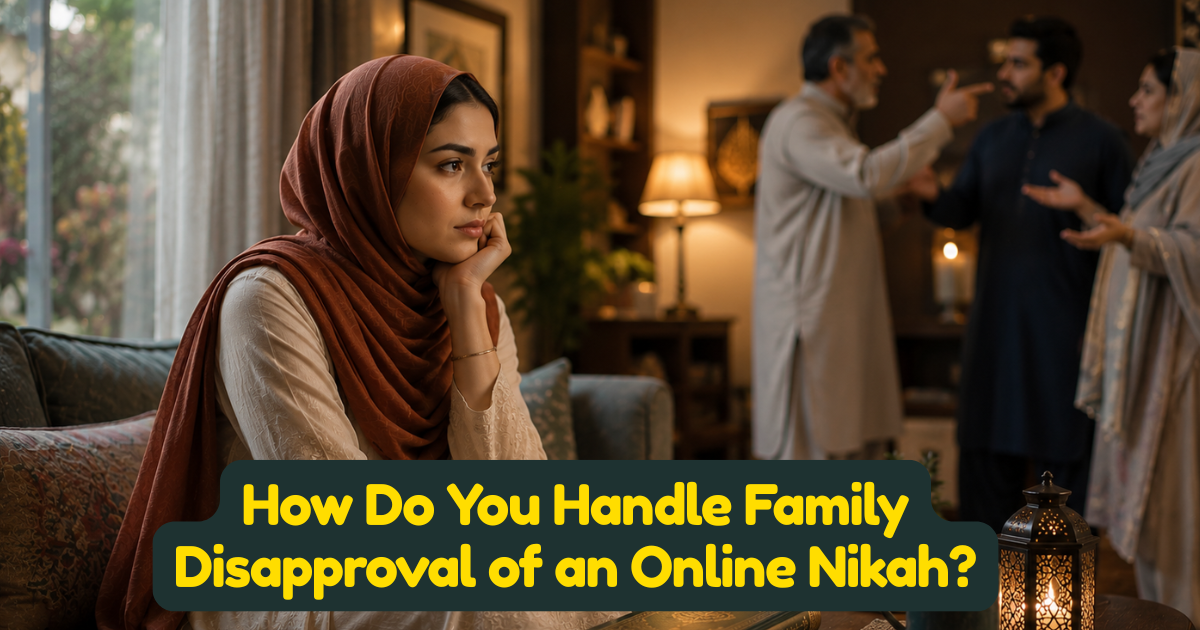
An online nikah already involves navigating distance and logistics. When one or both families also disapprove — because of a conversion, a cultural difference, or simply not knowing or trusting the other partner — that distance can make the disapproval feel especially isolating, since there's no in-person moment for skeptical family to witness and soften toward.
This Tension Has Real Religious Guidance Behind It
Islam takes parental relationships seriously, even amid genuine religious disagreement. Detailed guidance for converts navigating non-Muslim family disapproval draws on the Quranic account of a companion whose mother tried, through real personal suffering, to pressure him into abandoning his faith — and the guidance Allah revealed in response: be good and dutiful to parents, but do not obey them in matters that would mean disobeying Allah, while still treating them with kindness in worldly matters. This balance — firm on faith, genuinely kind in conduct — is the consistent thread running through Islamic guidance on this exact tension.
A Real Example: An Online Relationship Facing Family Disapproval
This isn't an abstract scenario. A detailed response to a convert whose non-Muslim family disapproved of her relationship with a man she'd been getting to know online addresses the situation directly: where disapproval is rooted in something superficial — where someone is from, how they look — rather than genuine concern about character or compatibility, there's no religious obligation to simply defer to that objection. The guidance encourages the woman to keep learning her own faith and rights thoroughly before proceeding, so she enters the marriage with real clarity, not just resolve.
Practical Wisdom From Couples Who've Navigated This
Beyond the religious guidance, real interfaith and intercultural couples offer genuinely useful practical advice. A detailed interview with couples who've navigated family disapproval recommends what one couple calls "radical transparency" — discussing difficult family dynamics openly rather than letting unspoken grievances build and harden over time. The same advice emphasises predicting how family members are likely to react before a difficult conversation happens, asking directly what they're actually afraid of rather than assuming, and presenting a unified front as a couple rather than letting one partner face family pushback alone.
What This Means for an Online Nikah Specifically
- Invite disapproving or unfamiliar family to watch, even if they remain uninvolved formally — being able to see the actual ceremony, even remotely, can do more to humanise the moment than a description of it afterward ever could.
- Explain the process clearly in advance, rather than assuming family already understands what an online nikah involves — unfamiliarity often drives more resistance than the marriage itself.
- Separate genuine character concerns from superficial objections honestly — a family's worry about your wellbeing deserves real engagement, while objections rooted purely in appearance, background, or unfamiliarity with Islam don't carry the same religious weight.
- Give it time rather than expecting instant acceptance — real accounts of interfaith and intercultural couples consistently show that approval, where it eventually comes, tends to build gradually through continued, patient engagement rather than a single conversation.
- Continue treating disapproving family with genuine kindness, even while proceeding with the marriage — this is the specific balance Islamic guidance consistently points toward, not estrangement and not capitulation.
Key Takeaway
Family disapproval of an online nikah — whether rooted in a conversion, cultural difference, or simple unfamiliarity — is a genuinely difficult but well-recognised situation, with real Islamic guidance pointing toward firmness on matters of faith combined with consistent, patient kindness in how family relationships are handled. The remote format of an online ceremony makes thoughtful inclusion — inviting family to watch, explaining the process clearly, giving real time for understanding to grow — even more worth the effort, since it's often the bridge that turns initial resistance into eventual acceptance.
```Admin User
Author